
Wick Antiques was established by Charles Wallrock in the early 1980s. Having grown up in the Antiques world Charles developed an extensive wealth of knowledge. Starting out as a ‘man with a van’ he quickly gained a good reputation and embarked on a longstanding relationship with Harrods. He was later joined by his wife, Caroline Wallrock. Caroline having completed a Persian degree, went on to study at Christie’s fine art and then joined Sotheby’s specializing in Islamic and Japanese works of art, as well as taking the occasional auction. Together they make a formidable team with extensive knowledge and buy and sell some of the best items on the market.
Wick Antiques Ltd
'%3e%3cpath fill='%23012169' d='M0 0v30h60V0z'/%3e%3cpath stroke='%23fff' stroke-width='6' d='m0 0 60 30m0-30L0 30'/%3e%3cpath stroke='%23C8102E' stroke-width='4' d='m0 0 60 30m0-30L0 30' clip-path='url(%23b)'/%3e%3cpath stroke='%23fff' stroke-width='10' d='M30 0v30M0 15h60'/%3e%3cpath stroke='%23C8102E' stroke-width='6' d='M30 0v30M0 15h60'/%3e%3c/g%3e%3c/svg%3e) Hampshire, UK
Hampshire, UK
Address
Unit 2 Riverside Business Park
Lymington
Hampshire
United Kingdom
SO41 9BB
Opening times
By Appointment Only
Mobile
+447768 877069
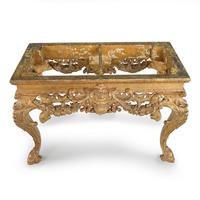
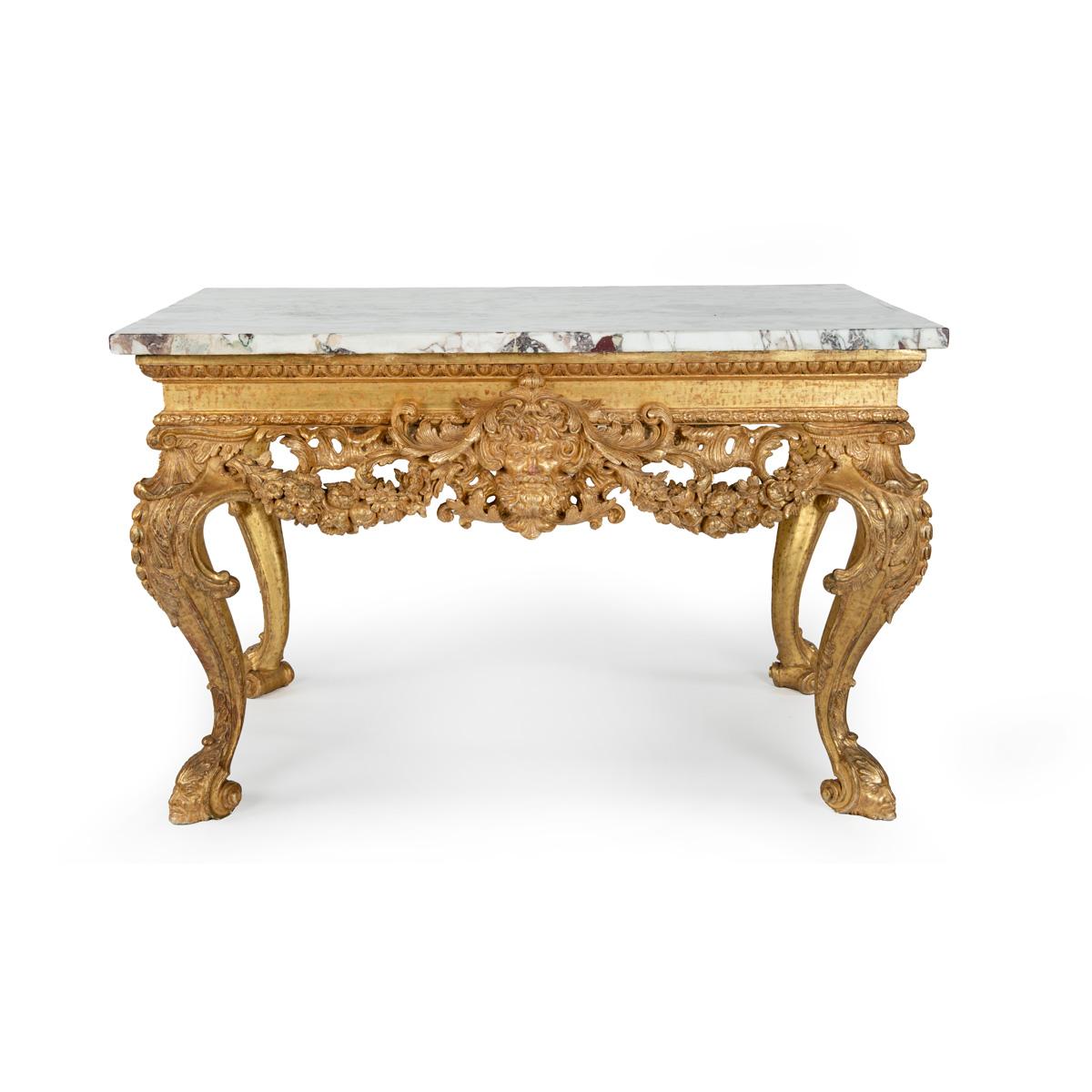
Fine & Highly Important Mid 18th Century Giltwood Centre Table in the Late Palladian/early Rococo Manner, c.1745-1750, Altered to Form a Centre Table in Early 19th Century
REF: LA577573
£125,000
€145,552
$166,803
LoveAntiques Dealersince Jan 2019Approved item572 sales by dealer
LoveAntiques Dealersince Jan 2019Approved item572 sales by dealer
Description
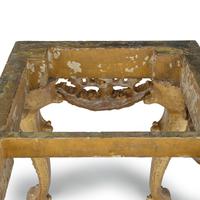
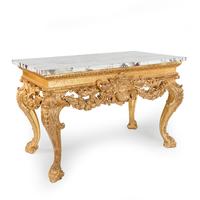
A fine and highly important mid 18th Century giltwood centre table in the late Palladian / early Rococo manner, c.1745-50, altered to form a centre table in the early 19th Century.
Provenance:
The Kent Gallery, London
By whom consigned to Sotheby’s 16th and 17th of February 1928, lot 215
Bought at the above sale by Cameron, presumably the dealers Cameron of Mount Street
With Moss Harris and Sons by April of 1928
With Mallett, London, by 1967
A private US collection
Exhibition History:
Exhibited at the Daily Telegraph Exhibition of Antiques and Works of Art at Olympia, regarded as the first “proper” antiques fair in England, in 1928
Literature:
The Times, saleroom report, 18th of February 1928 ‘a William Kent gilt wood centre table, with marble top, 52 in. wide-£100 (Cameron)’
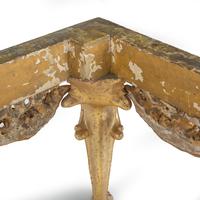
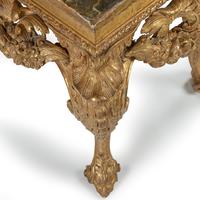
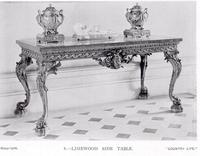
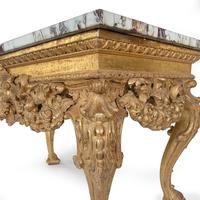
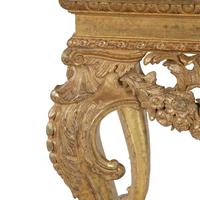
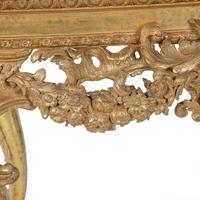
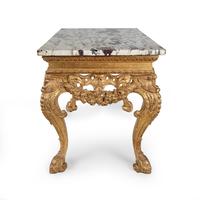
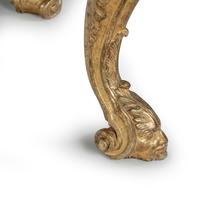
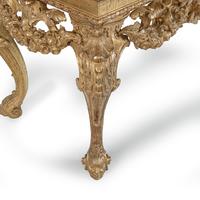
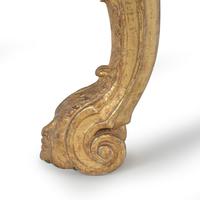
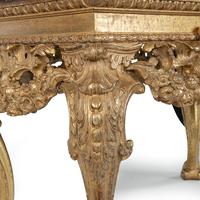
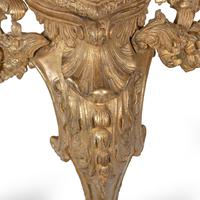
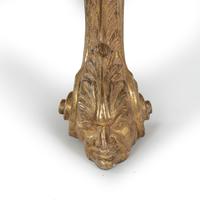
M Harris and Sons A Catalogue and Index of Old Furniture and Works of Decorative Art, Vol. II, pl. XXI.7, 1932, shown in situ on the firm’s stand at the Daily Telegraph fair from 1928. Almost certainly the table described by J. De. Serre in Country Life, 7th of April 1928, p.XXXVI as follows ‘At Messrs. Harris’ is also a marble-topped side table with elaborately carved frame. The cabriole legs, carved on the knee with a shell and acanthus leaf, finish in a volute carved with a human mask. The legs are united by an apron formed of pierced rococo detail and swags of flowers, centring in a human mask’.
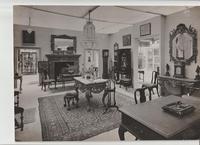
Illustrated in a M. Harris and Sons trade advert in Country Life, 8th of December 1928, p.lxiii, which incorporates an image of ‘part of one of our rooms at the recent Exhibition at Olympia’. Connoisseur, October 1967, illustrated in a Mallett and Sons advert Brian Austen A Handbook of Styles in English Antique Furniture, 1974 (illustrated plate 74).
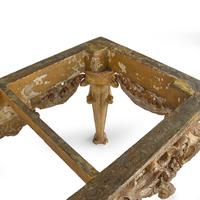
This outstanding table is very unusual in its present form in that it is now a centre table rather than the more usual side table. It is finished to all sides with a mask in the centre of the rail on both of the long sides, meaning that it was designed to be placed in the middle of a room and not against a wall as is more common with pieces of this sort. The table was made around 1745-50 at a time when styles in the most fashionable homes were transitioning from the Palladian taste to the emerging rococo and this transition is very evident in the fusion of the two styles of ornament seen on this piece. The grand proportions and rectangular form, together with the masks, are very much in the Palladian tradition but the cabriole legs and swags of flowers are of rococo style. The astonishing feet on this table are a sight to behold. They make use of native American masks with plumed headdresses, a feature sometimes found on the knees or friezes of gesso tables associated with the royal maker James Moore but very rarely encountered on feet. There is one other known example of this treatment on a table pictured in the Dictionary of English Furniture and also in Country Life, 6th of June 1931 p.740, fig. 6. This table was owned by the Duchess of Roxburghe and was in her hallway in her house in Carlton House Terrace. This second table features legs of identical design to those on the present table and also carved mask feet which are of a very similar and related model. Those mask feet are raised on later pads which are to the detriment of the overall design.
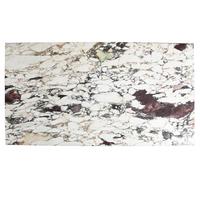
Our table’s marble top (c. 1820) is wonderfully figured and highly decorative and a further sign of the importance of this piece.
It is likely that the present table was originally conceived as a side table, as with the Roxburghe piece, but was then carved on the reverse to turn it in to a centre table which was of much greater value in the 19th century when these alterations took place. The delicacy of this later work and the sympathetic way in which it has been handled suggest the hand of a master craftsman and one name that has been suggested in this context is that of William Cribb, the carver and gilder in King Street, Covent Garden, who is known to have executed tables in the Kentian manner, including one for Chatsworth that was signed and dated 1834.
Certainly the present table would fit comfortably in to Cribb’s manner of working.
Although its original provenance remains unclear, this important table has been in the collections of three of the most important dealers in English furniture to have ever worked in this field. It was consigned anonymously to Sotheby’s by the top London dealer the Kent Gallery, selling on the 16th and 17th of September 1928, lot 215. The catalogue described the table as:
‘A William Kent gilt wood centre table, with marble top, the frieze carved all round with satyr masks supporting swags of fruit and flowers, and with acanthus, on carved cabriole legs, and “Red Indian” feet, 4ft 4in. wide’.
According to the sale room report in the Times, published the following day, the table was purchased for £100 by Cameron-almost certainly Beatrice Cameron who ran her eponymous antiques business from no. 16 Mount Street in this period. Mrs Cameron was a dealer of great taste and bought some very important pieces. In this present case, she presumably sold the table soon afterwards to Moss Harris as it is mentioned as part of their stock in a Country Life article published on the 7th of April 1928 as follows:
”At Messrs. Harris’ is also a marble-topped side table with elaborately carved frame. The cabriole legs, carved on the knee with a shell and acanthus leaf, finish in a volute carved with a human mask. The legs are united by an apron formed of pierced rococo detail and swags of flowers, centring in a human mask’
The table was illustrated in a room setting photograph in Moss Harris and Sons’ famous three volume catalogue titled A Catalogue and Index of Old Furniture and Works of Decorative Art. The catalogue was published in 1932 but includes an image of one of the rooms of furniture that they exhibited at what is widely believed to be the first modern day antiques fair, the Daily Telegraph Exhibition of Antiques and Works of Art, held at Olympia in 1928. This fair combined dealer exhibits with loans from private collections and Moss Harris, as the premiere dealer of the time, had multiple room settings there. Thankfully this particular one was recorded for posterity.
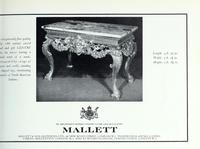
The table then reappeared on the antiques market in 1967, having been acquired by that period’s leading antiques dealer, Mallett of Bond Street, who advertised it in Connoisseur in October of that year. In the advert, the firm described the table as:
‘An exceptionally fine quality early 18th century carved wood and gilt CENTRE table, the frieze having a central motif of a mask, surrounded by swags of flowers and scrolls, standing on shaped legs, terminating in masks of North American Indians’.
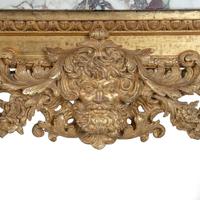
The central masks on this piece are extremely interesting and could represent either Bacchus or perhaps Neptune or a triton given the large-scale shell motifs used on the knees. The quality of carving throughout is extraordinary. A pair of tables of similar feeling with Neptune masks were made for Firle Place in East Sussex and pictured in Country Life on the 24th of February 1955 in the drawing room, p.566. These tables are side tables and not centre tables however and it is very difficult to find many parallels to the present piece in that regard. A slightly later table with more obviously rococo ornament, conceived as a centre table, was with the dealers Ronald Phillips Ltd in 2025.
It is also worth noting that Margaret Jourdain, when writing about the Duchess of Roxburghe’s table, mentioned above, made specific mention of the quality of the male mask on the frieze of that table, writing that:
‘Among the vigorous details, the fine quality of the male mask in the pendant, and the light feathers and foliations surrounding it, suggest the sculptor rather than the humbler carver of furniture’.
Jourdain’s praise could certainly be applied equally to the carver of the masks on our table which almost certainly come from the same workshop.
As always, we hope you have enjoyed reading this piece and if we can help with further information about any of the pieces of furniture discussed here then do please get in touch.
measurements
Height:
33 in
Width:
51.5 in
Depth:
29.75 in
declaration
Wick Antiques Ltd has clarified that the Fine & Highly Important Mid 18th Century Giltwood Centre Table in the Late Palladian/early Rococo Manner, c.1745-1750, Altered to Form a Centre Table in Early 19th Century (LA577573) is genuinely of the period declared with the date/period of manufacture being circa 1745-1750
additional info
Period:
Date of Manufacture:
circa 1745-1750
location
This Fine & Highly Important Mid 18th Century Giltwood Centre Table in the Late Palladian/early Rococo Manner, c.1745-1750, Altered to Form a Centre Table in Early 19th Century is located in Hampshire, United Kingdom
Share:
Ask a question
Please note,
This dealer does not accept instant online payment for this item.
To buy this item please email the dealer using the enquiry form below.
A selection of items from Wick Antiques Ltd
Wick Antiques Ltd has 752 items available.Fine & Important 19th Century Giltwood Side Table / Console Table in Irish George II Palladian Style
£ 54,500
€63,461$72,726
Wick Antiques Ltd
Fine Early 19th Century Side Table in the William Kent Manner - English c.1830
£ 16,500
€19,213$22,018
Wick Antiques Ltd
Fine & Important Late 19th Century Giltwood Side Table in Style of William Kent - English c.1880
£ 55,000
€64,043$73,393
Wick Antiques Ltd
Fine French Lyre Support Mahogany Centre Table, 2nd Quarter of the 19th Century c.1830
£ 8,800
€10,247$11,743
Wick Antiques Ltd