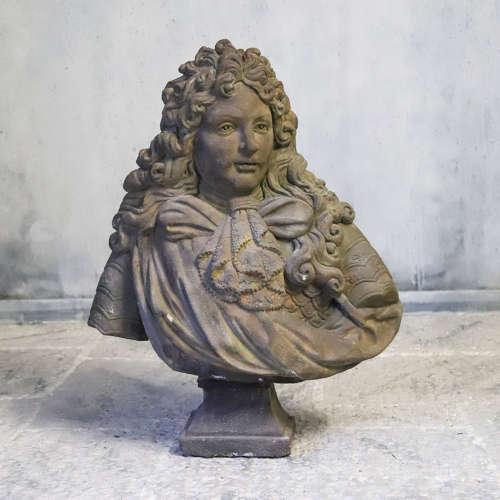
Imposing Grand Scale 19th Century Carved Stone Bust of Louis XIV
• French 19th Century circa 1880
• Grand scale
• Exceptional and imposing carved stone bust
• Louis XIV in his prime in his regalia
• Wonderful patina
• Fair condition - on later composite socle
• Wear consistent with age and use
• Minor losses and minor fading
• All this is part of its charm and character
• H: 82cm (32.3") W: 66cm (26") D: 38cm (15")
Wherever this imposing and exceptional carved stone bust of Louis XIV, The Sun King, is displayed serves as a tangible link to a bygone era and the legacy of one of France’s most influential monarchs.
The carved stone bust stands as a testament to the craftsmanship of its creator and imparts a sense of permanence and sophistication to the bust. It has been crafted with precision and reverence creating a masterful embodiment of artistry and historical grandeur. It captures the essence of the iconic French monarch in a timeless representation and has transformed a block of stone into a representation of Royal magnificence.
It is a privilege to witness the connection with historical significance and artistic brilliance encapsulated in this work. Each chisel mark and contour contributes to the lifelike quality and portrays Louis XIV with a commanding presence.
The opulence and authority of The Sun King are sculpted with meticulous attention to detail. The artist's skill brings forth the intricate nuances of facial features and you can feel the flowing movement from the fine contours of his long hair. There is so much visual beauty in such fine craftsmanship; from the Regalia and embellishments and the monarch’s likeness.
Louis XIV (Louis-Dieudonné; 5 September 1638 – 1 September 1715), also known as Louis the Great (Louis le Grand) or the Sun King (le Roi Soleil), was King of France from May 14, 1643 until his death in 1715.
His reign of 72 years and 110 days is the longest of any sovereign in history whose date is verifiable. Although Louis XIV's France was emblematic of the Age of Absolutism in Europe, the King surrounded himself with a variety of significant political, military, and cultural figures, such as Bossuet, Colbert, Le Brun, Le Nôtre, Lully, Mazarin, Molière, Racine, Turenne, and Vauban.
Louis began his personal rule of France in 1661, after the death of his chief minister, the Cardinal Mazarin. An adherent of the concept of the divine right of kings, Louis continued his predecessors' work of creating a centralised state governed from the capital.
He sought to eliminate the remnants of feudalism persisting in parts of France; by compelling many members of the nobility to inhabit his lavish Palace of Versailles, he succeeded in pacifying the aristocracy, many members of which had participated in the Fronde during his minority. By these means he became one of the most powerful French monarchs and consolidated a system of absolute monarchy in France that endured until the French Revolution.
Louis also enforced uniformity of religion under the Gallican Catholic Church. His revocation of the Edict of Nantes abolished the rights of the Huguenot Protestant minority and subjected them to a wave of dragonnades, effectively forcing Huguenots to emigrate or convert, as well as virtually destroying the French Protestant community.
During Louis's long reign, France emerged as the leading European power and regularly asserted its military strength. A conflict with Spain marked his entire childhood, while during his personal rule, the kingdom took part in three major continental conflicts, each against powerful foreign alliances: the Franco-Dutch War, the Nine Years' War, and the War of the Spanish Succession.
In addition, France also contested shorter wars, such as the War of Devolution and the War of the Reunions. Warfare defined Louis's foreign policy and his personality shaped his approach. Impelled by "a mix of commerce, revenge, and pique", he sensed that war was the ideal way to enhance his glory. In peacetime, he concentrated on preparing for the next war.
He taught his diplomats that their job was to create tactical and strategic advantages for the French military. Upon his death in 1715, Louis XIV left his great-grandson and successor, Louis XV, a powerful kingdom, albeit in major debt after the War of the Spanish Succession that had raged on since 1701.
Significant achievements during his reign which would go on to have a wide influence on the early modern period well into the Industrial Revolution and until today, include the construction of the Canal du Midi, the patronage of artists, and the founding of the French Academy of Sciences.
For a complete assessment of the item's condition, we encourage you to carefully examine all the provided photos. These pictures are integral to the description and condition report of the item, providing crucial visual details about its appearance and quality.
Purchasing any item online can sometimes be a bit of concern, rest assured we are an established and successful business and have many happy clients both in the trade and as private clients. We have a beautiful showroom in West Sussex and you are always welcome to visit to view any of our delightful items.
We do not include delivery in our prices as this is dependent upon many factors such as whether it is mainland or overseas. The following options are available to you:-
• You can arrange your own collection from our address
• You can fill in the delivery request option
• You can email us for further information if there is more than one item
• Proovia Delivery offer a 2 person delivery system
measurements
Height:
82 cm
Width:
66 cm
Depth:
38 cm
measurements
declaration
Whites Antiques has clarified that the Imposing Grand Scale 19th Century Carved Stone Bust of Louis XIV (LA516899) is genuinely of the period declared with the date/period of manufacture being circa 1880