




We are a family business with a shop on Haworth Main Street in West Yorkshire. We specialise in early English Oak and Walnut with the emphasis on quality, originality, colour and surface.
Christian Holmes is the 4th generation of the family to deal in Antique furniture
www.holmesantiques.co.uk




Holmes Antiques
'%3e%3cpath fill='%23012169' d='M0 0v30h60V0z'/%3e%3cpath stroke='%23fff' stroke-width='6' d='m0 0 60 30m0-30L0 30'/%3e%3cpath stroke='%23C8102E' stroke-width='4' d='m0 0 60 30m0-30L0 30' clip-path='url(%23b)'/%3e%3cpath stroke='%23fff' stroke-width='10' d='M30 0v30M0 15h60'/%3e%3cpath stroke='%23C8102E' stroke-width='6' d='M30 0v30M0 15h60'/%3e%3c/g%3e%3c/svg%3e) West Yorkshire, UK
West Yorkshire, UKHolmes Antiques
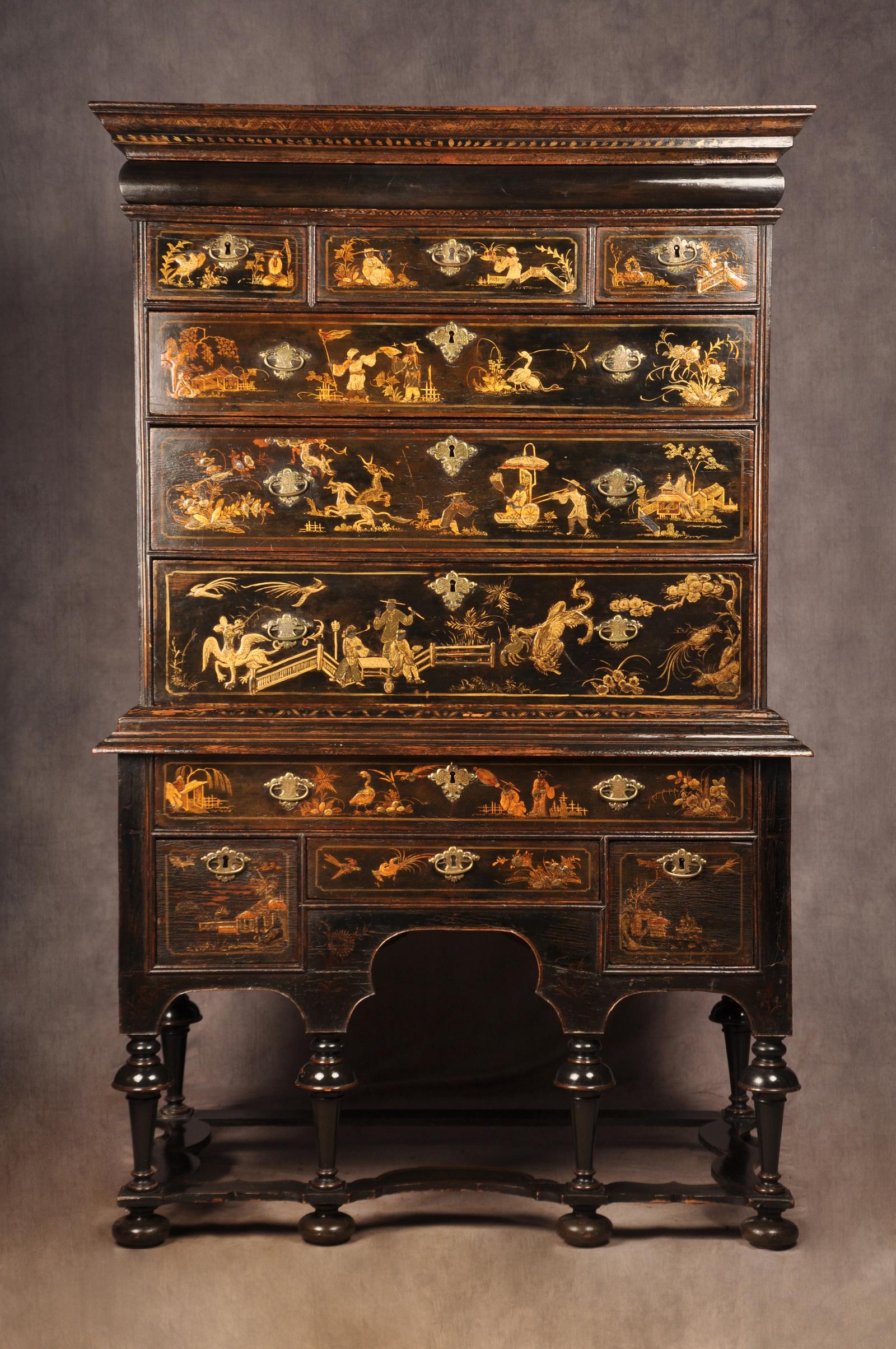
Rare Early 18th Century Chinoiserie-japanned Chest On Stand
REF: LA522900
£12,800
€14,886
$16,921
LoveAntiques Dealersince Oct 2016402 sales by dealer
LoveAntiques Dealersince Oct 2016402 sales by dealer
Description
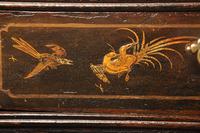
A Rare and magnificent Early 18th Century, Queen Anne Chinoiserie-Japanned Chest On Stand in exceptional condition. Retaining the original chased brass handles, locks and escutcheons all typical of the queen Anne period. The front and ends adorned with the most beautifully painted Scenes featuring birds, mythical beasts, dragons, and figures smoking long pipes.
These early pieces of japanned furniture usually have the drawer linings painted Red and this one is no exception, the original linings are made in oak. To the fronts a tight grained wood is applied to create a smooth surface in order that it can then be lacquered and painted.
The drawer surrounds decorated with a double bead, again typical of the Queen Anne period as is the cock bead which is steamed in order that it can be bent around the shaped freeze of the base.
A wonderful example of perfectly proportioned English country house furniture showing the early Fashion Chinoiserie lacquered pieces.
A similar example can be seen in the Metropolitan Museum Of Art.
V & A
The influence of East Asian lacquer on European furniture.
When lacquered objects made in East Asia first reached Europe in about the early 16th century, they were highly prized for their flawless finish and light-reflecting qualities.
Lacquer became available to European elites, along with other luxury items including silk and porcelain, once Portuguese explorers discovered a sea route to the East around the southern tip of Africa and across the Indian Ocean. The flow of goods increased in the early 17th century when the Dutch and English East India Companies began to bring goods to markets in Amsterdam and London. By 1700 many European country houses and palaces contained examples of East Asian export lacquer.
Asian lacquer was admired as a precious and mysterious material. Adding to its rarity and desirability was the fact that the key ingredient, a resin extracted from the lacquer tree (toxicodendron vernicifluum) native to East Asia, did not survive the long duration of the sea voyage without hardening beyond use. European demand for lacquer was such that the Chinese and Japanese soon began to capitalise on this lucrative market by making lacquered objects specifically for export, in forms and styles to suit Western tastes. This trade was not restricted to China and Japan. Varieties of the lacquer tree also grew in other Asian countries including Vietnam, where the English had a trading post, although it has, so far, been impossible to distinguish export lacquerware made in Vietnam in the 17th century.
The earliest Japanese export lacquer, made from the 1570s to 1630 for Portuguese markets, was made in Western forms such as cabinets and bowls, with decoration very different from lacquer made for use in Japan. These first exports are today described as nanban, a Japanese term literally meaning ''Southern barbarian'': foreigners whose ships arrived from the south. The decoration, in gold on a black background, sometimes inlaid with mother-of-pearl, covered almost the entire surface and was often contained within wide geometric borders. Later, from the 1630s, to suit the tastes of the Dutch and other northern European countries, Japanese lacquer makers adopted a more pictorial style in gold on a black background for their export ware.
measurements
Height:
170 cm
Width:
108 cm
Depth:
60 cm
declaration
Holmes Antiques has clarified that the Rare Early 18th Century Chinoiserie-japanned Chest On Stand (LA522900) is genuinely of the period declared with the date/period of manufacture being 1705
additional info
Period:
Material:
Origin:
Date of Manufacture:
1705
location
This Rare Early 18th Century Chinoiserie-japanned Chest On Stand is located in West Yorkshire, United Kingdom
Share:
Ask a question
Please note,
This dealer does not accept instant online payment for this item.
To buy this item please email the dealer using the enquiry form below.
A selection of items from Holmes Antiques
Holmes Antiques has 334 items available.