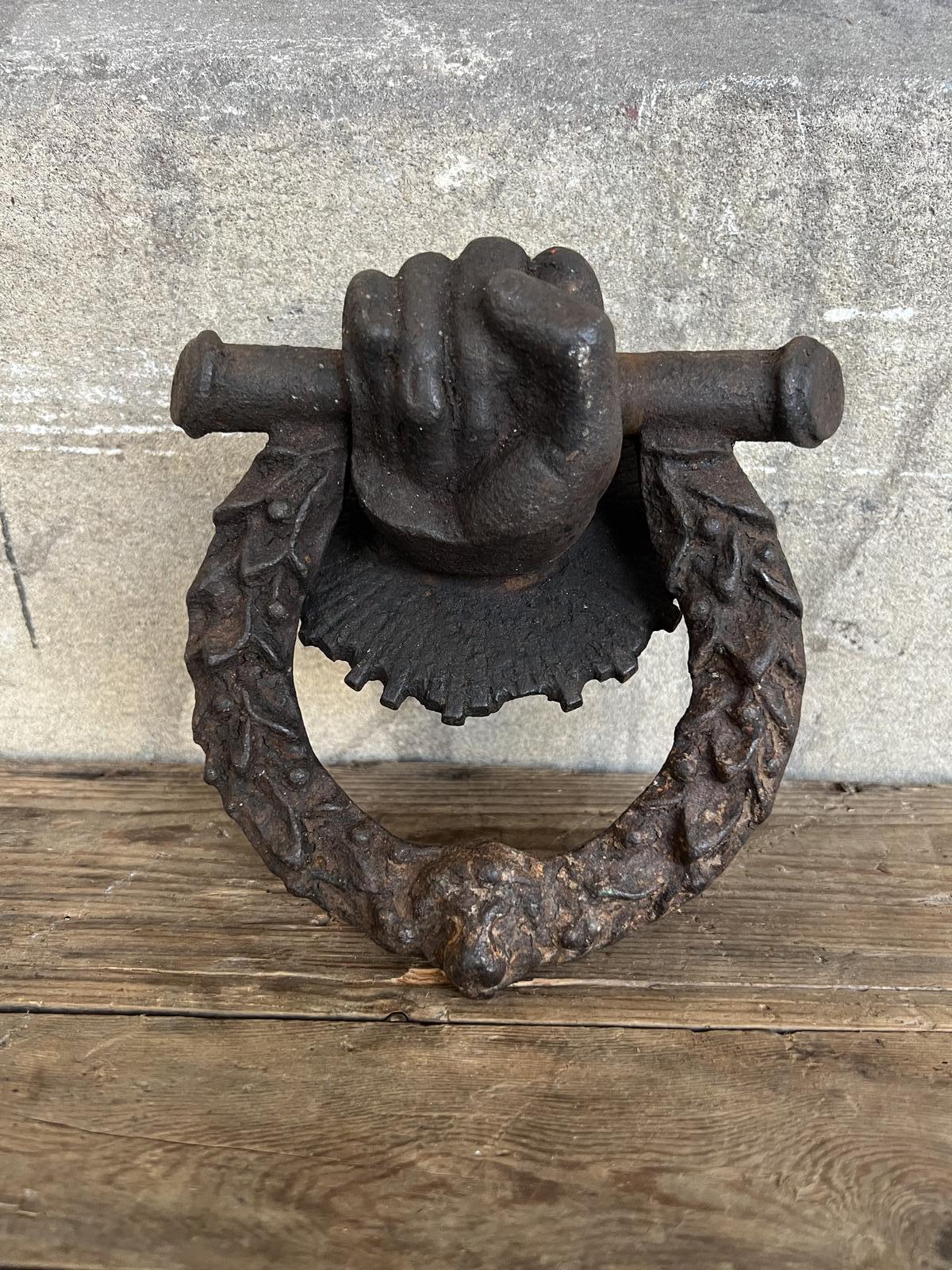
Cast Iron Door Knocker — In the Manner of David Bray, Cranbourn Street, Soho
A brooding, authoritative 19th-century cast-iron door knocker, centred on a clenched fist gripping a Field Marshal’s baton, framed by a wreath of laurel leaves — a quietly imposing emblem drawn from the martial world of the Duke of Wellington, whose victories shaped the imagination of Regency Britain.
The iron is dark, smoke-softened and beautifully untouched. Most unusually, the piece retains its original sunburst back plate, the radiating motif sitting behind the fist like a subdued halo — a hint of glory dimmed by time rather than erased.
Though unmarked, the form sits firmly within the tradition of David Bray of Cranbourn Street, Soho, the early-19th-century ironmonger associated with patriotic and military-inflected door furniture at the height of Wellington’s fame. Bray’s clientele embraced symbolism: fists, laurel wreaths, batons and heraldic forms that spoke of order, resilience and prestige.
Description
• Cast iron with deep, time-worn patina
• Bold sculpted fist gripping a Field Marshal’s baton
• Laurel wreath in high, classical relief
• Heavy, resonant knock — more proclamation than request
Commanding as a functional knocker, striking as a sculptural object.
⸻
Historical contex: Bray, Cranbourn Street & the Shadow of Wellington
In the early 1800s, Cranbourn Street — the strip of London where David Bray traded — was alive with noise, tradesmen and newly minted ambition. Britain had emerged from the Napoleonic Wars with Wellington as its defining military figure, and his imagery permeated domestic design.
London ironmongers responded with fittings that echoed that world: lion masks, profile knockers, laurel crowns, disciplined fists, and batons echoing Wellington’s own Field Marshal insignia. Such motifs allowed ordinary households to signal loyalty, steadiness and national pride right at their front door.
This piece, with its clenched fist and marshal’s baton, would have resonated strongly in that era — part tribute, part warning, part quiet declaration of British resolve.
⸻
Symbolism:
The fist is certainty manifests unsoftened strength.
The Field Marshal’s baton, Wellington’s own emblem of supreme command, speaks of authority forged through conflict rather than comfort.
The laurel wreath, cast in iron rather than greenery, marks triumph preserved, not celebrated.
And behind everything, the sunburst back plate glows faintly — not with new light, but with the heavy memory of it.
Together they create an object that feels less like hardware and more like a relic from a century shaped by iron will and iron deeds.
⸻
A rare and atmospheric example of Regency era ironwork — dark, symbolic, sculptural, and complete with its original sunburst back plate.
measurements
Height:
18 cm
Width:
18 cm
measurements
declaration
Hiraeth Decorative has clarified that the Wellington Door Knocker c.1815 (LA554914) is genuinely of the period declared with the date/period of manufacture being c.1815