
Wick Antiques was established by Charles Wallrock in the early 1980s. Having grown up in the Antiques world Charles developed an extensive wealth of knowledge. Starting out as a ‘man with a van’ he quickly gained a good reputation and embarked on a longstanding relationship with Harrods. He was later joined by his wife, Caroline Wallrock. Caroline having completed a Persian degree, went on to study at Christie’s fine art and then joined Sotheby’s specializing in Islamic and Japanese works of art, as well as taking the occasional auction. Together they make a formidable team with extensive knowledge and buy and sell some of the best items on the market.
Wick Antiques Ltd
'%3e%3cpath fill='%23012169' d='M0 0v30h60V0z'/%3e%3cpath stroke='%23fff' stroke-width='6' d='m0 0 60 30m0-30L0 30'/%3e%3cpath stroke='%23C8102E' stroke-width='4' d='m0 0 60 30m0-30L0 30' clip-path='url(%23b)'/%3e%3cpath stroke='%23fff' stroke-width='10' d='M30 0v30M0 15h60'/%3e%3cpath stroke='%23C8102E' stroke-width='6' d='M30 0v30M0 15h60'/%3e%3c/g%3e%3c/svg%3e) Hampshire, UK
Hampshire, UK
Address
Unit 2 Riverside Business Park
Lymington
Hampshire
United Kingdom
SO41 9BB
Opening times
By Appointment Only
Mobile
+447768 877069
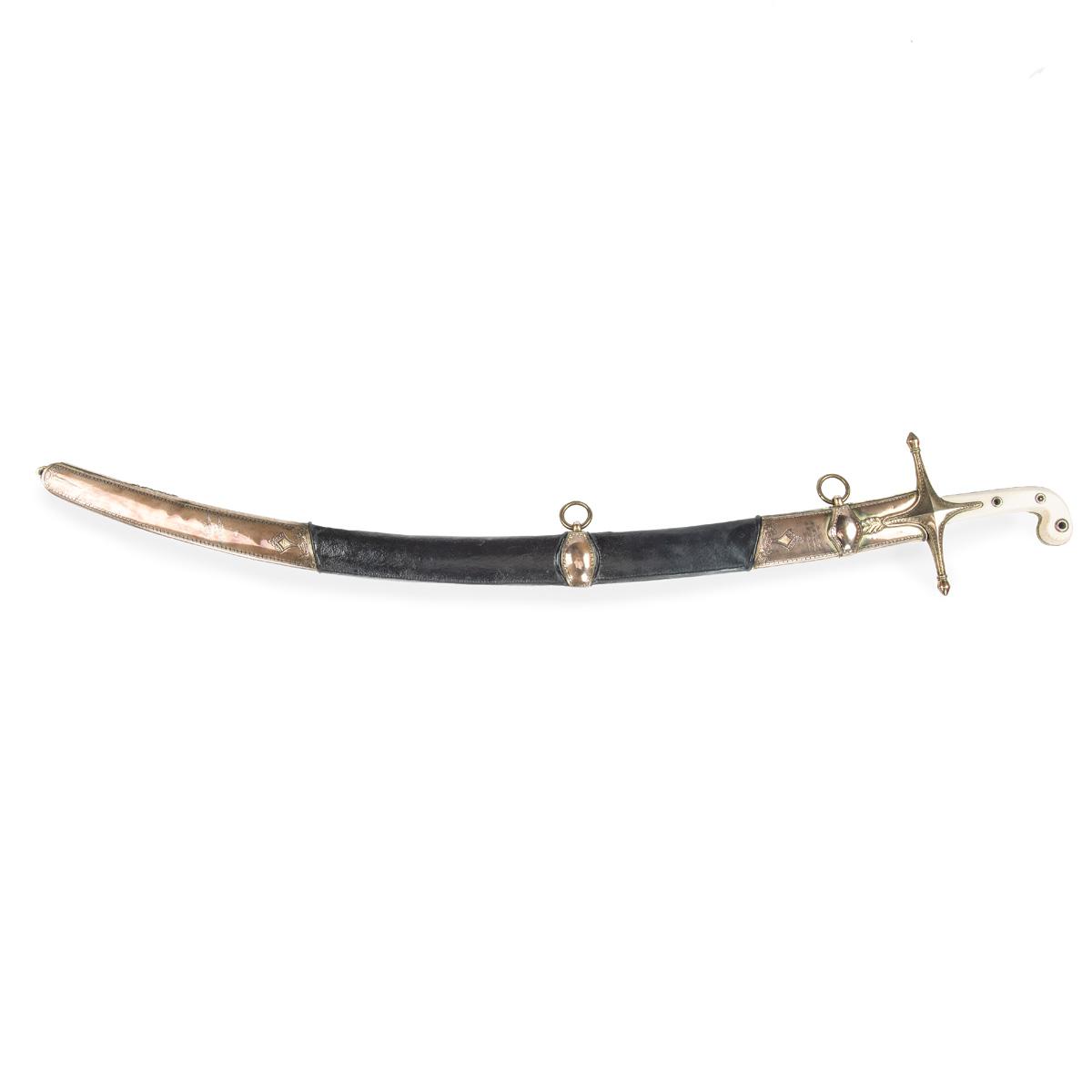
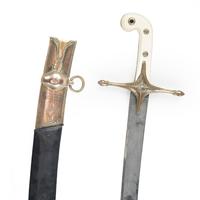
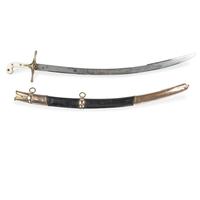
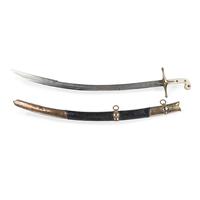
A Historically Important Sword Given to Midshipman Finucane by Sir Peter Parker, Captain of the Menelaus Who Was Killed in Action in 1814
REF: LA560827
£12,500
€14,555
$16,680
LoveAntiques Dealersince Jan 2019572 sales by dealer
LoveAntiques Dealersince Jan 2019572 sales by dealer
Description
Provenance
Vice-Admiral Sir Charles Paget (1778-1839)
Given to Sir Peter Parker (1775-1814)
Given to Midshipman Henry Augustus Finucane (1798-1850)
Given back by Finucane to the Parker family 1849 (W. R. Parker)
Capt. V. E. C. Parker 1876
Capt. V. E. H. R. Parker 1914
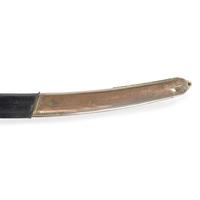
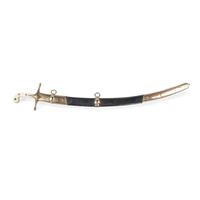
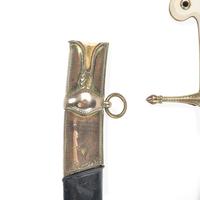
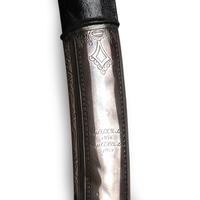
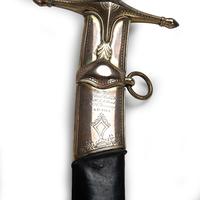
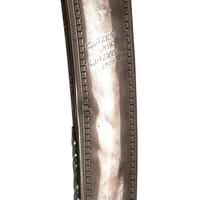
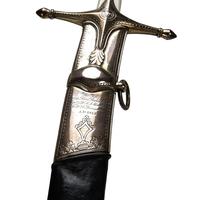
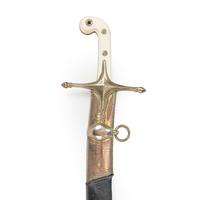
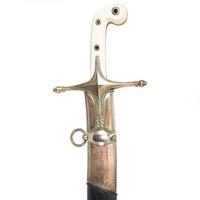
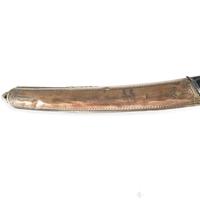
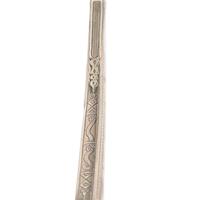
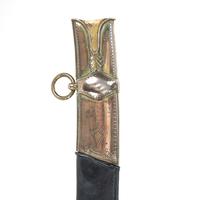
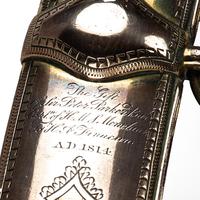
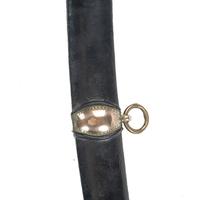
Of early 19th century date, this sword was made in the so-called Mameluke style. The blade is flat with a false edge. The grip is of bone and gilt brass is employed in the construction of the langet and cross guard. The scabbard has gilt brass fittings, all profusely engraved and decorated. The engraving includes much of the provenance of this piece including:
‘The gift of Sir Peter Parker Bart., Captn. Of HMS Menelaus to H. A. Finucane. A. D. 1814′
‘The Gift of H.A. Finucane to W.R. Parker 1849’
‘Capt. V.E.C. Parker 1876 and Capt. V.E.H.R. Parker 1914’
The sword measures 93.5cm in length.
The provenance of this sword is apparently even more impressive than these inscriptions indicate. The 1815 edition of A biographical memoir of the late Sir Peter Parker, baronet, captain of His Majesty’s ship Menelaus, of 38 guns, killed in action while storming the American camp at Bellair, near Baltimore, on the thirty-first of August, 1814 by Sir George Dallas, Parker’s father-in-law, details, on p.57, Parker writing his will on the night before his life was lost. The passage reads as follows:
‘Permission was not granted, and, under a disappointment that mortified equally Sir Peter Parker and his whole crew, the Menelaus was obliged again to put to sea. So strongly did the disappointment occasioned by this circumstance prey upon the sensitive mind of Sir Peter Parker, that, on the night before he fell, at the distance of some months from the period when it occurred, in making his will, he alludes to it in a manner as honorable (sic) to his heart, as to the professional merits of one of his young midshipmen, who seemed, in a more prominent degree to feel for and sympathize with him, under a disappointment which affected equally his health and spirits ; at the close of life it was uppermost in his thoughts. This instrument concludes by saying, — ” The only thing, then, I leave away fro;n my family, is the sword given me by my friend, Captain Paget, which I give to my friend, Mr. Henry Augustus Finucane, (Midshipman of Menelaus) as a mark of my esteem, and particularly for the feelings he shewed towards me in the state of my anxious disappointment when chasing the French frigates into Brest, on the 2-2d March, 1814.”
Although Parker’s will, preserved in The National Archives does not include a mention of the sword it is presumed that his men were happy to carry out his wishes and passed the sword on to Finucane as planned. Additionally, the text makes clear that Parker himself had received the sword as a gift from Vice-Admiral Charles Paget, adding another layer to this story.
100 years later, Sir Henry John Newbolt’s The Book of the Blue Sea, 1914, also alludes to this story.
‘The Menelaus went on to Malta with a convoy, and was then ordered to join the Mediterranean Fleet, under the command of Sir Edward Pellew. This was just what the whole ship’s company were longing for; they were tired of sheep-driving, even if the sheep were fat—they wanted to hunt the enemy’s flocks, and their dogs too. They knew their captain would go at anything, and they asked for nothing better than to go with him.
Their first hunt ended in a bitter disappointment. The Menelaus was beating up north-west between Cape Bon and the island of Maretimo when she sighted an enemy’s frigate, apparently larger than
herself, and some miles ahead on the same course. A single fight against odds was the one thing Captain Parker desired most in the world; he cleared for action, and gave chase at once, flying five colours and firing guns to make his challenge clear. The chase took no notice of him, but held on her way. The Menelaus did her best, and seemed by the end of the day to have gained a little, but in the night the enemy changed course, and as the following morning was misty the Menelaus overshot and was almost thrown out. She gained once more, and once more lost her advantage in the same way. Her whole company became first angry, then grave, then grim.
For the five days and nights the chase lasted look-out and watch-keeping became mere names: not a man left his place, not a man could be persuaded to turn in. When it became light, on the sixth morning, they scanned the horizon in vain; the chase was gone, and they never even learned her name. On the lower deck she was afterwards believed to have been a phantom. On the quarter-deck they did not think that; they had no such consolation. Charles was standing by the quarter-rail with a fellow-mid-shipman named Finucane, when it became certain at last that they had lost their race. They were both tired out with the long strain, and the disappointment was too much for them. Finucane leaned his head upon the rail and sobbed. Charles felt furious with him because he knew that he was in danger of doing the same himself. “Dry up!” he said; “dry up! here’s the captain.” He was too late, the captain had already seen what was going on. He began to come towards them, but turned away very suddenly and went to his cabin. The two mids dined with him that evening, and after dinner, when the King’s health had been drunk, he took his sword and laid it on the table. “Gentlemen,” he said to the officers, “I take you all to witness that if anything happens to me this sword is the property of Mr. Finucane. I have found out to-day that he and I are very nearly related.” Charles never told the reason of this curious scene, and no one else knew what the captain meant till his will was read after his death’.
The Death of Captain Parker
Menelaus had been stationed in the Mediterranean throughout 1812 but was reassigned to the Atlantic in 1813, meaning that she was directly involved in the War of 1812 against the American forces, attempting to disrupt the shipping off of the American coast. It was on the night of the 30thof August 1814 that the fateful decision was taken to send Parker and his men inland at Tolchester in Maryland to attack a group of Maryland militia. The British men were caught by surprise in an ambush and 14 men were killed including Parker. The survivors retreated back to the ship, with 27 additional men wounded. This disastrous incident was soon relayed to Britain and, as noted above, biographies of Parker were to appear by the following year.
Henry Augustus Finucane
After receiving Parker’s sword in this tragic manner, Finucane went on to have a long career in the navy, eventually reaching the rank of lieutenant. His death is recorded in the quarterly naval obituary in the Morning Post, 3rd of April 1850. His entry in A Naval Biographical Dictionary, 1849, by William R. O’Byrne, reads as follows:
FINUCANE. (Lieut., 1820. f-p., 9; h-p., 27.)
Henry Augustus Finucane entered the Navy, 2 Aug. 1811, as Sec.-cl. Vol., on board the Owen Glendower 36, Capt. Brian Hodgson; and, from Sept. following until Dec. 1814, served, latterly as Midshipman, in the Menelaus 38, Capt. Sir Peter Parker, on the Mediterranean and North American stations. While in the last-named vessel, he appears to have been exposed, 29 May, 1812, to a fire from the batteries on Pointe Ecampebarion, during an attempt made by her to cut off a French frigate and brig from entering Toulon. Until his promotion to the rank of Lieutenant, 30 Nov. 1820, he was afterwards employed, chiefly on the Home station, in the Eurotas 38, Capts. Robt. Bloye and Jas. Lillicrap, Hebrus 36, Capt. Edm. Palmer, Rivoli 74, Capts. Sir Chas. Ogle and Aiskew Paffard Hollis, Queen Charlotte 100, Capt. Thos. Briggs, and Royal George yacht, Capt. Sir Chas. Paget. Lieut. Funicane, whose next appointment was, 2 Feb. 1841, to the Coast Guard, left that service in 1842; but for a short time in 1846 was again employed in it. Agent – J. Hinxman.
measurements
Width:
93.5 cm
Depth:
15.25 cm
declaration
Wick Antiques Ltd has clarified that the A Historically Important Sword Given to Midshipman Finucane by Sir Peter Parker, Captain of the Menelaus Who Was Killed in Action in 1814 (LA560827) is genuinely of the period declared with the date/period of manufacture being 1814
additional info
Period:
Material:
Origin:
Date of Manufacture:
1814
location
This A Historically Important Sword Given to Midshipman Finucane by Sir Peter Parker, Captain of the Menelaus Who Was Killed in Action in 1814 is located in Hampshire, United Kingdom
Share:
Ask a question
Please note,
This dealer does not accept instant online payment for this item.
To buy this item please email the dealer using the enquiry form below.
A selection of items from Wick Antiques Ltd
Wick Antiques Ltd has 752 items available.Teak Model of the Stern of HMS Howe, Presented to Captain Assheton Gore Curzon Howe in February of 1892
£ 4,800
€5,589$6,405
Wick Antiques Ltd
Fine Cased Presentation Builder’s Model of the S.S.Tamaqua Cargo Ship, Launched in Glasgow in 1910 + Built by Napier & Miller
£ 18,500
€21,542$24,687
Wick Antiques Ltd
A Fine Suite of 12 Mahogany Dining Chairs by Gillows, Related to the Hackwood Park Commission, c.1825
£ 22,500
€26,199$30,024
Wick Antiques Ltd