Wick Antiques was established by Charles Wallrock in the early 1980s. Having grown up in the Antiques world Charles developed an extensive wealth of knowledge. Starting out as a ‘man with a van’ he quickly gained a good reputation and embarked on a longstanding relationship with Harrods. He was later joined by his wife, Caroline Wallrock. Caroline having completed a Persian degree, went on to study at Christie’s fine art and then joined Sotheby’s specializing in Islamic and Japanese works of art, as well as taking the occasional auction. Together they make a formidable team with extensive knowledge and buy and sell some of the best items on the market.
... See more
Address
Unit 2 Riverside Business Park
Lymington
Hampshire
United Kingdom
SO41 9BB
Opening times
By Appointment Only
Mobile
+447768 877069
LoveAntiques Dealersince Jan 2019Approved item517 sales by dealer
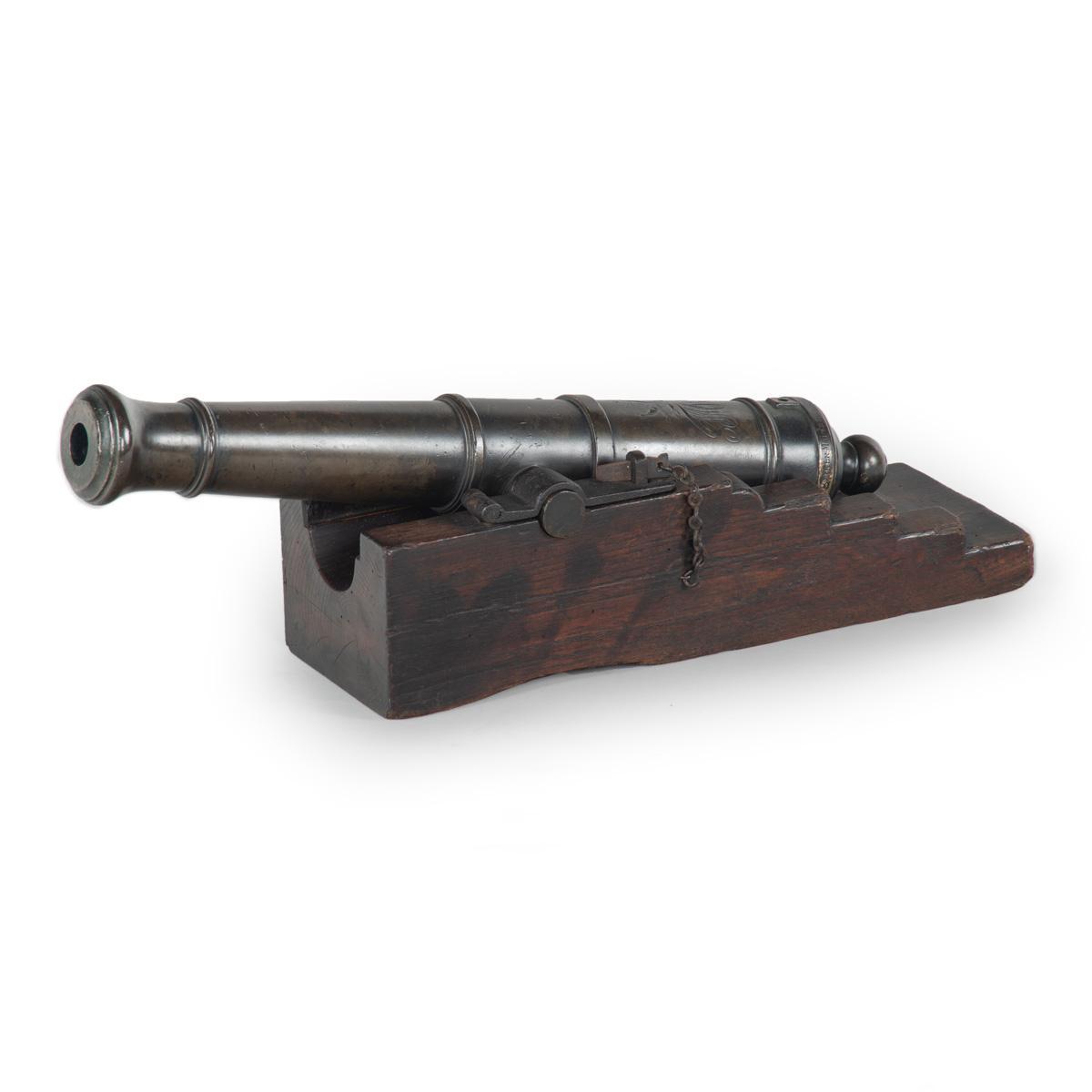
Early 19th Century English Signal Cannon by Royal Gunmaker William Parker
A Highly Interesting and Important Early 19th Century English Signal Cannon by Royal Gunmaker William Parker, with Crest and Cypher indicating a Likely Maryat-Wilson Family Provenance
Provenance:
Almost certainly made for Thomas Maryon-Wilson, 8th Baronet Wilson (1800-1869)
This fine cast bronze signal cannon is significant for a number of reasons. It retains its original stepped gun carriage and is signed by the maker ‘W Parker, Maker to His Majesty, Holborn, London’. This indicates that the piece was made during the George IV or William IV periods. Parker was active from his 233 High Holborn address between 1793 and 1841 and was appointed gunmaker to the Duke of Kent, Prince Edward and King William IV. None of his numerous adverts in the surviving newspapers from the earlier 19th century make mention of him receiving a royal warrant from Kings George III or IV but the fact that a trade card by Parker from the Sarah Sophia Banks collection survives in the British Museum complicates matters. Banks’ collection was acquired by the museum in 1818 and this card.
Also includes a mention of royal patent, but not a royal warrant. Nonetheless, the BM dates another trade card for the same maker to c.1800 (see section on Parker below) and it makes mention of Parker’s warrant. It seems more likely that the present cannon, and indeed Parker’s warrant, dates to the William IV period . Technically the use of a crown or electoral bonnet on the Hanoverian inescutcheon in the coat of arms ought to help solve this mystery but, on the second BM trade card.that detail is engraved in a way which is too naïve to be distinguishable. Therefore we have to allow the possibility that Parker might have held an earlier royal warrant, even though, as discussed below, the newspapers of the time do not seem to support that view.
The other fascinating detail about this piece is the finely engraved family crest and cypher or monogram on the barrel. The cypher consists of the conjoined mirrored letters T and M either side of a central W. Consulting Fairbairn’s Book of Crests, we were able to establish that the present crest, a demi-wolf rampant, was used by 31 families but only one family used M and W in the surname, that of Maryon-Wilson. Although other branches of the Wilson family were also prominent during the right period, the prominence being important because commissioning a cannon from Parker, the royal maker, was a significant expense, Thomas Maryon-Wilson was by far the most important gentleman of the period whose initials match the cypher and crest. It is therefore highly likely that the piece was made for him.
Thomas Maryon-Wilson (1800-1869)
Born in Prittlewell, now a suburb of Southend in Essex, Maryon-Wilson succeeded to the Wilson baronetcy upon the death of his father in 1821. He became a major landowner, owning large parts of Hampstead Heath which he had hoped to develop for housing but this was opposed by the local home owners. His primary estate was Charlton House near Woolwich which remained in the family well in to the 20th century. An outstanding Queen Anne settee with fine needlework from Charlton House was sold by Christie’s in 2009 and can be seen here, complete with Maryon-Wilson ownership label to the base with the demi-wolf crest clearly visible
https://www.invaluable.com/auction-lot/a-queen-anne-walnut-settee-173-c-5e6c6e801f?objectID=53589748&algIndex=undefined&queryID=84633bb7b21f51646a37f823f5c18c21
Maryon-Wilson studied at St John’s College, Cambridge and, as well as running his vast estates he was captain of the local militia and, from 1853, Colonel of the West Kent Light Infantry Militia, a role he held until his death in 1869. It is clear to see why a cannon from an important maker like Parker would have appealed to Maryon-Wilson.
William Parker of Holborn (1772-1841);
Born in Somerset in 1772 in Croscombe, Parker was established in High Holborn by 1792/93, probably initially as an apprentice to the silversmith John Field. By 1796 or 1797, Parker was trading under his own name as a gunmaker and this was to continue until his death in 1841. The firm continued as Parker and Field after Parker’s death, eventually becoming Field and trading until c.1886.
In addition to the aforementioned appointments as maker to the Duke of Kent, Prince Edward and King William IV, Parker was also appointed gun maker to ‘the honorable (sic) Board of Ordnance and the Honorable East India Company’ according to one of his trade cards in the Heal Collection in the British Museum.
Surviving cannon by Parker are rare survivals, a pair with engraved marquesses’ coronets and the initial C were offered on the art market in 2022 supplying further proof of the elite nature of Parker’s clientele.
measurements
Height:
7.5 in
Width:
20.5 in
Depth:
5 in
Barrel length:
18 in
measurements
declaration
Wick Antiques Ltd has clarified that the Early 19th Century English Signal Cannon by Royal Gunmaker William Parker (LA560914) is genuinely of the period declared with the date/period of manufacture being Early 19th Century