

Originally established in London since 1969, now in its second generation, Loveday Antiques specialises in an eclectic mix of 18th to 20th Century European furniture and works of art with a strong emphasis on fine quality, uniqueness and colour.
As proud members of British Antiques Dealers Association (BADA) and the London and Provincial Antique Dealers Association (LAPADA) and members of CINOA the worldwide association for Antique Dealers, our clients can buy with 100% confidence and reassurance as we are committed to upholding and abiding by the strict standards of each association.
Our clients can rest assured that each item is as described and photographed.


Loveday Antiques
'%3e%3cpath fill='%23012169' d='M0 0v30h60V0z'/%3e%3cpath stroke='%23fff' stroke-width='6' d='m0 0 60 30m0-30L0 30'/%3e%3cpath stroke='%23C8102E' stroke-width='4' d='m0 0 60 30m0-30L0 30' clip-path='url(%23b)'/%3e%3cpath stroke='%23fff' stroke-width='10' d='M30 0v30M0 15h60'/%3e%3cpath stroke='%23C8102E' stroke-width='6' d='M30 0v30M0 15h60'/%3e%3c/g%3e%3c/svg%3e) Hertfordshire, UK
Hertfordshire, UK
Opening times
By Appointment only
Phone
+441438 869819
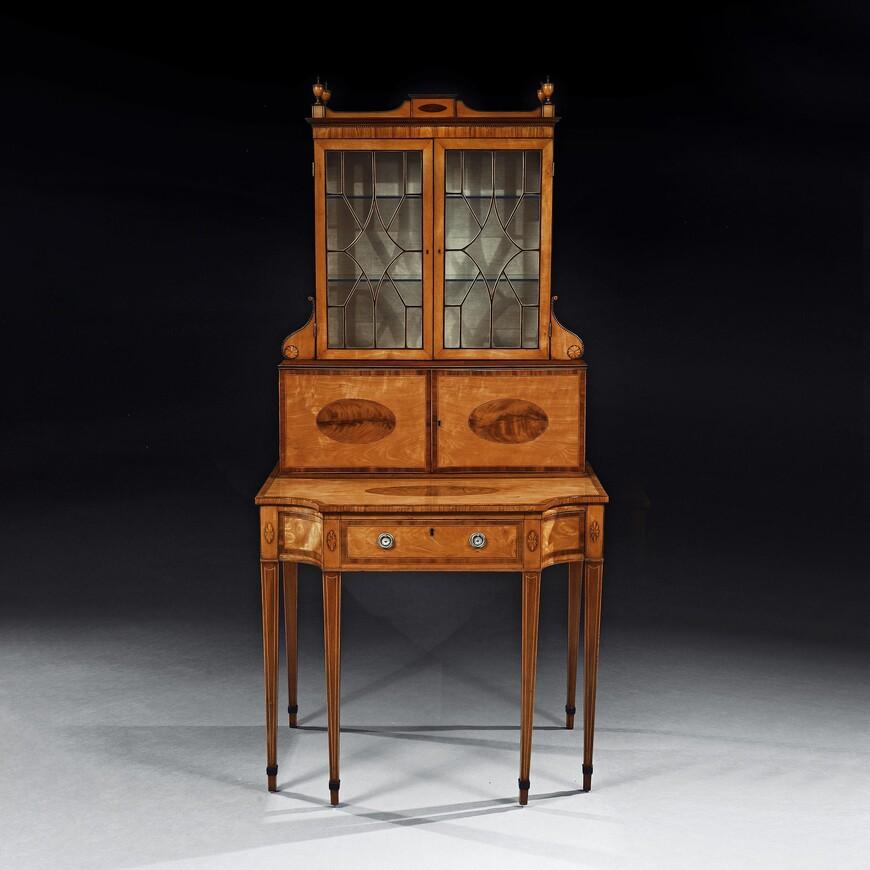
Important 18th Century George III Satinwood & Sabicu Writing Cabinet
REF: 2896 / LA423530
£44,500
€51,774
$59,080
Secure Payments By
LoveAntiques Dealersince Oct 2017Approved item452 sales by dealerAvailable for local pick-up
LoveAntiques Dealersince Oct 2017Approved item452 sales by dealerAvailable for local pick-up
Description
A fine late 18th Century George III Satinwood and sabicu ladies writing cabinet with important provenance. (Possibly by George Simpson) English London made - Circa 1785
Provenance Exhibited by W. R. Harvey in their Old Bond Street showrooms in 1986 and 1987, the piece being chosen to be advertised in Country Life magazine in 1986 and in the Grosvenor House Antiques Fair catalogue in 1987. The collection of Roger De Clerck, Eaton Square, London.
This very elegantly drawn writing cabinet is constructed with the finest cuts of satinwood, banded with sabicu and strung with boxwood. The shaped and inlaid pediment with vase finials above a pair of glazed doors with patera-inlaid scrolled lower supporting brackets, over a pair of doors inlaid with oval mahogany panels enclosing pigeonholes, drawers and central lockable door. The lower section writing desk with in-curved front corners, with pull out writing drawer fitted with ratcheted reading slide, pen and crystal ink wells. The whole raised on slender tapering legs, headed with inlaid oval patera and strung with boxwood having collared feet.
An exceptional quality piece in superb original condition and of wonderful colour.
More research on this design and possibly maker below. The secretaire section of this piece is based on a plate in Chippendale's Director depicting a “Lady's Writing Table and Bookcase”.
However the overall form has been softened in the Sheraton manner with slimmer tapering legs with collars rather than the block feet suggested by Chippendale. Additionally, the breakfront doors in Chippendale's design have been substituted for a simpler pair of doors but with a much more elaborate series of pigeon holes in the middle section. The choice of the finest cuts of veneer and the beautifully-executed astragal glazing bars are further evidence of quality and the piece was clearly executed by one of the major workshops of the period. Although it is very difficult to make an attribution for such an unusual piece of furniture with no well-recorded comparatives in museum or stately home collections, it is possible that this piece might have been the work of George Simson, a cabinetmaker and upholder based in St Paul's Churchyard in London. Simson is best known today for a series of fine secretaire cabinets made for Thomas Weeks and his museum in Tichborne Street. These Weeks cabinets survive in several museum collections including Temple Newsam in Leeds.
In his Pictorial Dictionary of Marked London Furniture 1700-1840, Christopher Gilbert illustrated many pieces of furniture with Simson's trade label. Illustrated below are two of these pieces which all bear some stylistic similarities to our writing table although, as stressed above, this attribution can only be tentative at this stage along with there being an unusual amount of labelled items by this George Simpson. So many top makers, such as Mayhew and Ince etc did not sign or label their work as the majority of furniture at this level were made for private commissions. Labelling tended to be restricted to items that were for sale in a shop. Nevertheless this fine piece would have been supplied by a top London maker.
In particular, it is interesting to note the comparatively large number of writing cabinets that bear Simson's trade label and the lavish use of satinwood. Despite Percy MacQuoid's use of the term “The Age of Satinwood” to describe furniture produced in England in the late 18th century, the timber itself was still used on comparatively few pieces produced during this period-certainly as the primary veneer.
Our Piece in Print
As mentioned earlier, our piece was owned by the dealers W. R. Harvey in the late 1980s and it featured in two of their exhibitions-The Elegant Quarter-Satinwood and Related Furniture 1785- 1810 (held in 1986) and The Englishman's Library 1700-1830 (held in 1987). The first exhibition was advertised with a full page advert of the piece in Country Life and the second exhibition was advertised in the back of the Grosvenor House Antiques Fair catalogue for 1987. The Harveys were not exhibitors at the fair but chose the catalogue as a way of capturing the attention of all serious furniture collectors at the time. Additionally, our research has revealed that a very closely related piece, almost certainly from the same workshop, was advertised in Connoisseur Magazine by the dealers J. W. Needhams of Manchester in September of 1923.
Roger De Clerck
Thanks to information provided by David Harvey, we have been able to ascertain that W. R. Harvey sold the present piece to Roger (Baron) De Clerck for his Eaton Square residence in London. Named as the “15th richest Belgian” at one time during his later life, De Clerck was the CEO of the Beaulieu Textile Group, a fabric weaving conglomerate headquartered in Waregem in Flanders. De Clerck's interesting life also included accusations of fiscal fraud and other such business dealings for which he was supposedly denied the title of a Baron but his entrepreneurial career was a highly successful one and he was also a keen collector of art and antiques. Our piece is a highly individual treatment of the lady's writing table that would appeal to the connoisseur collector looking for a statement piece of satinwood furniture.
Width: 34 inches - 86cm Height: 73 inches - 185cm Depth: 25 inches - 63.5cm
measurements
Height:
185 cm
Width:
86 cm
Depth:
63.5 cm
declaration
Loveday Antiques has clarified that the Important 18th Century George III Satinwood & Sabicu Writing Cabinet (LA423530) is genuinely of the period declared with the date/period of manufacture being c.1785
condition
This is an exceptional quality piece in superb original condition and of wonderful colour.
additional info
Material:
Date of Manufacture:
c.1785
location
This Important 18th Century George III Satinwood & Sabicu Writing Cabinet is located in Hertfordshire, United Kingdom
Share:
A selection of items from Loveday Antiques
Loveday Antiques has 89 items available.Regency Mahogany Partners Writing Table in The Manner of George Smith
£ 19,500
€22,688$25,889
Loveday Antiques
George III Mahogany Serpentine Tea Table of Exceptional Colour and Patination
£ 5,800
€6,748$7,700
Loveday Antiques
An Important 19th Century French Henry Dasson Commode in the Louis XVI Style After the Model by Weisweiler
£ 79,500
€92,496$105,547
Loveday Antiques