
Wick Antiques was established by Charles Wallrock in the early 1980s. Having grown up in the Antiques world Charles developed an extensive wealth of knowledge. Starting out as a ‘man with a van’ he quickly gained a good reputation and embarked on a longstanding relationship with Harrods. He was later joined by his wife, Caroline Wallrock. Caroline having completed a Persian degree, went on to study at Christie’s fine art and then joined Sotheby’s specializing in Islamic and Japanese works of art, as well as taking the occasional auction. Together they make a formidable team with extensive knowledge and buy and sell some of the best items on the market.
Wick Antiques Ltd
'%3e%3cpath fill='%23012169' d='M0 0v30h60V0z'/%3e%3cpath stroke='%23fff' stroke-width='6' d='m0 0 60 30m0-30L0 30'/%3e%3cpath stroke='%23C8102E' stroke-width='4' d='m0 0 60 30m0-30L0 30' clip-path='url(%23b)'/%3e%3cpath stroke='%23fff' stroke-width='10' d='M30 0v30M0 15h60'/%3e%3cpath stroke='%23C8102E' stroke-width='6' d='M30 0v30M0 15h60'/%3e%3c/g%3e%3c/svg%3e) Hampshire, UK

Address
Unit 2 Riverside Business Park
Lymington
Hampshire
United Kingdom
SO41 9BB
Opening times
By Appointment Only
Mobile
+447768 877069
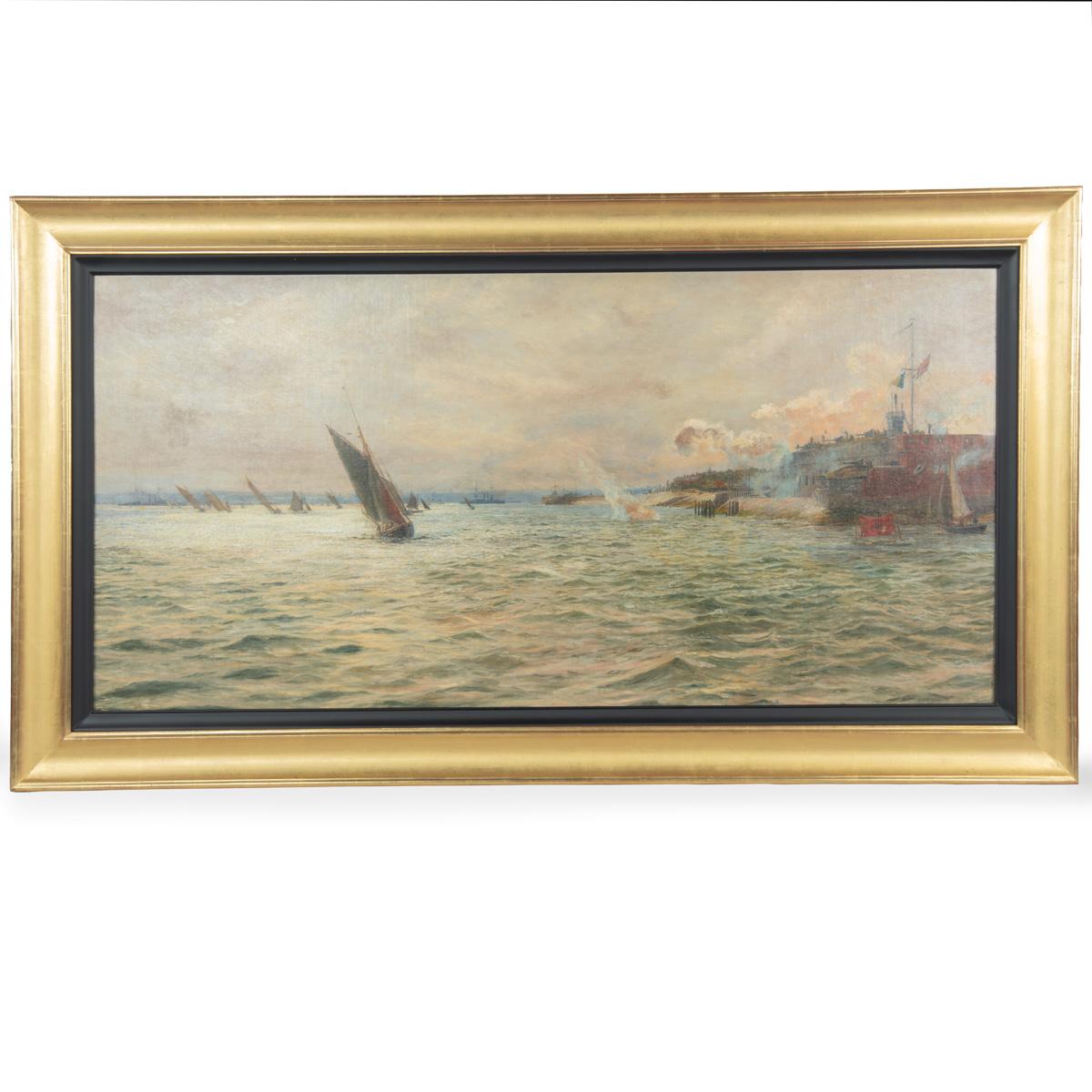
William Lionel Wyllie (British, 1851-1931) Signalling From Fort Blockhouse at the Entrance to Portsmouth Harbour, Circa 1912
REF: LA591814
£22,500
€26,959
$30,375
LoveAntiques Dealersince Jan 2019587 sales by dealer
LoveAntiques Dealersince Jan 2019587 sales by dealer
Description
William Lionel Wyllie (British, 1851-1931) Signalling From Fort Blockhouse at the Entrance to Portsmouth Harbour, Circa 1912
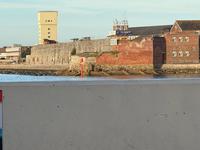
This very fine example of William Wyllie’s work would have been painted from his studio in Old Portsmouth, which looks directly out towards the Blockhouse on the Gosport side of the entrance to Portsmouth harbour.
This painting shows signalling from the blockhouse as well as race on the port hand side of the painting, there would also appear to be some form of firing exercise circa 1912.
I believe that WLY painted this for his own personal house in Old Portsmouth; hence, there is no signature, and it was sold by the artist’s family back in 1991. This is exactly what he would have seen day after day.
Provenance
The Artist’s family.
Sotheby’s London: Marine Pictures and Nautical Works of Art, 22 May 1991, lot 126.
Jason Pilalas collection. USA
The gun is drawing the naval ship’s attention to the hand semaphore signal ‘J’, which indicates that a detailed signal is imminent, as evidenced by the red and white second substitute flag which is about to be hoisted above the numerical instruction code
W.L.WYLLIE
R.A., R.I., R.E.
1851 – 1931
Marine Artist
lived here
from 1906 until 1931
Further Information
William Lionel Wyllie was one of Britain’s most respected maritime artists and rightly deserves to be considered alongside Dickens or Conan Doyle when the story of Portsmouth’s contribution to the arts is discussed. As Sir Hugh Casson P.R.A. wrote when Whyllie was in his 70s, “To me he seemed the perfect man living the perfect life. I was passionate about boats but here was somebody lucky beyond belief who seemed to live entirely on behalf of (and only for) boats. He designed them, cared for them sailed them and above all he never ceased to draw and paint them in every size and shape and in all weathers. He drew them as a seaman would… accurately, affectionately and above all with that deep practical understanding of the fact born of experience, that seamanship is fun but it is also serious.”
Wyllie was born in London in 1851 into an artistic family, and trained at Heatherley’s Academy, and then at the Royal Academy Schools, where he first exhibited in 1868. During the mid-1870s he spent much time on a barge, converted into a floating studio, going up and down the Thames, then in 1879 he married Marion Amy Carew and in 1885 they moved to Hoo lodge at Rochester. In 1889 he was elected ARA and subsequently became a full Academician in 1907.
1906 saw the Wyllie family, by now including five sons and two daughters, move to Tower House at the entrance to Portsmouth Harbour. It had been a complex of stores, chambers, wharves when it was auctioned by King & King but the Whyllie’s converted it into a dream house for a maritime artist. Here he could sit and paint, so close to the water’s edge that he could almost touch the ships passing by.
For the next 25 years W.L. and Marion firmly embedded themselves in the social, academic, naval and artistic fabric of Portsmouth. Shortly after arriving in the town he founded, at the request of Lord Baden-Powell, the Portsmouth Sea Scouts Troop with whom he maintained a close connection for the rest of his life. In addition he was a founding member of the Portsmouth Sailing Club. But it was in his painting that he had the greatest influence, especially during the Great War during which he became a de facto war artist. Two of Wyllie’s sons were killed in the First World War and both have memorials in Portsmouth Cathedral, one of which is a painting by WL Wyllie.
Prior to the war, Wyllie had been involved with a group of enthusiasts interested in the preservation of HMS Victory which was gradually rotting away in Portsmouth Harbour. This had been a continuation of his fascination with the ship which had led him to discover in a Chatham Dockyard store the original battle-torn top-sail carried by the Victory at Trafalgar (This is now on permanent display as part of the Royal Naval Museum in Portsmouth Dockyard).
After the war, HMS Victory was brought into dry dock and her restoration began. This inspired Whyllie to further pursue his idea of creating a large panorama of the Battle of Trafalgar to be on permanent display close by the ship. This project was to last for nine months during which time he worked closely with his daughter Aileen. The mural was unveiled by King George V in 1930 and is now in the Royal Naval Museum close by the Victory.
Wyllie died on 6th April 1931 having suffered a heart attack. His funeral was held at Portsmouth Cathedral after which his coffin was carried to Point and placed aboard a cutter from HMS Nelson which transported it to St Mary’s Church in the grounds of Portchester Castle where Wyllie is buried alongside his wife and daughters Eva and Aileen
measurements
Height:
29 in
Width:
59.5 in
declaration
Wick Antiques Ltd has clarified that the William Lionel Wyllie (British, 1851-1931) Signalling From Fort Blockhouse at the Entrance to Portsmouth Harbour, Circa 1912 (LA591814) is genuinely of the period declared with the date/period of manufacture being Circa 1912
additional info
Period:
Material:
Origin:
Artisan:
Date of Manufacture:
Circa 1912
location
This William Lionel Wyllie (British, 1851-1931) Signalling From Fort Blockhouse at the Entrance to Portsmouth Harbour, Circa 1912 is located in Hampshire, United Kingdom
Share:
Ask a question
Please note,
This dealer does not accept instant online payment for this item.
To buy this item please email the dealer using the enquiry form below.
A selection of items from Wick Antiques Ltd
Wick Antiques Ltd has 777 items available.The Return, Saved from the Wreck by Thomas Brooks, Exhibited at the Royal Academy in 1862
£ 32,500
€38,941$43,875
Wick Antiques Ltd
Fine Genre Oil Painting by William Arthur Breakspeare Depicting the Fictional
£ 12,500
€14,977$16,875
Wick Antiques Ltd
Fine Late Period Walter Sickert Painting - The Coffee Mill - Which is Entirely Fresh to the Market Having Never Before Been Offered for Sale
£ 28,500
€34,148$38,475
Wick Antiques Ltd