


About Cheshire Antiques Consultant LTD®
Cheshire Antiques Consultant LTD® is an international fine art dealer and online gallery specialising in British and European paintings, sculpture and decorative arts.
Established in 2005 and led by directors Michael and Victoria, the firm brings over two decades of experience in sourcing, evaluating and placing historically significant works with private collectors, galleries, interior designers and institutions worldwide.
As elected members of the Fine Art Trade Guild, our work is grounded in connoisseurship, academic research and rigorous standards of authenticity. Every work we present is subject to careful vetting and offered with full transparency regarding condition and provenance.
Private Online Gallery
Virtual Viewings by Appointment
We operate exclusively online, offering private one-to-one virtual viewings to discuss condition, scale and provenance in detail. High-resolution images and comprehensive condition reports are available upon request, ensuring complete confidence prior to acquisition.
Areas of Specialisation
Fine Art & Works of Art (17th–21st Century)
British and European oil paintings, watercolours and mixed media
Portraiture, marine and nautical subjects
Animal, hunting and sporting scenes
Landscapes, cityscapes and genre compositions
Sculpture and three-dimensional works
Decorative Arts
Period furniture and interior pieces
Bronzes, carvings and objets d’art
Hallmarked silver, ceramics and glassware
Collectible works spanning the 18th–20th centuries
Each piece is selected with careful attention to historical context, condition and aesthetic quality, curated for both established collectors and emerging buyers.
Sustainability & Enduring Craftsmanship
We recognise the inherent sustainability of historic works of art and decorative arts. These pieces require no new materials while preserving craftsmanship, cultural heritage and artistic legacy. They integrate seamlessly into both traditional and contemporary interiors, offering individuality and permanence.
Payments & Shipping
Payments
Card payments accepted online up to £5,000
Amounts exceeding £5,000 payable by bank transfer
Proforma invoices available upon request
Shipping
UK and worldwide shipping available (quotation on request)
All items professionally packed, fully insured and shipped with tracked delivery
Customs & International Orders
All international shipments are handled on a Delivery Duty Unpaid (DDU) basis. Import duties, VAT and customs clearance are the responsibility of the buyer.
Clients within the European Union and United States are advised to consult local customs authorities regarding applicable import procedures. If a shipment is refused and returned, return shipping costs will be deducted from any refund.
Company Information
Cheshire Antiques Consultant LTD®
71–75 Shelton Street
Covent Garden
London WC2H 9JQ
United Kingdom
Registered in England & Wales
Company No. 15666518
GB VAT No. 466128775
Cheshire Antiques Consultant LTD® is a registered United Kingdom trade mark (UK00004303420).


Cheshire Antiques Consultant LTD
'%3e%3cpath fill='%23012169' d='M0 0v30h60V0z'/%3e%3cpath stroke='%23fff' stroke-width='6' d='m0 0 60 30m0-30L0 30'/%3e%3cpath stroke='%23C8102E' stroke-width='4' d='m0 0 60 30m0-30L0 30' clip-path='url(%23b)'/%3e%3cpath stroke='%23fff' stroke-width='10' d='M30 0v30M0 15h60'/%3e%3cpath stroke='%23C8102E' stroke-width='6' d='M30 0v30M0 15h60'/%3e%3c/g%3e%3c/svg%3e) Greater London, UK
Greater London, UK
Address
71-75 Shelton Street
London
Greater London
United Kingdom
WC2H 9JQ
Opening times
By appointment only
Mobile
+447494 763382
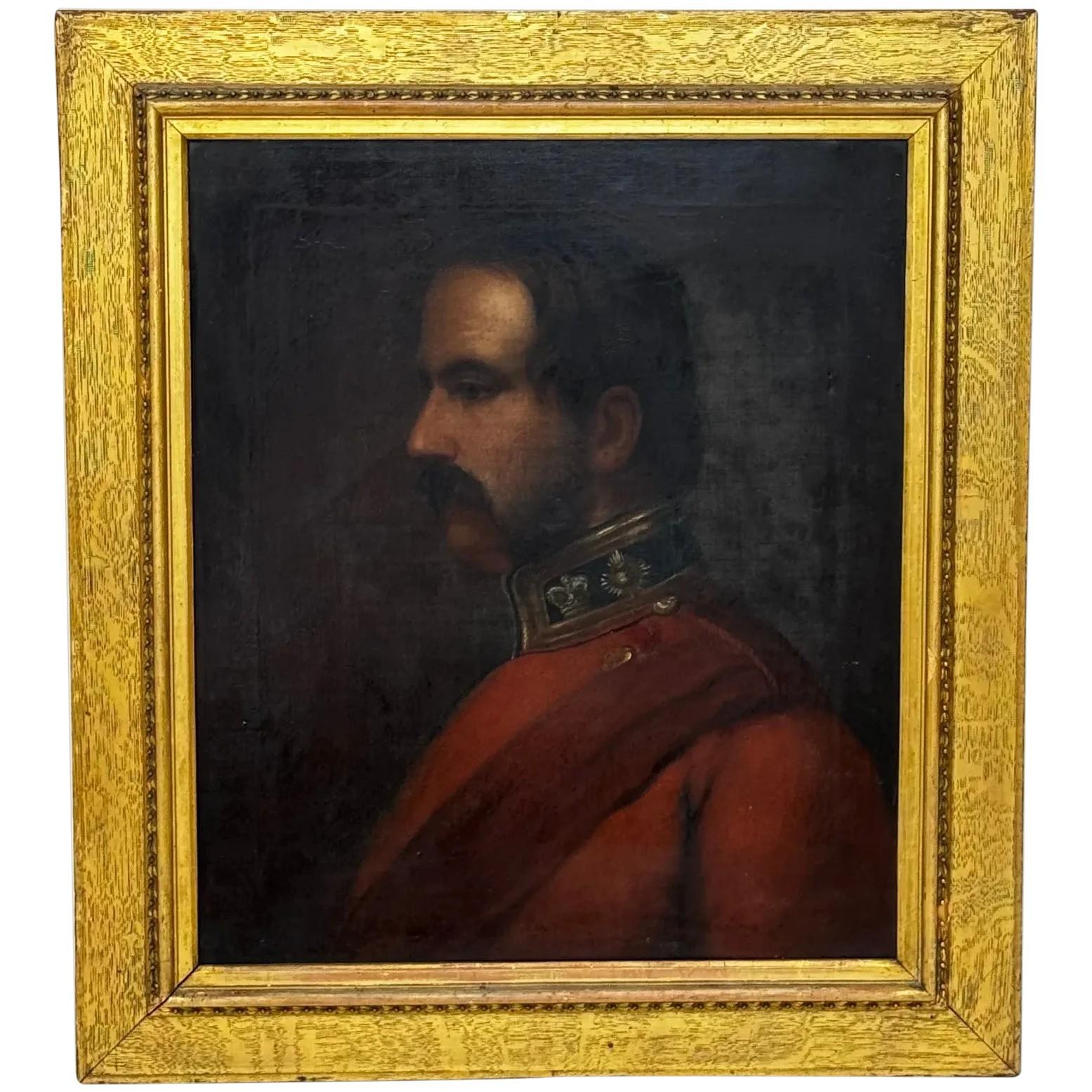
19th Century Military Oil Painting Portrait Red Tunic Coat Victorian Officer
REF: LA506094
£3,500
€4,081
$4,707
Secure Payments By
LoveAntiques Dealersince Mar 2017Approved item549 sales by dealerFree Delivery
LoveAntiques Dealersince Mar 2017Approved item549 sales by dealerFree Delivery
Description
British 19th Century military oil painting on canvas portrait of a red tunic coat Victorian officer in uniform.
Impress your clients & guests in your home or office make a big statment with this military artwork that will suite your interior design theme.
Title “Red Coat Victorian British Officer Lieutenant Colonel”. Subject side profile view portrait half length view of a military British red coat 19th century army officer who is wearing his smart regimental military red with brass buttoned tunic uniform. He has dark blue eyes, having strong typical masculime feaatures, prominent jawline, a large bushy moustache, aristocratic nose, with thick dark hair, healty skin complexion looking to the right.
Having the Queen Victoria Crown Pip- Rank of Lieutenant Colonel, showing a single star beneath a crown. A lieutenant colonel commands an infantry battalion, artillery regiment or cavalry regiment. They are responsible for the unit both in the field and when stationed in barracks. Badges for field officers were first introduced in 1810.
These badges consisted of crowns and stars. The star is that of the Order of the Bath. The colour red he is wearing signifies that he is representing the Royal Crown. Rather nice hue colours with the red & golden also brown thats stand out. Unsigned, British School. So collectible and extremely sought after by collectors.
Set in a traditional original gilt frame with hanging thread on the back ready for immediate home display. A good easy to display in any home compact size being 68cm high and 60cm width of the frame.
Inscribed verso Mr Miles Lampson, biography of notable former owner Miles Wedderburn Lampson, 1st Baron Killearn, Gcmg, Cb, Mvo, Pc (24 August 1880 – 18 September 1964) was a British diplomat. Miles Lampson was the son of Norman Lampson, and grandson of Sir Curtis Lampson, 1st Baronet. His mother was Helen, daughter of Peter Blackburn, Mp for Stirlingshire. He was educated at Eton. Lampson entered the Foreign Office in 1903. He served as Secretary to Garter Mission, Japan, in 1906, as 2nd Secretary at Tokyo, Japan, between 1908 and 1910, as 2nd Secretary at Sofia, Bulgaria in 1911, as 1st Secretary at Peking in 1916, as Acting British High Commissioner in Siberia in 1920 and as British Minister to China between 1926 and 1933. In 1934 he was appointed High Commissioner for Egypt and the Sudan. As a result of the Anglo-Egyptian Treaty in December 1936, to which Lampson was a signatory Britain loosened its grip on Egypt and the post title was changed to Ambassador to Egypt and High Commissioner for the Sudan in 1936. Lampson continued in this office until 1946.
As ambassador to Egypt he forced King Farouk I to change the cabinet to a Wafdist one through surrounding the king's palace with tanks in the Abdeen Palace incident of 1942. He was then Special Commissioner in Southeast Asia between 1946 and 1948. He was admitted to the Privy Council in 1941 and raised to the peerage as Baron Killearn, of Killearn in the County of Stirling, on 17 May 1943. He was also awarded the Order of the Rising Sun, Gold Rays with Neck Ribbon of Japan[3] and the Order of the Sacred Treasure, Gold Rays with Neck Ribbon of Japan. Lord Killearn died in September 1964, aged 84, and was succeeded in the barony by his son by his first marriage, Graham. As Graham died without male heirs, the title subsequently passed to Lord Killearn's son from his second marriage, Victor. The 3rd Lord Killearn took legal action in 2011 to prevent his mother selling off the family home, Haremere Hall.
Provenance: Private collection of Mr Miles Lampson, Bonhams, Oxford, April 2015, auction labels verso & in collection of Cheshire Antiques Consultant Ltd.
Red coat, also referred to as redcoat or scarlet tunic, was a military garment which was widely (though not exclusively) used by the infantry units of the British military, including the British Army and Royal Marines, from the 16th to 19th centuries. The garment was also widely used by the British Colonial Auxiliary Forces and the British Indian Army during the 18th and 19th centuries.
Though by the 20th centuries the red coat was abandoned for practical duties in favour of khaki by all British and Commonwealth military units, it continues to be used for ceremonial full dress and mess dress uniforms. The usage of red coats by English soldiers dates back to the Tudor period, when the Yeomen of the Guard and the Yeomen Warders were both equipped in the royal colours of the House of Tudor, red and gold. During the Tudor conquest of Ireland and the Wars of the Three Kingdoms, units of English soldiers were equipped in red coats, most notably the New Model Army, which fought on the Parliamentary side.
From the mid-17th century to the 19th century, the uniform of most British soldiers (apart from artillery, rifles and light cavalry) included a madder red coat or coatee. From 1873 onwards, the more vivid shade of scarlet was adopted for all ranks, having previously been worn only by officers, sergeants and all ranks of some cavalry regiments.
Viewings are welcome by appointment only for customer support please send a message thank you. Browse our other exciting Fine Arts, antiques & collectibles available in our shop gallery.
measurements
Height:
68 cm
Width:
60 cm
Depth:
1.5 cm
declaration
Cheshire Antiques Consultant LTD has clarified that the 19th Century Military Oil Painting Portrait Red Tunic Coat Victorian Officer (LA506094) is genuinely of the period declared with the date/period of manufacture being c.1880
condition
Offered in fine used condition. The painting surface has various foxing staining & craquelure, paint fading & minor paint losses, also having had a small paint touch up to his upper red uniform just below his collar also lower down near the bottom, patch repair shown verso. Varnish discolouration as shown & frame stretcher lines showing through.
The frame having various old repairs, general noticeable wear, scuffs, scratches, chips losses to the frame commensurate with usage and old age.
additional info
Category:
Material:
Origin:
Date of Manufacture:
c.1880
location
This 19th Century Military Oil Painting Portrait Red Tunic Coat Victorian Officer is located in Greater London, United Kingdom
Share:
Ask a question
Please note,
This dealer does not accept instant online payment for this item.
To buy this item please email the dealer using the enquiry form below.
A selection of items from Cheshire Antiques Consultant LTD
Cheshire Antiques Consultant LTD has 346 items available.Oil Painting Portrait Mayor Maidstone Kent Red Coat Robes Signed Bernard Hailstone
£ 4,000
€4,664$5,380
Cheshire Antiques Consultant LTD
Large 19th Century Hunting Red Coat Charging Oil Painting by Thomas Smythe
£ 15,000
€17,490$20,174
Cheshire Antiques Consultant LTD
Oil Painting Portrait British Infantry Officer Second Lieutenant Killed Aged 19
£ 2,650
€3,090$3,564
Cheshire Antiques Consultant LTD