
Wick Antiques was established by Charles Wallrock in the early 1980s. Having grown up in the Antiques world Charles developed an extensive wealth of knowledge. Starting out as a ‘man with a van’ he quickly gained a good reputation and embarked on a longstanding relationship with Harrods. He was later joined by his wife, Caroline Wallrock. Caroline having completed a Persian degree, went on to study at Christie’s fine art and then joined Sotheby’s specializing in Islamic and Japanese works of art, as well as taking the occasional auction. Together they make a formidable team with extensive knowledge and buy and sell some of the best items on the market.
Wick Antiques Ltd
'%3e%3cpath fill='%23012169' d='M0 0v30h60V0z'/%3e%3cpath stroke='%23fff' stroke-width='6' d='m0 0 60 30m0-30L0 30'/%3e%3cpath stroke='%23C8102E' stroke-width='4' d='m0 0 60 30m0-30L0 30' clip-path='url(%23b)'/%3e%3cpath stroke='%23fff' stroke-width='10' d='M30 0v30M0 15h60'/%3e%3cpath stroke='%23C8102E' stroke-width='6' d='M30 0v30M0 15h60'/%3e%3c/g%3e%3c/svg%3e) Hampshire, UK
Hampshire, UK
Address
Unit 2 Riverside Business Park
Lymington
Hampshire
United Kingdom
SO41 9BB
Opening times
By Appointment Only
Mobile
+447768 877069
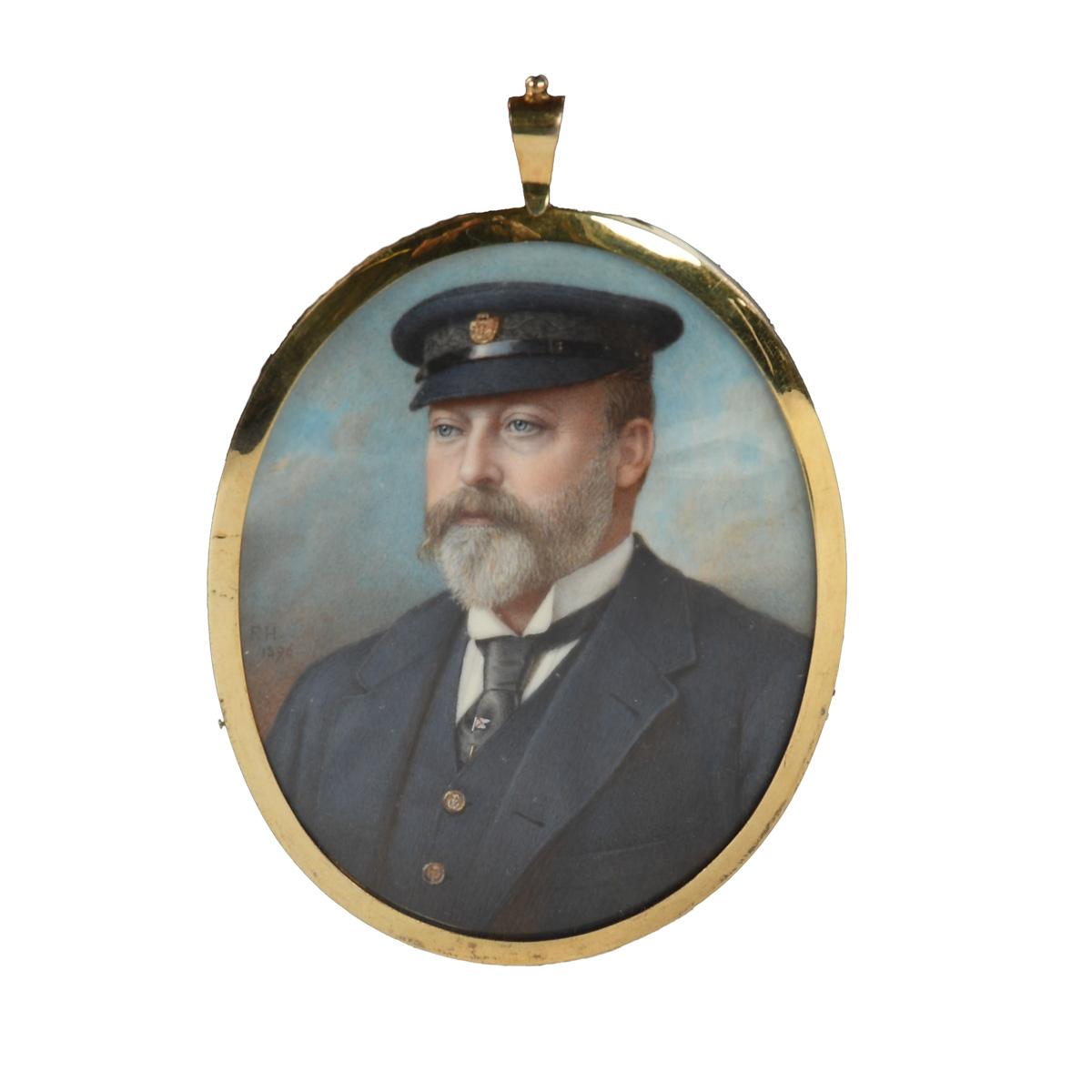
Miniature Portrait of the Prince of Wales, Later Edward VII, as Captain of the Royal Yacht Britannia Painted in 1896 by Robert Henderson for the Royal Warrant Holders Dickinson and Foster
REF: LA558912
£6,850
€8,110
$9,074
LoveAntiques Dealersince Jan 2019Approved item579 sales by dealer
LoveAntiques Dealersince Jan 2019Approved item579 sales by dealer
Description
A Very Fine and Important Miniature Portrait of the Prince of Wales, Later Edward VII, as Captain of the Royal Yacht Britannia Painted in 1896 by Robert Henderson for the Royal Warrant Holders Dickinson and Foster
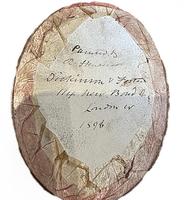
This fine miniature depicts the future King Edward VII whilst still Prince of Wales in 1896 in the uniform he wore whilst captaining the Royal Yacht Britannia including his peaked cap and, in his tie, his tie pin with the burgee for the Royal Yacht Squadron of which he was a proud member. The miniature is signed “R H” and dated 1896 and contained in a 14ct gold bezel with suspension ring, suggesting perhaps that it was mounted in America where 14ct was the usual standard of gold whereas in England it would have been much more likely to have been 15ct or 18ct at this time. This suggests that it may have been given to an American friend of the Prince, perhaps the owner of one of the American yachts against which the Britannia raced in the 1896 season. A label on the back of the miniature states that it was ‘painted by R. Henderson, Dickenson (sic) & Foster, 114 New Bond St.’.
Dickinson and Foster and Robert Henderson
The article Robert Henderson (1826–1904) and the Family Order of King Edward VII, published in the The British Art Journal, Winter 2014/15, Vol. 15, No. 2 (Winter 2014/15), pp. 93-102, by James Greville is an invaluable source of information about the firm of Dickinson and Foster and their relationship with Robert Henderson. Founded in London in the 1820s, the firm of Dickinson was established as a print publisher but also having the capability to produce frames and dealing in second hand and antique paintings as well. In 1851 the firm was given the first of many endorsements by the royal family, being awarded a Royal Warrant by Prince Albert due to his interest in a set of lithographs of the Great Exhibition that the firm published that year. Queen Victoria commissioned the firm to produce a very large scale miniature portrait of herself for presentation to the American George Peabody in 1866. The request caused the firm some difficulty but the result was to everyone’s satisfaction when delivered in 1867. The success of this piece led the firm to experiment with early photographic technology that allowed them to blow up photographic images and then combine them with traditional painting techniques to produce portrait miniatures for a larger market. This was commercially successful but something of an artistic failure despite the calibre of some of the artists involved. As a result when the firm was sold by the Dickinson family to Joshua James Foster in 1876, one of his first decisions as head of the firm was to concentrate on more traditional portrait techniques and to search for an artist of requisite skill. The firm advertised itself as ‘miniature painters and publishers to the Queen’ and Foster was keen to develop this reputation. Our research in the newspaper archives uncovered an interesting advert from 1896 reproduced here.
This demonstrates what a large part of the firm’s business now depended on the production of miniatures of one form or another and by this stage the firm had found an artist who was able to supply them with work of the highest quality befitting a firm with a Bond Street address and an elite clientele. That artist was Robert Henderson, a Scot born in Dumfries in 1826 who had lived in London since as a young man he had moved to the English capital to train as a wood carver. From 1854, and somewhat as a result of the interesting social circles in which he moved due to his wife’s position as a successful actress, Henderson started working full time as an artist. Although he began by painting in oils, Henderson’s first love was the portrait miniature and luckily the art form began to see a steady increase in interest and just the same time as his career began to take off. He is recorded has having produced some work for Dickinson pre-Foster’s take over but it was in the 1880s when he really began to make a real name for himself in this field and he was by then contracted exclusively to Dickinson and Foster. This arrangement lasted the rest of his life and benefited both parties greatly.
The Prince of Wales had by this time come in to contact with the firm and, to quote from Greville’s article,
‘There were also royal visits by the Prince and Princess of Wales to exhibitions held in the company’s gallery and in 1895 Edward agreed to sit for a composite picture, The Royal Yacht Squadron at Cowes. He was evidently intrigued by its production for he visited Dickinson & Foster twice to be photographed and once to review progress’
It would have been natural for the Prince to have chosen the firm to memorialise him for presentation to a friend or fellow yachtsmen in his Britannia uniform.
The Prince also used the firm to produce portrait miniatures of him in more conventional regal garb for use on his Family Order, a decoration featuring a portrait of the now King that was commissioned in 1902 and presented to the King’s closest female relatives. 11 of these orders are known to have been made with three retained in the Royal Collection to this day, two of them linked below. All of the portraits were painted by Henderson.
https://www.rct.uk/collection/9019/miniature-portrait-of-edward-vii-1841-1910-in-a-diamond-bezel
https://www.rct.uk/collection/441450/family-order-of-king-edward-vii
During the 1896 season, Britannia raced 58 times, winning 14 of those races and achieving other prizes on another 10 occasions. One of the most famous yachts she faced that year was the Meteor II, designed by Scottish builder George Lennox Watson in Glasgow. It is likely that the owner of one of the yachts with whom the Prince of Wales came in to contact in 1896 was the lucky recipient of this exceptional painting.
ROBERT HENDERSON (UK, 1826–1904)
Miniature oil on ivory in 14K gold case of King Edward VII (1841–1910) in uniform as Captain of HMY “Britannia”, a gaff-rigged cutter yacht built in 1898 (note burgee tie pin, initialed “RH” over his right shoulder), dated 1896 and inscribed on backing paper:
“Painted by R. Henderson, Dickenson & Foster, 114 New Bond S., London W, 1898”.
Under convex glass lens, with moire satin back.
4 1/2 inches x 3 1/4 inches including suspension loop.
measurements
Height:
4.5 in
Width:
3.25 in
declaration
Wick Antiques Ltd has clarified that the Miniature Portrait of the Prince of Wales, Later Edward VII, as Captain of the Royal Yacht Britannia Painted in 1896 by Robert Henderson for the Royal Warrant Holders Dickinson and Foster (LA558912) is genuinely of the period declared with the date/period of manufacture being 1896
additional info
Category:
Material:
Date of Manufacture:
1896
location
This Miniature Portrait of the Prince of Wales, Later Edward VII, as Captain of the Royal Yacht Britannia Painted in 1896 by Robert Henderson for the Royal Warrant Holders Dickinson and Foster is located in Hampshire, United Kingdom
Share:
Ask a question
Please note,
This dealer does not accept instant online payment for this item.
To buy this item please email the dealer using the enquiry form below.
A selection of items from Wick Antiques Ltd
Wick Antiques Ltd has 745 items available.Signed Water Colour by Charles Dixon of Yachts of Calshot in the Solent
£ 2,850
€3,374$3,775
Wick Antiques Ltd
Shamrock Becalmed – by Kirk and Sons of the Famous j Class Yacht Shamrock
£ 285
€337$378
Wick Antiques Ltd