Established in 2010, we are dealers in good quality antique furniture, silver, metalware, fine porcelain, artwork and glassware ranging from the 18th century to the early 20th century. We have a particular interest in the Arts and Crafts movement, and much of our stock dates to this era. We’ve published several books on antiques, which are available via Amazon.
We have a large dealers unit at Carlton Fine Arts and Antiques Centre in Salts Mill, Saltaire, West Yorkshire, and we stand at fine arts and antiques fairs in Yorkshire and Lancashire.
... See more
LoveAntiques Dealersince Apr 2017382 sales by dealerFree Delivery
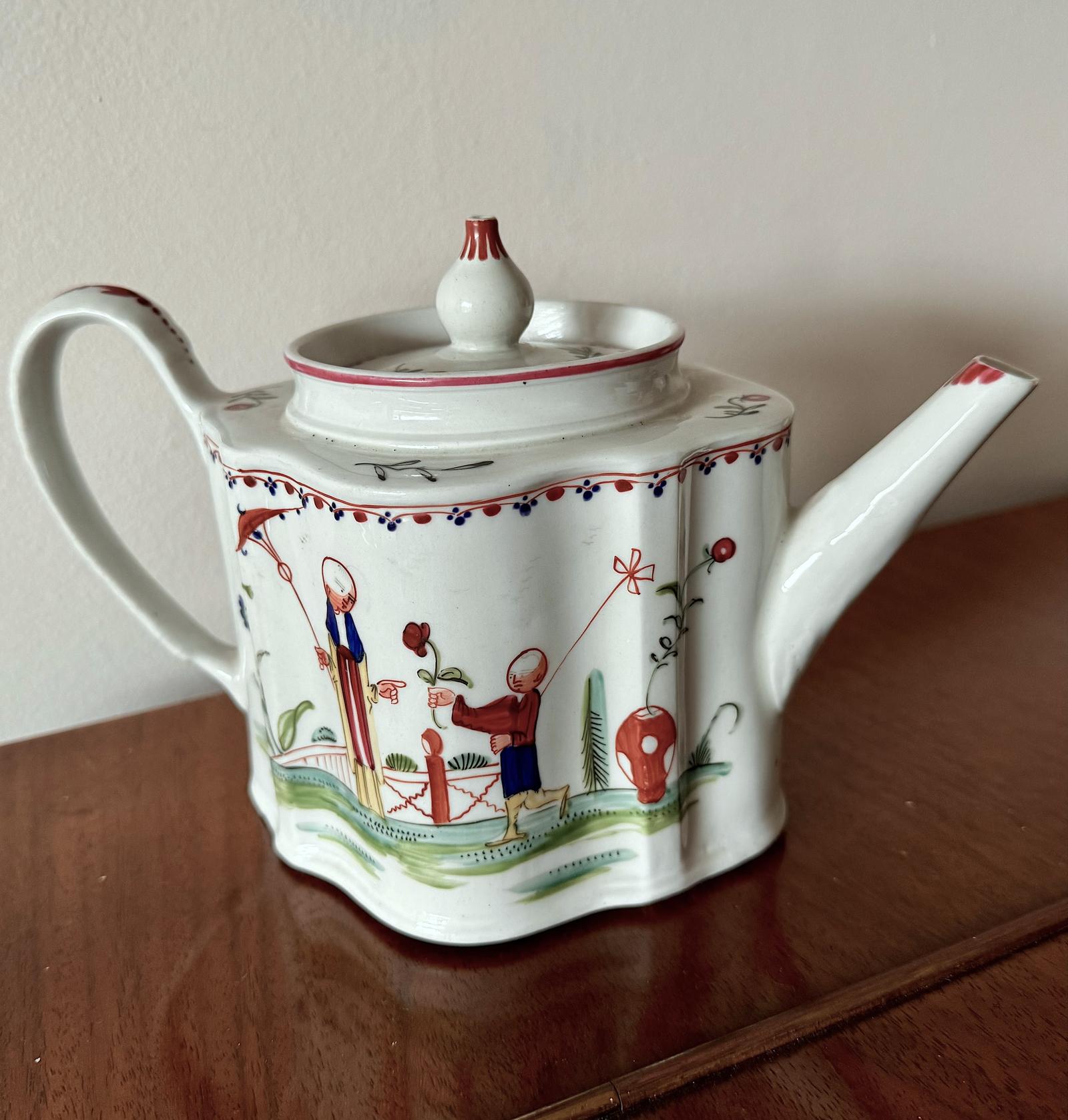
We have for sale a very early New Hall pattern No. 20 (Pat Preller, "A Partial Reconstruction of the New Hall Pattern Book" 2003) teapot dating from around 1782-1785. The provenance of this teapot includes a sales receipt from Antonia Agnew and Felicity Marno of Stockspring Antiques, Kennsington Church Street, London.
This very attractive hard paste porcelain teapot is one of the earliest examples of a New Hall silver shaped teapot with very unusual rosette feet and is decorated with one of the very first polychrome New Hall patterns, pattern No 20. This pattern is of a Chinoiserie polychrome design in iron reds, yellows, blues and greens and charmingly depicts a boy with a flower running towards a man holding a parasol. This Teapot represents the output of what can be described as New Hall's experimental period.
New Hall was established in 1781 when Richard Champion of the Bristol manufactury sold his rights to the William Cookworthy of Plymouth's hard paste porcelain patent to a group of potters including John Turner, Anthony Keeling, Samuel Hollins, John Daniel and Jacob and Peter Warburton of the New Hall at Shelton in Staffordshire. Unfortunately, Richard Champion failed to fully instruct the potters at New Hall how to produce his porcelain because he was otherwise occupied by taking up the exciting position of Deputy Paymaster General. As a result of this, the early period of New Hall involved the potters experimenting with the porcelain and its glaze for around 4 years to standardize and optimise its production and test the market with a range of tea and dessert service designs and shapes (see Rachel L. Denyer, Morgan C.T. Denyer and Howell G.M. Edwards "Armorial Porcelain: The Genesis", Springer Nature, Switzerland, 2024, ISBN 978-3031637445, and "New Hall and Its Imitators", David Holgate, The Collectors' Book Club, 1971, ISBN 090308533X). This teapot dates from this early New Hall period of 1782-1785. The pattern was trialled on both globular and silver teapot shape and the later silver shape was clearly more popular resulting in it being used in the production of the majority of 18th century teapots produced by New Hall. This teapot dating to the New Hall experimental period also explains the very unusual rosette feet, which were not incorporated into the later New Hall silver shaped teapot designs.
The teapot is approximately 5.2 inches (13cm) high and 8.5 inches (21.5cm) wide and in a very good to excellent condition and is accompanied by it's purchase receipt for the sum of £1050 from Antonia Agnew and Felicity Marno of Stockspring Antiques of 114 Kennsington Church Street, London W8 4BH, dated 14 December 1991, in which it is stated that the finial was replaced. This repair is invisible.
measurements
Height:
13 cm
Width:
21.5 cm
measurements
declaration
Penrose Antiques Ltd has clarified that the Early New Hall Pattern No 20 Teapot C1782-85 (LA534268) is genuinely of the period declared with the date/period of manufacture being 1785
declaration
condition
condition
The teapot is in a very good to excellent condition and is accompanied by it's purchase receipt for the sum of £1050 from Antonia Agnew and Felicity Marno of Stockspring Antiques of 114 Kennsington Church Street, London W8 4BH, dated 14 December 1991, in which it is stated that the finial was replaced. This repair is invisible.