
Wick Antiques was established by Charles Wallrock in the early 1980s. Having grown up in the Antiques world Charles developed an extensive wealth of knowledge. Starting out as a ‘man with a van’ he quickly gained a good reputation and embarked on a longstanding relationship with Harrods. He was later joined by his wife, Caroline Wallrock. Caroline having completed a Persian degree, went on to study at Christie’s fine art and then joined Sotheby’s specializing in Islamic and Japanese works of art, as well as taking the occasional auction. Together they make a formidable team with extensive knowledge and buy and sell some of the best items on the market.
Wick Antiques Ltd
'%3e%3cpath fill='%23012169' d='M0 0v30h60V0z'/%3e%3cpath stroke='%23fff' stroke-width='6' d='m0 0 60 30m0-30L0 30'/%3e%3cpath stroke='%23C8102E' stroke-width='4' d='m0 0 60 30m0-30L0 30' clip-path='url(%23b)'/%3e%3cpath stroke='%23fff' stroke-width='10' d='M30 0v30M0 15h60'/%3e%3cpath stroke='%23C8102E' stroke-width='6' d='M30 0v30M0 15h60'/%3e%3c/g%3e%3c/svg%3e) Hampshire, UK
Hampshire, UK
Address
Unit 2 Riverside Business Park
Lymington
Hampshire
United Kingdom
SO41 9BB
Opening times
By Appointment Only
Mobile
+447768 877069
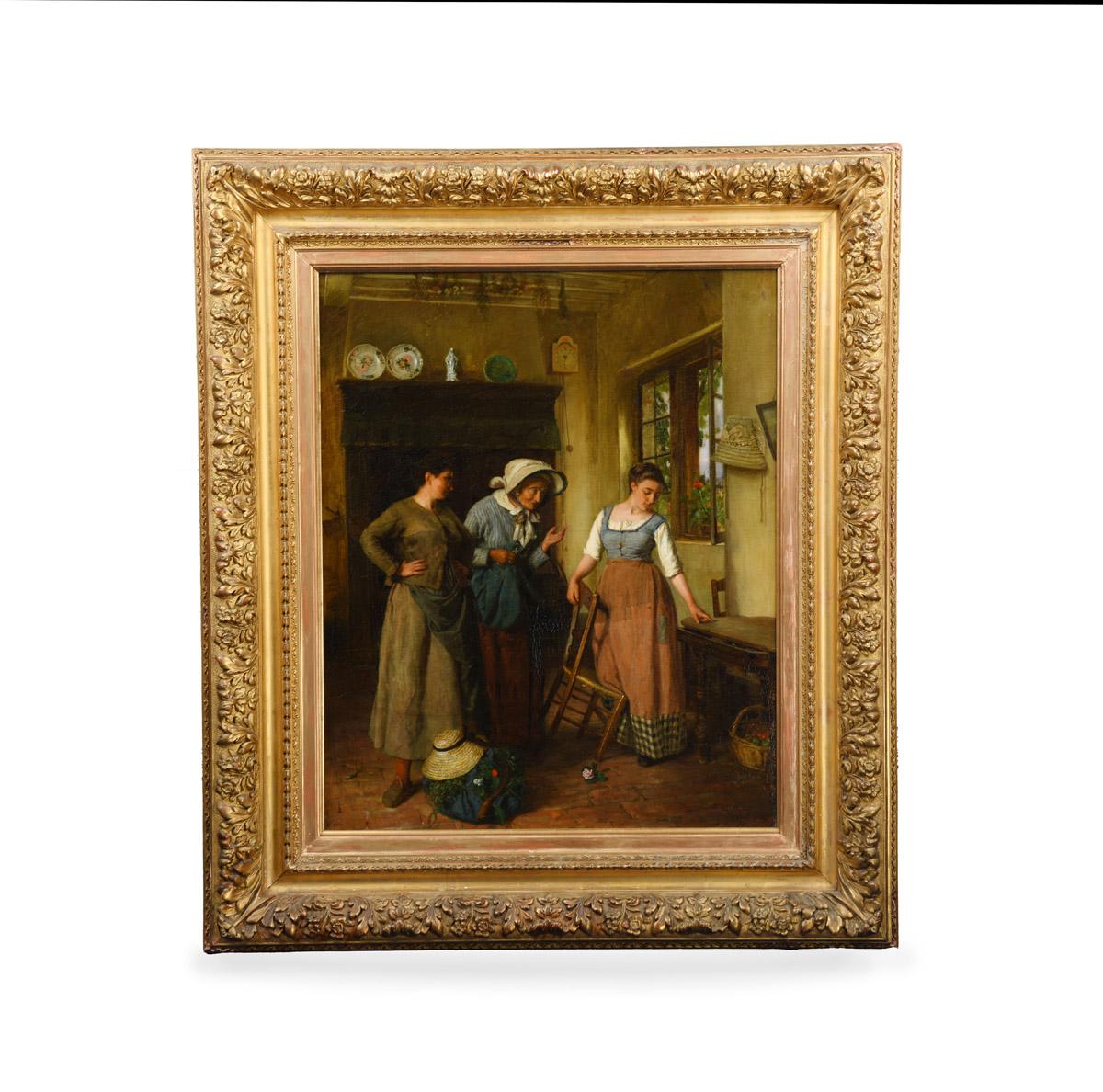
Genre Interior Scene Painted by Jules Ruinart de Brimont (1838-1898)
REF: LA537995
£3,800
€4,419
$5,023
LoveAntiques Dealersince Jan 2019Approved item573 sales by dealer
LoveAntiques Dealersince Jan 2019Approved item573 sales by dealer
Description
This fine oil on canvas shows three female generations of the same family, grandmother, mother and daughter, in the interior of a country cottage. The youngest of the three women seemingly being admonished by her grandmother for some misdemeanour or perhaps advised as to her moral conduct going forward. The girl cannot meet her grandmother’s gaze and stares down at a table, holding on to the side of a chair with one hand. The pieces of decorative art such as pieces of faience pottery and a wall clock particularly finely observed. A fine example of the work of this very talented artist whose career, as outlined below, is under-studied.
Although paintings by Ruinart have appeared on the market many times, his biography has remained elusive with only his dates of birth recorded and auction houses and dealers alike stating that his career was undocumented. Our research in the French newspaper archives has changed this. An article written shortly after the artist’s death in L’Independent Remois, 29th of November 1898, gives many details about the artist, his inspiration and his work and is reproduced below in full in English translation.
‘A Champagne Artist
Jules Ruinart de Brimont
While there are artists who desire fame and spare no effort to make themselves known, there are others whose private lives, entirely devoted to work, remain unknown to the general public and whose talent is matched by their modesty.
It is among these that we should rank our compatriot Jules Ruinart, who died last summer in his hermitage in Rilly.
Jules Ruinart de Brimont, descended from one of the oldest and finest Champagne families, was born in Coblenz in 1838 during a stay his parents made there. From early childhood, he developed a strong taste for drawing; therefore, at the age of fourteen, he entered the Antwerp Academy of Fine Arts, where he remained for two years. He then studied at the famous Dusseldorff School under Rudolph Jordan (painter of scenes depicting the lives of fishermen on the island of Markeu, in Holland) and Oswald Achenbach, whose talent is too well known and appreciated for us to discuss it.
Jules Ruinart left the Dusseldorff School after two years to try his hand at a series of genre paintings, inspired by the customs of Westphalia and the banks of the Rhine. He was then 18 years old.
He undertook the Italian voyage, dreamed of by all artists, and stayed six months in Rome, and six months in Naples and Capri.
It was then that, captivated by the beauty and marvellous light of the Italian landscapes, and feeling, in this regard, the inadequacy of his studies, Jules Ruinart had the courage to return to Dusseldorff and asked to attend the Academy’s landscape classes.
After a few months, he was granted a master studio, a secluded studio where the directors came to examine his work and offer advice. The student’s progress was so noticeable that the Academy purchased his first major painting from him for 2,000 francs (a huge sum for the time).Then the war of 1870 broke out, and Ruinart left Germany to return to France, where he settled in Rilly. Since that time, he made frequent trips to England, Holland, Belgium, Germany, Bohemia, Spain, and Italy, continually studying, painting, and drawing, drawing from everywhere the most varied subjects of moral scenes, genre scenes, and landscapes.
Jules Ruinart did not much like to be in the world, although he himself kept the best company; he preferred, in keeping with his artistic tastes, to live simply, without noise or clamour, surrounded by the landscapes and peasants who served as his models every day. It was in this environment, which was dear to him, that he ended his days, leaving in his studio an unsuspected quantity of paintings, drawings, sketches, watercolours, and sketches, many of which were by a master. The sale of all these works, we are told, will take place in the auctioneers’ room on Saturday, December 3, and the public exhibition the day before. We urge our compatriots to visit this exhibition which, better than the lines we have just written, will be able to give them an idea of the value of the artist we have lost’.
We have conducted additional research in the British Newspaper Archive and Ruinart exhibited frequently in Britain during the 1870s and 1880s though the first reference we have found comes from The Tablet, 17th of July 1869. In the article ‘Fine Arts in France’, a Ruinart work on exhibition in the Palais de Champs-Élysées is discussed by the author.
‘Jules Ruinart paints for us “Un Portrait d’une Religieuse” with the clam and happy air that one rarely sees but through a convent grille‘.
In the Birmingham Daily Gazette, 4th of September 1871, a review of the exhibition of the Royal Society of Artists’ annual exhibition includes a reference to Ruinart’s work.
‘Just below is a picture (62) by, we presume, a German artists, Jules Ruinart, of a girl with a water-can; in treatment the direct antithesis of Mr Hills-sombre in colour, carefully elaborate in finish and drawing’.
The South Wales Daily News, 18th of August 1881 carried a feature on the Cardiff Fine Art Exhibition and Ruinart’s entry was described as follows:
‘”A Funeral at Rome”, by Jules Ruinart. A very good picture’
The South Bucks Free Press, 26th of May 1882, reported on the Loan Picture Exhibition in Aid of the Wycombe Literary and Scientific Institute.
‘No. 350 (“Hastings Beach”, by Jules Ruinart), which will deserve more than a passing notice’
Finally, The Hastings and St Leonards Observer, 19th of November 1887, previewed the forthcoming exhibition of the Hastings Sketching Club. This was an exhibition of pieces largely drawn from local private collections rather than from the artists themselves and three works by Ruinart were to be on display. They were sent to the exhibition by the artist himself.
‘M. Ruinart sends “Girl with fruit”, ”A canal in Italy”, “An errand for mother” and “Neapolitan boys”, all by Jules Ruinart’
Provenance
From a private collection.
measurements
Height:
40.5 in
Width:
35 in
Depth:
3.75 in
declaration
Wick Antiques Ltd has clarified that the Genre Interior Scene Painted by Jules Ruinart de Brimont (1838-1898) (LA537995) is genuinely of the period declared with the date/period of manufacture being 1838-1898
additional info
Period:
Category:
Material:
Artisan:
Date of Manufacture:
1838-1898
location
This Genre Interior Scene Painted by Jules Ruinart de Brimont (1838-1898) is located in Hampshire, United Kingdom
Share:
Ask a question
Please note,
This dealer does not accept instant online payment for this item.
To buy this item please email the dealer using the enquiry form below.
A selection of items from Wick Antiques Ltd
Wick Antiques Ltd has 753 items available.Fine Genre Oil Painting by William Arthur Breakspeare Depicting the Fictional
£ 12,500
€14,537$16,524
Wick Antiques Ltd
Fine Farmyard Scene Sand Picture by Benjamin Zobel - Inspired by the Work of George Morland
£ 2,850
€3,314$3,768
Wick Antiques Ltd