


About Cheshire Antiques Consultant LTD®
Cheshire Antiques Consultant LTD® is an international fine art dealer and online gallery specialising in British and European paintings, sculpture and decorative arts.
Established in 2005 and led by directors Michael and Victoria, the firm brings over two decades of experience in sourcing, evaluating and placing historically significant works with private collectors, galleries, interior designers and institutions worldwide.
As elected members of the Fine Art Trade Guild, our work is grounded in connoisseurship, academic research and rigorous standards of authenticity. Every work we present is subject to careful vetting and offered with full transparency regarding condition and provenance.
Private Online Gallery
Virtual Viewings by Appointment
We operate exclusively online, offering private one-to-one virtual viewings to discuss condition, scale and provenance in detail. High-resolution images and comprehensive condition reports are available upon request, ensuring complete confidence prior to acquisition.
Areas of Specialisation
Fine Art & Works of Art (17th–21st Century)
British and European oil paintings, watercolours and mixed media
Portraiture, marine and nautical subjects
Animal, hunting and sporting scenes
Landscapes, cityscapes and genre compositions
Sculpture and three-dimensional works
Decorative Arts
Period furniture and interior pieces
Bronzes, carvings and objets d’art
Hallmarked silver, ceramics and glassware
Collectible works spanning the 18th–20th centuries
Each piece is selected with careful attention to historical context, condition and aesthetic quality, curated for both established collectors and emerging buyers.
Sustainability & Enduring Craftsmanship
We recognise the inherent sustainability of historic works of art and decorative arts. These pieces require no new materials while preserving craftsmanship, cultural heritage and artistic legacy. They integrate seamlessly into both traditional and contemporary interiors, offering individuality and permanence.
Payments & Shipping
Payments
Card payments accepted online up to £5,000
Amounts exceeding £5,000 payable by bank transfer
Proforma invoices available upon request
Shipping
UK and worldwide shipping available (quotation on request)
All items professionally packed, fully insured and shipped with tracked delivery
Customs & International Orders
All international shipments are handled on a Delivery Duty Unpaid (DDU) basis. Import duties, VAT and customs clearance are the responsibility of the buyer.
Clients within the European Union and United States are advised to consult local customs authorities regarding applicable import procedures. If a shipment is refused and returned, return shipping costs will be deducted from any refund.
Company Information
Cheshire Antiques Consultant LTD®
71–75 Shelton Street
Covent Garden
London WC2H 9JQ
United Kingdom
Registered in England & Wales
Company No. 15666518
GB VAT No. 466128775
Cheshire Antiques Consultant LTD® is a registered United Kingdom trade mark (UK00004303420).


Cheshire Antiques Consultant LTD
ID verified dealer
'%3e%3cpath fill='%23012169' d='M0 0v30h60V0z'/%3e%3cpath stroke='%23fff' stroke-width='6' d='m0 0 60 30m0-30L0 30'/%3e%3cpath stroke='%23C8102E' stroke-width='4' d='m0 0 60 30m0-30L0 30' clip-path='url(%23b)'/%3e%3cpath stroke='%23fff' stroke-width='10' d='M30 0v30M0 15h60'/%3e%3cpath stroke='%23C8102E' stroke-width='6' d='M30 0v30M0 15h60'/%3e%3c/g%3e%3c/svg%3e) Greater London, UK
Greater London, UK
Address
71-75 Shelton Street
London
Greater London
United Kingdom
WC2H 9JQ
Opening times
By appointment only
Mobile
+447494 763382
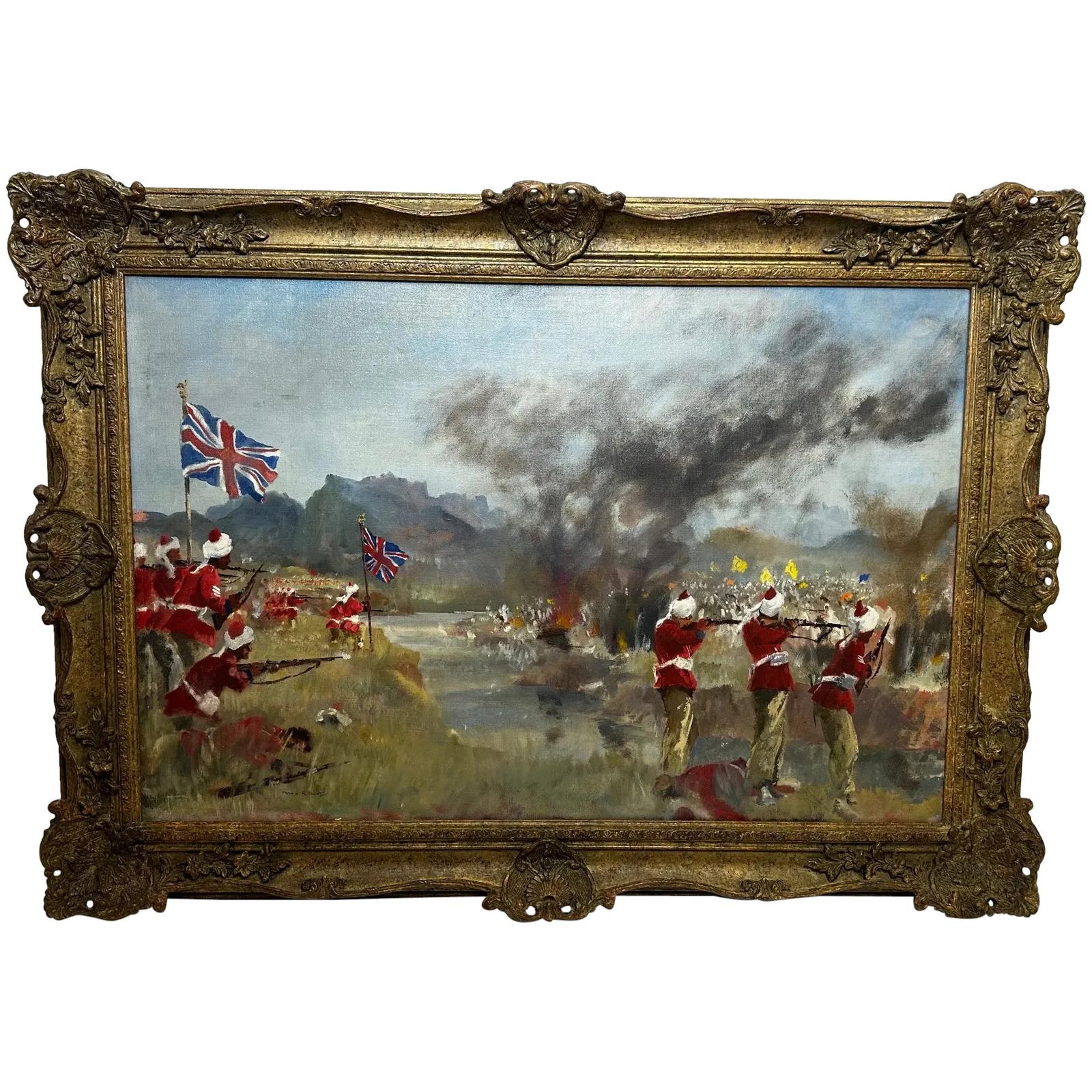
Oil Painting Military Battle Kam Dakkha 2nd Afghan War by Francis Russell Flint
REF: LA477621
£9,500
€11,053
$12,613
LoveAntiques Dealersince Mar 2017Approved item553 sales by dealerFree DeliveryAvailable for local pick-up
LoveAntiques Dealersince Mar 2017Approved item553 sales by dealerFree DeliveryAvailable for local pick-up
Description
Large fine impressionist art oil painting on canvas Military Battle Kam Dakkha 2nd Afghan War by Francis Russell Flint.
Title “Punjab Infantry Rifleman Battle Of Kam Dakka The Second Afghan War” By Francis Russell Flint 1915-1977.
Subject depicting the late 19th century British Anglo Indian military battle war against the Afghans. This is such a thrilling exciting fascinating scene the colour hues are so vibrant. Your focus is drawn to the action with smoke and fire burning on the edge of the river bank, you can witness the Anglo Punjab regiment fighting a rearguard action holding there lines fighting and shooting at the large mass of brave Afghan warrior forces who are charging on horseback towards the red coat positions, on the right flank the Anglo British forces in position & holding the Union Jack flags aloft, below a dead red coat soldier, further back with infantry lines crouching in firing line position, in the distant background views of hills and mountains, above a mix of overcast sky with blue shining through.
Signed in the bottom area by the known artist Francis Russell Flint. In our opinion this one of his finest works. Having beautiful highly detailed perspective.
Artist biography Francis Russell Flint a British artist born in the year 1915, he was the son of the known painter Sir William Russell Flint. He had his early childhood being brought up in London by his mother & father, mainly in Kensington. painted in oil & also in watercolour, he was known to have been educated at the Grosvenor School of Modern Art, Royal Academy School also having a period studying in Paris France. He also served in the merchant navy. He shown at the Royal Academy also in the Royal Watercolour Society, Royal Society of Marine Artists, Imperial War Museum and he was the official war admiralty artist in World war 2. Many of his works have been featured in Royal Academy Illustrated and in the Sketch also Tatler & in the Illustrated London News. Flint was also known to have written for the Artist and the Studio along with writing books about watercolour painting. He lived at Burgess Hill in Sussex in Southern England. He died in at the age of 62 in 1977 due to an accident whilst he was abroad. His works have sold at auctions around the world.
The Second Anglo-Afghan War was a military conflict fought between the British Raj and the Emirate of Afghanistan from 1878 to 1880, when the latter was ruled by Sher Ali Khan, Khan, Khan of the Barakzai dynasty, the son of former Emir Dost Mohammed Khan. The war was part of the Great Game between the British and Russian empires. The war was split into two campaigns – the first began in November 1878 with the British invasion of Afghanistan from India. The British were quickly victorious and forced the Amir – Sher Ali Khan to flee.
Ali's successor Mohammed Yaqub Khan immediately sued for peace and the Treaty of Gandamak was then signed on 26 May 1879. The British sent an envoy and mission led by Sir Louis Cavagnari to Kabul, but on 3 September this mission was massacred and the conflict was reignited by Ayub Khan which led to the abdication of his brother Yaqub. The second campaign ended in September 1880 when the British decisively defeated Ayub Khan outside Kandahar. Abdur Rahman Khan who had been an opponent of the British, was invited to be the new Amir and accepted. He ratified and confirmed the Gandamak treaty once more. Having created the buffer the British wanted between the Raj and the Russian Empire, British and Indian soldiers then withdrew from Afghanistan.
The Battle of Kam Dakka was fought on 22 April 1879 between British forces under Captain O’ Moore Creagh and Afghan forces, mainly Mohmand tribesmen, during the Second Anglo Afghan War. During the first phase of the Second Anglo-Afghan War, a British force under Sir Sam Browne had advanced through the Kyber pass as far as Gandamak. The task of guarding the long and exposed supply lines against attacks from local tribesmen fell to the Second Division under Sir Francis Maude. The fort at Dakka, on the Afghan side of the border, was defended by 800 men and six guns, under Lieutenant-Colonel Barnes.
As Browne's force was occupying Gandamak, rumours began to circulate of large numbers of Mohmand tribesmen preparing to attack the British lines of communication. The Khan of Kam Dakka, a village situated some seven miles from Dakka on the banks of the Kabul River, came to Barnes seeking protection from the Mohmand. Accordingly, on 21 April, the Lieutenant-colonel led a force of two guns, a squadron of the 10th Bengal Lancers, and three companies of infantry from the Mhairwarra battalio to secure the village. No Mohmands were sighted, but the villagers insisted large numbers of them were preparing to attack on the opposite bank of the river. Advised by the political officer at Maude's headquarters, Barnes agreed to send a small force to Kam Dakka, while withdrawing his main force to Dakka.
Two companies of the Mhairwarra battalion, under Captain O’Moore Creagh were dispatched from the fort on the same day, arriving at Kam Dakka shortly before midnight. To their surprise, they found that the villagers refused to let them enter, and they were forced to camp outside the village.
Early next morning, Creagh was once again denied entry, and very soon large numbers of Mohmands were observed crossing the river, whereas the villagers were becoming increasingly hostile. At 8:00 pm, Creagh's force was joined by an additional 37 men, who informed him that the route to Dakka was cut, and that no reinforcements should be expected for the rest of the day. A messenger was sent back to Dakka, warning of the imminent danger. Coming under increasing pressure, Creagh withdrew his force to a nearby cemetery, located between the Dakka road and the river, where his men constructed a breastwork of stones.
As soon as they had finished, the Afghans launched their attack. Surrounding the small force, they used crops and other cover to advance, and engaged them in hand to hand combat using knives and swords, while the Mhairwarras defended themselves with their rifles and bayonets. While they were able to hold their position, Creagh's force were in danger of annihilation, and gradually ran short of ammunition.
Meanwhile, General Maude, suspicious of his political officer's views, had dispatched various forces to support Creagh. It was however from Dakka, where the messenger had arrived safely, that help arrived. Two companies of infantry, also from the Mhairwarra battalion, and a squadron of cavalry from the 10th Bengal Lancers, under Captain D.M. Strong, arrived on the scene at 3:00 pm. Leaving one company to guard the pass through which he had passed, Strong led the other in a charge that managed to break through to Creagh's force. When the Bengal lancers joined the battle, Strong led them in an attack, supported by Creagh's men, that dispersed the Afghan force.
As the British forces began to withdraw, the Mohmands regrouped and once again moved to attack. They were thwarted by the arrival of Major Dyce, with a company of the 12th Foot and two guns, whose fire forced them to disperse again. The British were then able to leave the scene, slowed down by their wounded and harassed by the tribesmen. The next day, a strong British force of cavalry, infantry and artillery returned to Kam Dakka. Some tribesmen were shelled from a distance, but no resistance was encountered. Captain O’Moore Creagh was awarded the Victoria Cross for his role in the battle.
Provenance label verso from a private collection & now in the collection of Cheshire Antiques Consultant.
Sources Artists in Britain Since 1945 by David Buckman (Art Dictionaries Ltd, part of Sansom & Company) Wiki & Wikitree.
Set in a fine gilt frame with hanging thread on the back ready for immediate home display. Incredible conversation piece for your guests. A superb collectors item.
We only select & sell paintings based upon subject, quality & significance. We provide our clients with friendly professional customer service. Viewings are welcome by appointment only for customer support please send a message thank you. Checkout our exciting other Fine Arts, antiques & collectibles available in our shop gallery.
measurements
Height:
66 cm
Width:
91 cm
Depth:
6 cm
declaration
Cheshire Antiques Consultant LTD has clarified that the Oil Painting Military Battle Kam Dakkha 2nd Afghan War by Francis Russell Flint (LA477621) is genuinely of the period declared with the date/period of manufacture being c.1950
condition
Offered in fine used condition. The front painting surface is in good overall order with foxing staining, craquelure in areas in places. The frame having various signs of wear, scuffs, scratches, stains, dust, losses in places and repairs also some cracking, commensurate with usage & old age.
additional info
Category:
Material:
Origin:
Date of Manufacture:
c.1950
location
This Oil Painting Military Battle Kam Dakkha 2nd Afghan War by Francis Russell Flint is located in Greater London, United Kingdom
Share:
Ask a question
Please note,
This dealer does not accept instant online payment for this item.
To buy this item please email the dealer using the enquiry form below.
A selection of items from Cheshire Antiques Consultant LTD
Cheshire Antiques Consultant LTD has 341 items available.Huge Military WW1 Cavalry Battle Oil Painting After The Charge by Edith Alice Simkins
£ 9,000
€10,471$11,949
Cheshire Antiques Consultant LTD
Scottish Angling Oil Painting of Brown Trout from Culroy Burn by James B. Russell
£ 2,950
€3,432$3,917
Cheshire Antiques Consultant LTD
Oil Painting Civil War Royalist Pursued by Roundheads Escape From Worcester 1651 by George Derville Rowlandson
£ 8,000
€9,308$10,621
Cheshire Antiques Consultant LTD
19th Century Oil Painting Battle - The Wounded Greek Attributed Abraham Cooper RA
£ 20,000
€23,269$26,553
Cheshire Antiques Consultant LTD