


About Cheshire Antiques Consultant LTD®
Cheshire Antiques Consultant LTD® is an international fine art dealer and online gallery specialising in British and European paintings, sculpture and decorative arts.
Established in 2005 and led by directors Michael and Victoria, the firm brings over two decades of experience in sourcing, evaluating and placing historically significant works with private collectors, galleries, interior designers and institutions worldwide.
As elected members of the Fine Art Trade Guild, our work is grounded in connoisseurship, academic research and rigorous standards of authenticity. Every work we present is subject to careful vetting and offered with full transparency regarding condition and provenance.
Private Online Gallery
Virtual Viewings by Appointment
We operate exclusively online, offering private one-to-one virtual viewings to discuss condition, scale and provenance in detail. High-resolution images and comprehensive condition reports are available upon request, ensuring complete confidence prior to acquisition.
Areas of Specialisation
Fine Art & Works of Art (17th–21st Century)
British and European oil paintings, watercolours and mixed media
Portraiture, marine and nautical subjects
Animal, hunting and sporting scenes
Landscapes, cityscapes and genre compositions
Sculpture and three-dimensional works
Decorative Arts
Period furniture and interior pieces
Bronzes, carvings and objets d’art
Hallmarked silver, ceramics and glassware
Collectible works spanning the 18th–20th centuries
Each piece is selected with careful attention to historical context, condition and aesthetic quality, curated for both established collectors and emerging buyers.
Sustainability & Enduring Craftsmanship
We recognise the inherent sustainability of historic works of art and decorative arts. These pieces require no new materials while preserving craftsmanship, cultural heritage and artistic legacy. They integrate seamlessly into both traditional and contemporary interiors, offering individuality and permanence.
Payments & Shipping
Payments
Card payments accepted online up to £5,000
Amounts exceeding £5,000 payable by bank transfer
Proforma invoices available upon request
Shipping
UK and worldwide shipping available (quotation on request)
All items professionally packed, fully insured and shipped with tracked delivery
Customs & International Orders
All international shipments are handled on a Delivery Duty Unpaid (DDU) basis. Import duties, VAT and customs clearance are the responsibility of the buyer.
Clients within the European Union and United States are advised to consult local customs authorities regarding applicable import procedures. If a shipment is refused and returned, return shipping costs will be deducted from any refund.
Company Information
Cheshire Antiques Consultant LTD®
71–75 Shelton Street
Covent Garden
London WC2H 9JQ
United Kingdom
Registered in England & Wales
Company No. 15666518
GB VAT No. 466128775
Cheshire Antiques Consultant LTD® is a registered United Kingdom trade mark (UK00004303420).


Cheshire Antiques Consultant LTD
ID verified dealer
'%3e%3cpath fill='%23012169' d='M0 0v30h60V0z'/%3e%3cpath stroke='%23fff' stroke-width='6' d='m0 0 60 30m0-30L0 30'/%3e%3cpath stroke='%23C8102E' stroke-width='4' d='m0 0 60 30m0-30L0 30' clip-path='url(%23b)'/%3e%3cpath stroke='%23fff' stroke-width='10' d='M30 0v30M0 15h60'/%3e%3cpath stroke='%23C8102E' stroke-width='6' d='M30 0v30M0 15h60'/%3e%3c/g%3e%3c/svg%3e) Greater London, UK
Greater London, UK
Address
71-75 Shelton Street
London
Greater London
United Kingdom
WC2H 9JQ
Opening times
By appointment only
Mobile
+447494 763382
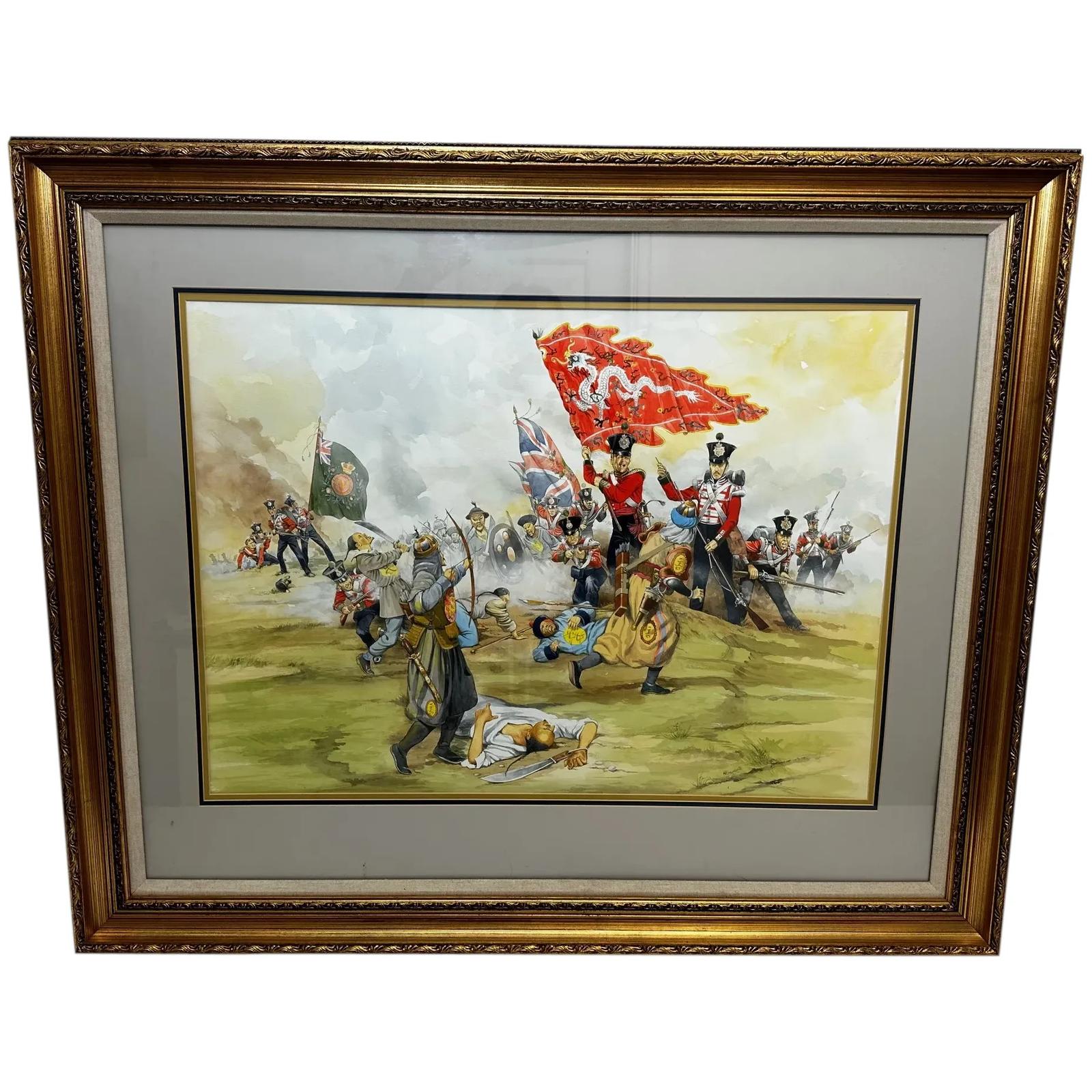
Large Painting Battle Chusan Opium Wars 55th Westmorland Assaulting Guards Hill
REF: LA473862
£5,000
€5,817
$6,638
Secure Payments By
LoveAntiques Dealersince Mar 2017Approved item553 sales by dealerAvailable for local pick-up
LoveAntiques Dealersince Mar 2017Approved item553 sales by dealerAvailable for local pick-up
Description
Large fine Military art painting of Battle of Chusan Opium Wars Westmorland Regiment Assaulting Guards Hill.
Title “55th Westmorland Regiment of Foot Capture Chusan Assaulting Enemy Strongpoint Guards Hill, First Opium Wars 1841” By the artist Malcolm Greensmith".
Subject depicting the mid 19th century British - Chinese military battle during the first Opium Wars the capture of Chusan which is now known as Zhoushan which is an archipelago-city in Zhejiang, China. Your focus is drawn to the British army 55th Westmorland regiment red coats who are charging assaulting the Chinese strongpoint of Guards Hill, the Westmoreland regiment have just taken & now occupy the high ground on the hill & are holding & firing muskets with smoke all around from the fire, they are raising the Union Jack & captured Dragon flag, you can see Chinese archers firing bow and arrows at the British positions & others holding Chinese soldiers running. With wounded and dead Chinese soldiers on the ground. on the left flank a Red coat is holding the 55th Westmoreland regiment glag colours. Such a thrilling exciting scene the colour hues are so vibrant.
Signed in the bottom corner by the known military artist Malcolm Greensmith. In our opinion this is the finest example of his work. Medium watercolour on card with a front heavy glass cover. Having beautiful highly detailed perspective. Set in a fine gilt frame, with hanging thread on the back ready for immediate home display.
Artist biography Malcolm Greensmith is a postwar & contemporary artist. A renowned British military artist, Malcolm born near the Isle of Ely which is a historic region in Cambridgeshire during the 20th century, his career has spanned over 60 years in total, he grew a deep passion for nature when he was a young child. His dad worked with country Shire horses also rural crafts.
His father encouraged Malcolm to study and paint wildlife also pastoral scenes. The young artist grew and expanded his skills when he attended Wisbech Grammar School also Kibworth Beauchamp in Leicestershire. He finished his education in Fine Arts at the Leicester College of Art.
Malcolm also adored ornithology works of Charles Tunnicliffe, along with Rowland Hilder a landscape artist and Norman Rockell a figurative artist along with James Bama he also very much admired. He developed his own unique style and specialised in Military paintings.
Malcolm is known for his fine prints in the United Kingdom & around Europe also the USA. His artworks have also been placed onto Royal Doulton collectors plates, his designs lead the latest trends and fashion tastes of the time, he created a large portfolio of his works, he has also been asked to design stamps for the Royal Mail. In 2009 he was commissioned to paint a scene to capture the Olympic & Paralympic Games, the painting was called Celebrating Sport which you can find on the 2nd page position located in Malcolm’s gallery. His paintings are highly sought after due to the collectible nature of his subject matter and his wonderful detail.
The Opium Wars conflicts waged between China & Western powers during the mid-19th century. The First Opium War was fought from 1839 to 1842 between China and Britain. It was triggered by the Chinese government’s campaign to enforce its prohibition of opium, which included destroying opium stocks owned by British merchants and the British East India Company. The British government responded by sending a naval expedition to force the Chinese government to pay reparations and allow the opium trade.
The superior military advantages enjoyed by European forces led to several easy victories over the Chinese military, with the consequence that China was compelled to sign the unequal treaties to grant favourable tariffs, trade concessions, reparations and territory to Western powers. The conflicts, along with the various treaties imposed during the "century of humiliation” weakened the Chinese government's authority and forced China to open specified treaty ports including Shanghai to Western merchants. In addition, China ceded sovereignty over Hong Kong to the British Empire, which maintained control over the region until 1997. During this period, the Chinese economy also contracted slightly as a result of the wars, though the Taiping Rebellion and Dungan Revolt had a much larger economic effect.
The First Opium War broke out in 1839 between China and Britain it was fought over trading rights (including the right of free trade and Britain's diplomatic status among Chinese officials. In the eighteenth century, China enjoyed a trade surplus with Europe, trading porcelain silk, and tea in exchange for silver. By the late 17th century, the British East India Company (Eic) expanded the cultivation of opium in the Bengal Presidency, selling it to private merchants who transported it to China and covertly sold it on to Chinese smugglers.
By 1797, the Eic was selling 4,000 chests of opium (each weighing 77 kg) to private merchants per annum. By 1833, the Chinese opium trade soared to 30,000 chests. British and American merchants sent opium to warehouses in the free-trade port of Canto, and sold it to Chinese smugglers. In 1834, the Eic's monopoly on British trade with China ceased, and the opium trade burgeoned. Partly concerned with moral issues over the consumption of opium and partly with the outflow of silver, the Daoguang Emperor charged Governor General Lin Zexu with ending the trade. In 1839, Lin published in Canton an open letter to Queen Victoria requesting her cooperation in halting the opium trade. The letter never reached the Queen. It was later published in The Times as a direct appeal to the British public for their cooperation.
An edict from the Daoguang Emperor followed on 18 March, emphasising the serious penalties for opium smuggling that would now apply henceforth. Lin ordered the seizure of all opium in Canton, including that held by foreign governments and trading companies (called factories), and the companies prepared to hand over a token amount to placate him. Charles Elliot who was Chief Superintendent of British Trade in China, arrived 3 days after the expiry of Lin's deadline, as Chinese troops enforced a shutdown and blockade of the factories. The standoff ended after Elliot paid for all the opium on credit from the British government (despite lacking official authority to make the purchase) and handed the 20,000 chests (1,300 metric tons) over to Lin, who had them destroyed at Humen.
Elliott then wrote to London advising the use of military force to resolve the dispute with the Chinese government. A small skirmish occurred between British and Chinese warships in the Kowloon Estuary on 4 September 1839. After almost a year, the British government decided, in May 1840, to send a military expedition to impose reparations for the financial losses experienced by opium traders in Canton and to guarantee future security for the trade. On 21 June 1840, a British naval force arrived off Maca and moved to bombard the port of Dinghai In the ensuing conflict, the Royal Navy used its superior ships and guns to inflict a series of decisive defeats on Chinese forces.
The war was concluded by the Treaty Of Nankin (Nanjing) in 1842, the first of the unequal treaties between China and Western powers. The treaty ceded the Hong Kong Island and surrounding smaller islands to Britain, and established five cities as treaty port open to Western traders: Shanghai, Canton, Ningbo, Fuzhou, and Xiamen (Amoy).The treaty also stipulated that China would pay a twenty-one million dollar payment to Britain as reparations for the destroyed opium, with six million to be paid immediately, and the rest through specified instalments thereafter. Another treaty the following year gave most favoured nation status to Britain and added provisions for British extraterritoriality, making Britain exempt from Chinese law. France secured several of the same concessions from China in the Treaty of Whampoa in 1844.
The 55th Regiment of Foot was a British Army infant regiment raised in 1755. After 1782 it had a country designation added, becoming known as the 55th (Westmorland) Regiment of Foot. Under the Childers Reforms it amalgamated with the 34th Cumberland Regiment of Foot to form the Border Regiment in 1881.
In 1841 the regiment was deployed to China for service in the First Opium War. It was selected as part of the expeditionary force that moved north from Hong Kong and participated in the Battle of Amoy in August 1841. The regiment was the first to land when British forces disembarked from boats at the Capture of Chusan in October 1841. It landed on a beach and then assaulted an enemy strong point called Guards Hill, where it ascended under heavy fire but eventually took the hill. It then proceeded to take the heights overlooking Tinghai and then immediately descended and placed its regimental colours on the walls of the city.
After the battle, a detachment of the 55th and 18th Regiment of Foot were left to garrison the city. On 10 October 1841 the 55th again was part of the force that engaged Qing troops at the Battle of Chinhai: the regiment was left to garrison the city after the battle and remained there for the remainder of the year. In 1842, the regiment saw action at Chapu in May, and Chinkiang in July. It then garrisoned Chinkiang until the Treat of Nanking was signed. Part of the regiment remained in Hong Kong after the war. For its service during the war it was allowed the addition of a dragon badge superscribed "China" on its regimental colour.
Incredible conversation piece for your guests. A superb collectors item. Provenance labels verso Exhibited in Cyprus presentation piece Exp 220, commissioned for the Barracks, Famous Lord Hill Museum & in the collection of Cheshire Antiques Consultant.
We only select & sell paintings based upon subject, quality & significance. We provide our clients with friendly professional customer service.
Viewings are welcome by appointment only for customer support please send a message thank you. Checkout our exciting other Fine Arts, antiques & collectibles available in our shop gallery.
measurements
Height:
95.5 cm
Width:
115 cm
Depth:
4.5 cm
declaration
Cheshire Antiques Consultant LTD has clarified that the Large Painting Battle Chusan Opium Wars 55th Westmorland Assaulting Guards Hill (LA473862) is genuinely of the period declared with the date/period of manufacture being Late 20th century
condition
Offered in fine used condition. The front painting surface is in good overall order with foxing staining in areas. The frame having various signs of wear, scuffs, scratches, stains, losses in places commensurate with usage & age.
additional info
Category:
Material:
Origin:
Date of Manufacture:
Late 20th century
location
This Large Painting Battle Chusan Opium Wars 55th Westmorland Assaulting Guards Hill is located in Greater London, United Kingdom
Share:
Ask a question
Please note,
This dealer does not accept instant online payment for this item.
To buy this item please email the dealer using the enquiry form below.
A selection of items from Cheshire Antiques Consultant LTD
Cheshire Antiques Consultant LTD has 341 items available.Australian Watercolour Group 3 Kookaburras Bird in Bush Outback Signed Robin Hill
£ 8,000
€9,308$10,621
Cheshire Antiques Consultant LTD
Historic HMS London First World War Watercolour by Frank Watson Wood
£ 8,500
€9,889$11,285
Cheshire Antiques Consultant LTD
Large Painting High Tide off Trebarwith Strand” Dramatic Cornish Shipwreck Masterpiece by Charles Sim Mottram RBA, 1894
£ 10,000
€11,635$13,276
Cheshire Antiques Consultant LTD
Oil Painting Battle of Britain WW2 RAF Pilots Ready for Takeoff Biggin Hill Airfield
£ 19,500
€22,688$25,889
Cheshire Antiques Consultant LTD