


About Cheshire Antiques Consultant LTD®
Cheshire Antiques Consultant LTD® is an international fine art dealer and online gallery specialising in British and European paintings, sculpture and decorative arts.
Established in 2005 and led by directors Michael and Victoria, the firm brings over two decades of experience in sourcing, evaluating and placing historically significant works with private collectors, galleries, interior designers and institutions worldwide.
As elected members of the Fine Art Trade Guild, our work is grounded in connoisseurship, academic research and rigorous standards of authenticity. Every work we present is subject to careful vetting and offered with full transparency regarding condition and provenance.
Private Online Gallery
Virtual Viewings by Appointment
We operate exclusively online, offering private one-to-one virtual viewings to discuss condition, scale and provenance in detail. High-resolution images and comprehensive condition reports are available upon request, ensuring complete confidence prior to acquisition.
Areas of Specialisation
Fine Art & Works of Art (17th–21st Century)
British and European oil paintings, watercolours and mixed media
Portraiture, marine and nautical subjects
Animal, hunting and sporting scenes
Landscapes, cityscapes and genre compositions
Sculpture and three-dimensional works
Decorative Arts
Period furniture and interior pieces
Bronzes, carvings and objets d’art
Hallmarked silver, ceramics and glassware
Collectible works spanning the 18th–20th centuries
Each piece is selected with careful attention to historical context, condition and aesthetic quality, curated for both established collectors and emerging buyers.
Sustainability & Enduring Craftsmanship
We recognise the inherent sustainability of historic works of art and decorative arts. These pieces require no new materials while preserving craftsmanship, cultural heritage and artistic legacy. They integrate seamlessly into both traditional and contemporary interiors, offering individuality and permanence.
Payments & Shipping
Payments
Card payments accepted online up to £5,000
Amounts exceeding £5,000 payable by bank transfer
Proforma invoices available upon request
Shipping
UK and worldwide shipping available (quotation on request)
All items professionally packed, fully insured and shipped with tracked delivery
Customs & International Orders
All international shipments are handled on a Delivery Duty Unpaid (DDU) basis. Import duties, VAT and customs clearance are the responsibility of the buyer.
Clients within the European Union and United States are advised to consult local customs authorities regarding applicable import procedures. If a shipment is refused and returned, return shipping costs will be deducted from any refund.
Company Information
Cheshire Antiques Consultant LTD®
71–75 Shelton Street
Covent Garden
London WC2H 9JQ
United Kingdom
Registered in England & Wales
Company No. 15666518
GB VAT No. 466128775
Cheshire Antiques Consultant LTD® is a registered United Kingdom trade mark (UK00004303420).


Cheshire Antiques Consultant LTD
ID verified dealer
'%3e%3cpath fill='%23012169' d='M0 0v30h60V0z'/%3e%3cpath stroke='%23fff' stroke-width='6' d='m0 0 60 30m0-30L0 30'/%3e%3cpath stroke='%23C8102E' stroke-width='4' d='m0 0 60 30m0-30L0 30' clip-path='url(%23b)'/%3e%3cpath stroke='%23fff' stroke-width='10' d='M30 0v30M0 15h60'/%3e%3cpath stroke='%23C8102E' stroke-width='6' d='M30 0v30M0 15h60'/%3e%3c/g%3e%3c/svg%3e) Greater London, UK
Greater London, UK
Address
71-75 Shelton Street
London
Greater London
United Kingdom
WC2H 9JQ
Opening times
By appointment only
Mobile
+447494 763382
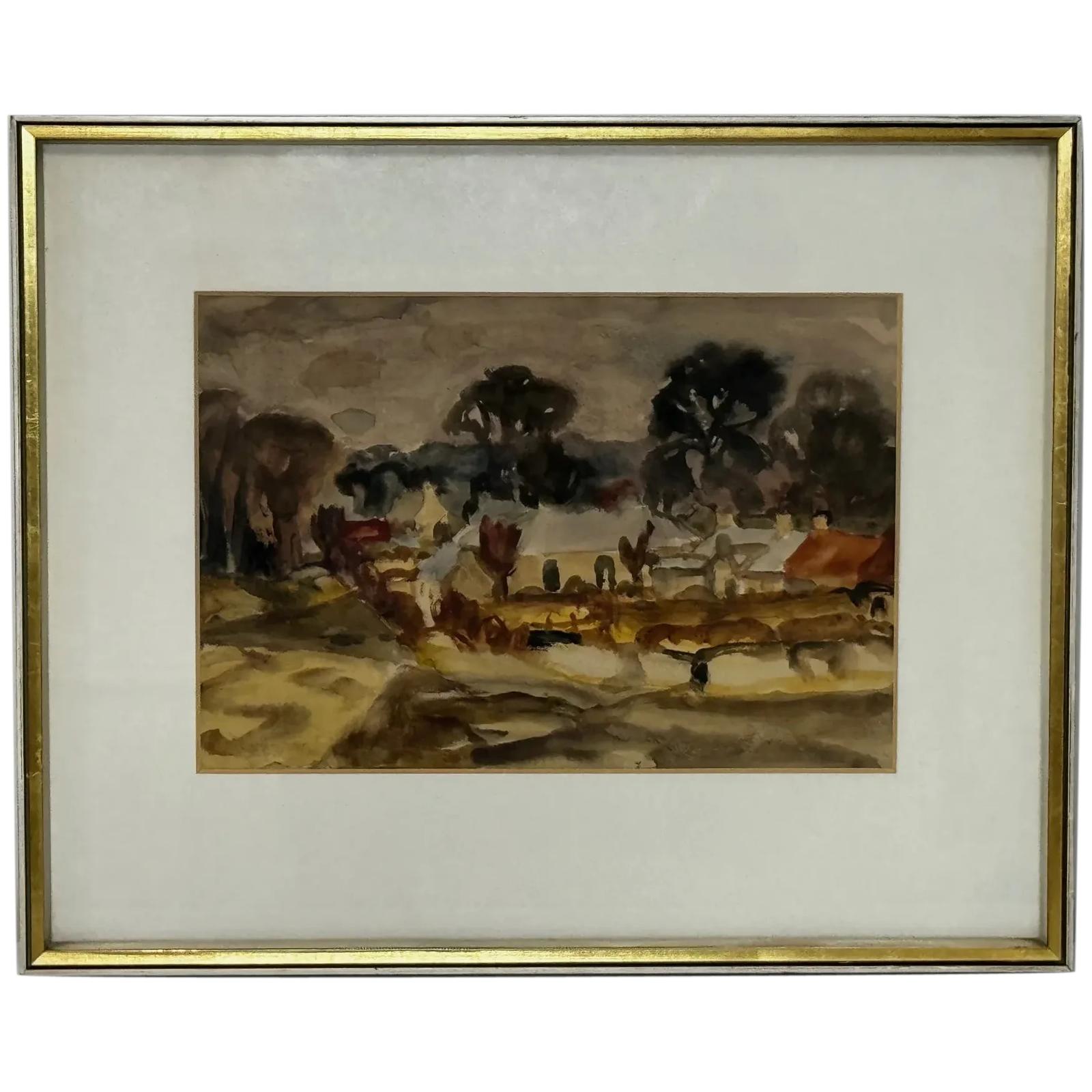
Mid Century Watercolour Historic Midlothian Temple Village by Sir William George Gillies
REF: LA503531
£11,500
€13,374
$15,203
LoveAntiques Dealersince Mar 2017Approved item553 sales by dealerFree Delivery
LoveAntiques Dealersince Mar 2017Approved item553 sales by dealerFree Delivery
Description
Mid Century Scottish Watercolpir Painting Historic Midlothian Parish Village Temple Village Autumn by Sir William George Gillies CBE LLD RSA PPRSW RA.
Add this landscape masterpiece to your home or office collection & really impress your guests & clients.
Title: “Temple Village, Autumn” by Sir William George Gillies CBE LLD RSA PPRSW RA.
Subject: landscape view of the historic known village of Temple in Midlothian in Scotland set during autumn, showing the artist's country cottage home in the village along with other buildings homes and tall trees by Temple Church in the background. His distinct use of various dark and light hue colours browns, maroon, yellow. gray, white which stand out.
Circa mid 20th century 1960s.
Medium is watercolour on paper backed with board, with a front protective glass over.
Set in the original mid century frame.
Signed W. Gillies in the lower bottom corner by the known artist Sir William George Gillies CBE LLD RSA PPRSW RA.
Inscribed & numbered by the artist verso G1327.
A nice easy to display size with the frame being 54.5 cm wide and 44.5 cm high.
Artist Biography:- Sir William George Gillies CBE RA (21 September 1898 – 15 April 1973) was a renowned Scottish landscape and still life painter. He is often referred to simply as W. G. Gillies. His works have been sold in auction houses like Sotherby’s, Christie’s also Bonhams around the world and exhibited in galleries like National Galleries of Scotland, Royal Scottish Academy & The Scottish Gallery. The highest sold price is $47,755 US Dollars. Gillies was born in Haddington, East Lothian. He had just enrolled at the Edinburgh College of Art, when he was called up for service in World War I with the Royal Engineers.
After the War, he returned to the College, and after graduation taught there for over 40 years with other notable Scottish artists including Adam Bruce Thomson. He was Principal of the College from 1959 until his retirement in 1966. In 1922 along with nine fellow students, including William Crozier, William Geissler and William MacTaggart, he founded the 1922 Group, an exhibition society which promoted their works at the New Gallery in Edinburgh for the next ten years. Assisted by a travelling scholarship, Gillies studied under André Lhote in Paris in 1923 and he went on to visit Italy in 1924.
For a brief period after these experiences he worked in a cubist manner, but would later revert to a more traditional style. His cubist influenced works are typified by the 1933 still life, Two Pots, Saucer and Fruit. The arrangement of the objects, which are close together on a tilted table top, are influenced by Cézanne, whereas the understated colours and textures are reminiscent of Braque and Picasso. In 1934 Gillies attended an exhibition of Paul Klee's work and was impressed by the childlike qualities and imaginative use of colour that he saw. Klee's influence is clear in Gillies' 1934 work, The Harbour, which depicts the harbour at Anstruther.
Gillies has created a grid-like composition, using bold blocks of contrasting colour emphasising the vertical lines of the buildings and the ships masts. This is balanced by the use of rippling horizontal brushstrokes. Although he experimented with portraiture in his early career, Gillies concentrated principally on landscapes and still lifes, frequently depicting the Lothian, Fife and Border regions. Several of his works feature ceramics created by his younger sister, the potter Emma Smith Gillies, who died prematurely in 1936. Both in his prolific output over the course of his career, and in his 40 years of teaching, Gillies influence on Scottish painting of the twentieth century has been profound. He died in his home village in Temple Scotland in 1973.
Temple (Scottish Gaelic: Baile nan Trodach) is a village and civil parish in Midlothian, Scotland. Situated to the south of Edinburgh, the village lies on the east bank of the river South Esk. The name "Temple" refers to its historical connection to the Knights Templar. In 1237, the town name was recorded as "Ballentrodoch", from the Scottish Gaelic Baile nan Trodach, which means "town of the warriors", again a reference to the Knights Templar. Historically the Parish of Temple was divided into three portions, the ancient parish of Clerkington, and the chapelries of Moorfoot and Balantrodach. Clerkington was a parsonage held by the monks of Newbattle Abbey, Moorfoot was a chapelry founded by monks from the same institution.
Balantrodach on the other hand, was a chapelry of the Knights Templar. Temple Church Temple Midlothian In 1128, Hugues de Payens, the first Grand Master, met with David I in Scotland and was granted the lands of Balantrodach. In 1128, the Council of Troyes formally recognised the Order.
Balantrodach became their principal Templar seat and preceptoryin Scotland until the suppression of the order between 1307 and 1312. As Temple, being just to the south of the Firth of Forth, was an area of the country occupied by England at this time, knights were prosecuted, but not all were found guilty.
Nearby to the north, politics was even more on their side – Robert the Bruce had been excommunicated, and so was not required to follow papal commands, and at war with England, it has been suggested that he may have been welcoming to powerful and desperate allies. Following 1312 and the Papal bull (edict) entitled Ad providam, King Edward II of England abolished the Templars in both England and Scotland. According to the edict, all Knight Templar property was to be seized and handed over to the control of the Knights Hospitaller, who had a preceptory at Torphichen in West Lothian. Although he was located in Scotia, north of the Firth of Forth, Robert the Bruce, being under interdictat the time, was reluctant to do so.
Legend has it that treasure of the Knights Templar was removed secretly from Paris, to be hidden in Temple. A local legend states: 'Twixt the oak and the elm tree/You will find buried the millions free.' French legends about the Templar treasure apparently also state that the treasure was taken to Scotland, with the knights landing on the Isle of May, the first island they would encounter in the Firth of Forth. Geographically, this would take them to the mouth of the river Esk, which could take them on to Rosslyn.
Sources:- A Chasm in Time - Scottish War Art and Artists in the Twentieth Century, by Patricia R. Andrew, Birlinn Ltd., 2014. Isbn 978-1780271903. "1922 Group". Retrieved 16 January 2015. The 1922 Group, Seventh Exhibition, New Gallery, Shandwick Place (Closing Day 10 May 1929). Members: Arthur V. Couling, William Crozier, A.R.S.A, William Gillies, William Geissler, David W. Gunn, C. Wright Hall, William MacTaggart, John Maxwell, William G. Scoular, George C. Watson. Orton-Hatzis, Anna (May 2015). "Emma Gillies: Rediscovered". Scottish Pottery Society Annual Review.
Provenance:- Aitken Dott & Son (The Scottish Gallery) 26 Castle Street Edinburgh, in collection of Cheshire Antiques Consultant Ltd.
Highly sought after due to the collectible nature of the landscape subject matter.
With hanging thread on the back ready for immediate home wall display.
We only select & sell paintings based upon subject, quality & significance.
We provide our clients with friendly professional customer service.
Viewings are welcome by appointment only for customer support please send a message thankyou.
Checkout our exciting other available Fine Arts, antiques & collectibles in our shop gallery.
measurements
Height:
44.5 cm
Width:
54.5 cm
Depth:
3 cm
declaration
Cheshire Antiques Consultant LTD has clarified that the Mid Century Watercolour Historic Midlothian Temple Village by Sir William George Gillies (LA503531) is genuinely of the period declared with the date/period of manufacture being c.1960s
condition
Offered in fine used condition. Front painting surface is in good overall order. Having some foxing staining, craquelure in areas. The frame which has general wear, scuffs, scratches, some losses commensurate with usage & age.
additional info
Material:
Date of Manufacture:
c.1960s
location
This Mid Century Watercolour Historic Midlothian Temple Village by Sir William George Gillies is located in Greater London, United Kingdom
Share:
Ask a question
Please note,
This dealer does not accept instant online payment for this item.
To buy this item please email the dealer using the enquiry form below.
A selection of items from Cheshire Antiques Consultant LTD
Cheshire Antiques Consultant LTD has 340 items available.Historic HMS London First World War Watercolour by Frank Watson Wood
£ 8,500
€9,885$11,237
Cheshire Antiques Consultant LTD
Mid-20th Century Watercolour Portrait of Franklin D. Roosevelt
£ 6,000
€6,978$7,932
Cheshire Antiques Consultant LTD
Early 20th Century Watercolour Coastal Babbacombe Beach Devon by Samuel Edward Kelly
£ 4,000
€4,652$5,288
Cheshire Antiques Consultant LTD
Scottish Watercolour Redwing Bird Signed by Ralston Gudgeon
£ 800
€930$1,058
Cheshire Antiques Consultant LTD