


About Cheshire Antiques Consultant LTD®
Cheshire Antiques Consultant LTD® is an international fine art dealer and online gallery specialising in British and European paintings, sculpture and decorative arts.
Established in 2005 and led by directors Michael and Victoria, the firm brings over two decades of experience in sourcing, evaluating and placing historically significant works with private collectors, galleries, interior designers and institutions worldwide.
As elected members of the Fine Art Trade Guild, our work is grounded in connoisseurship, academic research and rigorous standards of authenticity. Every work we present is subject to careful vetting and offered with full transparency regarding condition and provenance.
Private Online Gallery
Virtual Viewings by Appointment
We operate exclusively online, offering private one-to-one virtual viewings to discuss condition, scale and provenance in detail. High-resolution images and comprehensive condition reports are available upon request, ensuring complete confidence prior to acquisition.
Areas of Specialisation
Fine Art & Works of Art (17th–21st Century)
British and European oil paintings, watercolours and mixed media
Portraiture, marine and nautical subjects
Animal, hunting and sporting scenes
Landscapes, cityscapes and genre compositions
Sculpture and three-dimensional works
Decorative Arts
Period furniture and interior pieces
Bronzes, carvings and objets d’art
Hallmarked silver, ceramics and glassware
Collectible works spanning the 18th–20th centuries
Each piece is selected with careful attention to historical context, condition and aesthetic quality, curated for both established collectors and emerging buyers.
Sustainability & Enduring Craftsmanship
We recognise the inherent sustainability of historic works of art and decorative arts. These pieces require no new materials while preserving craftsmanship, cultural heritage and artistic legacy. They integrate seamlessly into both traditional and contemporary interiors, offering individuality and permanence.
Payments & Shipping
Payments
Card payments accepted online up to £5,000
Amounts exceeding £5,000 payable by bank transfer
Proforma invoices available upon request
Shipping
UK and worldwide shipping available (quotation on request)
All items professionally packed, fully insured and shipped with tracked delivery
Customs & International Orders
All international shipments are handled on a Delivery Duty Unpaid (DDU) basis. Import duties, VAT and customs clearance are the responsibility of the buyer.
Clients within the European Union and United States are advised to consult local customs authorities regarding applicable import procedures. If a shipment is refused and returned, return shipping costs will be deducted from any refund.
Company Information
Cheshire Antiques Consultant LTD®
71–75 Shelton Street
Covent Garden
London WC2H 9JQ
United Kingdom
Registered in England & Wales
Company No. 15666518
GB VAT No. 466128775
Cheshire Antiques Consultant LTD® is a registered United Kingdom trade mark (UK00004303420).
Cheshire Antiques Consultant LTD
ID verified dealer
'%3e%3cpath fill='%23012169' d='M0 0v30h60V0z'/%3e%3cpath stroke='%23fff' stroke-width='6' d='m0 0 60 30m0-30L0 30'/%3e%3cpath stroke='%23C8102E' stroke-width='4' d='m0 0 60 30m0-30L0 30' clip-path='url(%23b)'/%3e%3cpath stroke='%23fff' stroke-width='10' d='M30 0v30M0 15h60'/%3e%3cpath stroke='%23C8102E' stroke-width='6' d='M30 0v30M0 15h60'/%3e%3c/g%3e%3c/svg%3e) Greater London, UK
Greater London, UK
Address
71-75 Shelton Street
London
Greater London
United Kingdom
WC2H 9JQ
Opening times
By appointment only
Mobile
+447494 763382
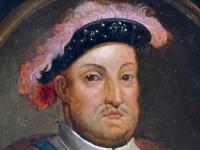
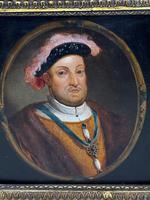
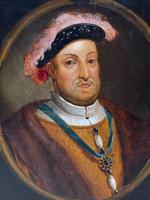
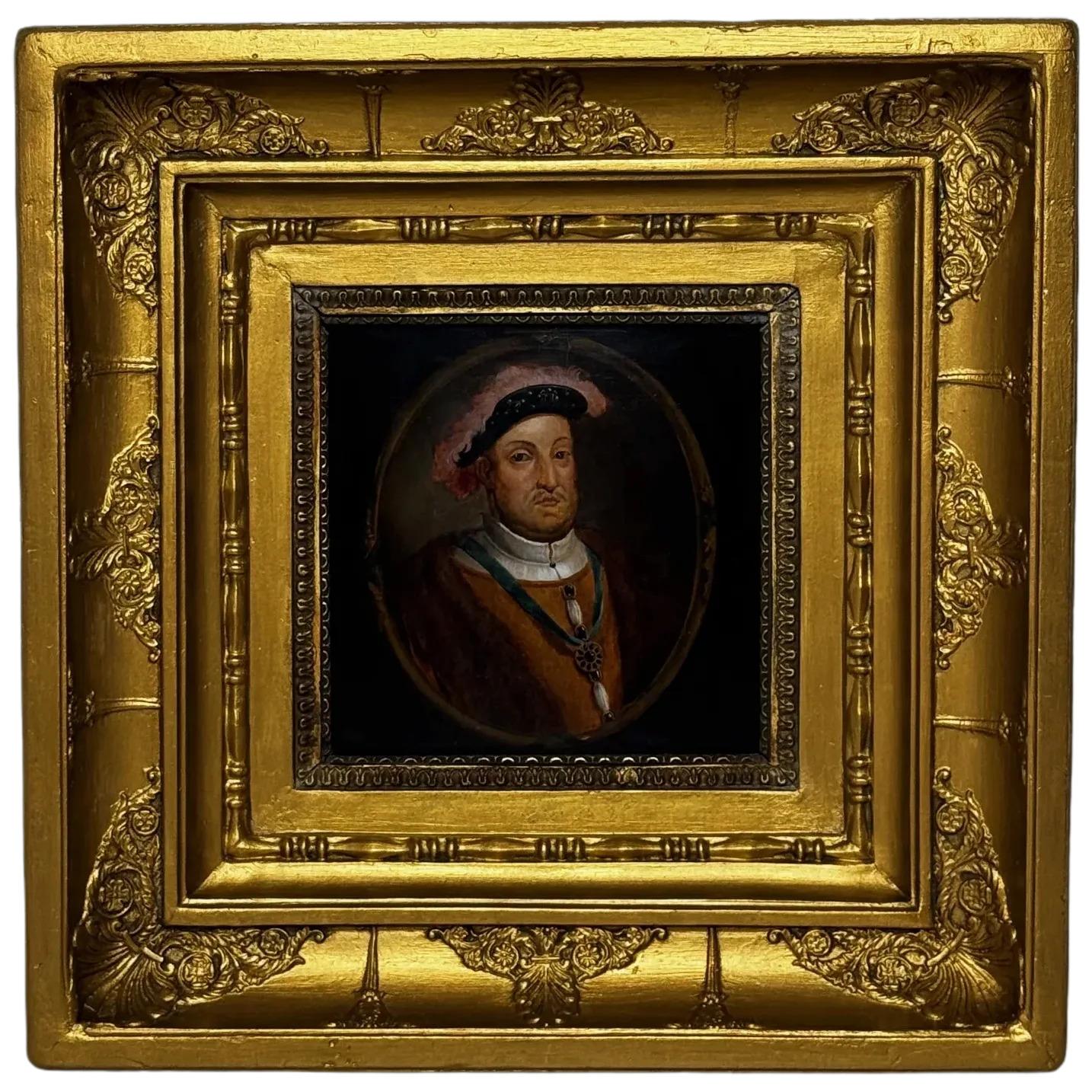
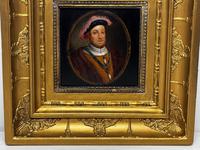
Portrait of King Henry VIII (1491–1547) After Hans Holbein the Younger English School c.1750
REF: LA566299
£18,500
€21,567
$24,722
LoveAntiques Dealersince Mar 2017Approved item553 sales by dealerFree Delivery
LoveAntiques Dealersince Mar 2017Approved item553 sales by dealerFree Delivery
Description
Portrait of King Henry VIII (1491–1547)
After Hans Holbein the Younger
English School, circa 1750
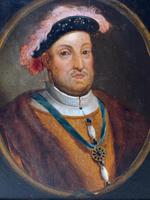
A finely executed Georgian antiquarian cabinet portrait derived from the canonical Tudor image of Henry VIII, uniting Renaissance royal iconography with 18th-century historical revival.
Medium and Support
Oil on single chamfered oak panel
Panel size: 15cm x 15cm
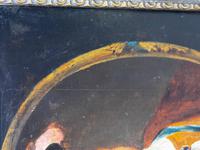
This mid 18th Century cabinet painting presents Henry VIII in bust-length within a painted feigned oval, following the widely disseminated 1561 prototype derived from Hans Holbein the Younger’s lost Whitehall Palace mural of 1537.
Holbein’s Whitehall composition established the definitive image of Henry VIII as a symbol of dynastic authority. Through engravings and painted copies, this likeness became one of the most recognisable royal portraits in European art. The present work belongs firmly within that enduring visual tradition.
Composition and Technique:
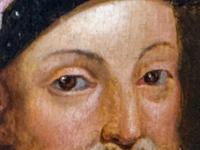
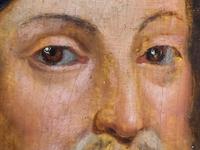
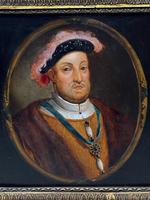
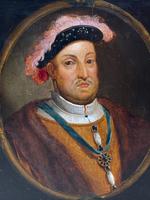
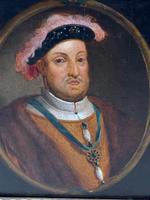
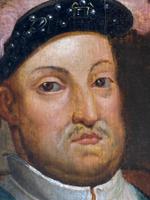
Henry VIII is shown in a frontal pose, slightly turned, with a composed and authoritative gaze. The painted oval format creates a medallion-like presentation, enhancing both intimacy and formality.
The painting reflects mid 18th Century antiquarian technique:
* Controlled linear modelling of facial structure
* Subtle tonal transitions in flesh passages
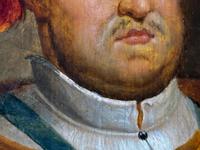
* Simplified yet precise treatment of costume
* Balanced contrast between warm garment tones and dark ground
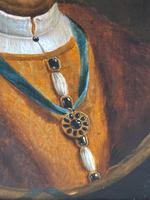
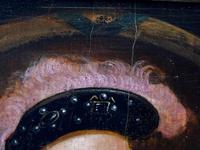
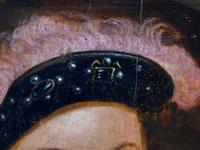
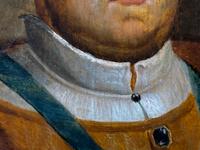
The jewelled cap and feather plume are crisply articulated, while highlights across the collar and insignia provide depth and definition.
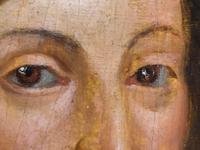
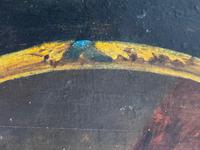
Age-consistent craquelure is present and supports the work’s authenticity without detracting from visual clarity.
The use of a single chamfered oak panel is entirely consistent with Georgian cabinet picture production.
The Sitter: King Henry VIII
Henry VIII (1491–1547), King of England from 1509 to 1547, remains one of the most significant monarchs in British history.
* Founder of the Church of England
* Central figure of the English Reformation
* Architect of Tudor dynastic authority
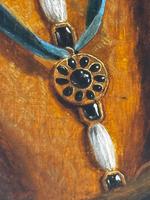
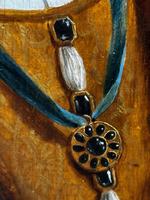
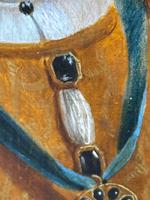
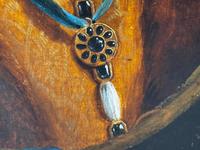
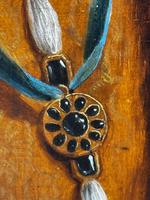
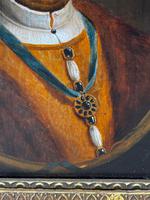
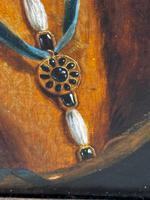
He is depicted wearing a simplified form of the badge of the Most Noble Order of the Garter, of which he was Sovereign.
In full Tudor state portraits, Henry appears with the elaborate Garter collar and the “Great George” pendant. In later engravings and painted derivatives, this insignia was often reduced to a radiating jewelled roundel with pendant drop, as seen in this example, demonstrating adherence to established iconography.
Historical Context:
Executed circa 1750, this painting belongs to the Georgian antiquarian revival, a period during which British collectors and scholars turned renewed attention to the Tudor past.
Portraits of historical monarchs were produced for display in:
* Libraries
* Gentleman’s studies
* Country houses
* Antiquarian collections
The engraver George Vertue (1684–1756) played a central role in standardising Tudor imagery through print culture. His work helped fix Holbein’s lost Whitehall mural in the public imagination, leading to a sustained demand for painted versions such as this.
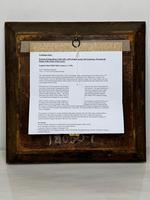
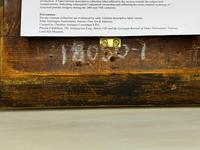
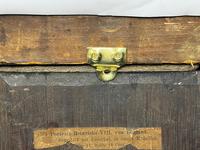
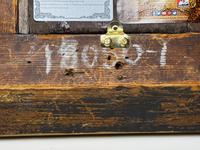
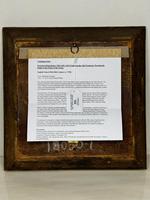
This work represents not only a portrait but an 18th-century expression of historical memory and dynastic identity. An early German descriptive label on the reverse indicates later Continental ownership, confirming the cross-European circulation and appreciation of English royal portraiture.
Attribution:
English School, mid-18th century
Unsigned, as is typical for Georgian antiquarian cabinet portraits.
The work demonstrates:
Fidelity to engraving-derived prototypes
Linear modelling consistent with the period
Use of oak panel support
Restraint and historical accuracy over theatrical embellishment
Frame
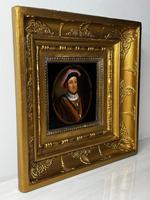
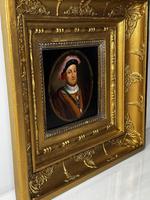
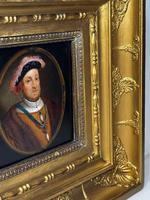
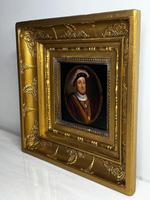
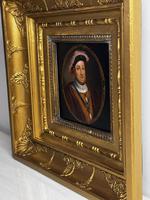
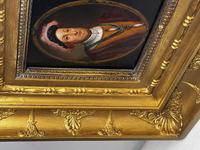
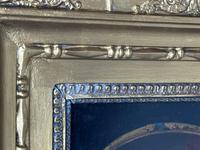
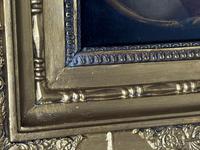
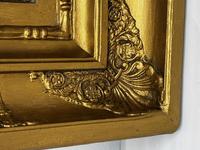
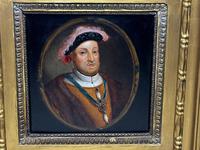
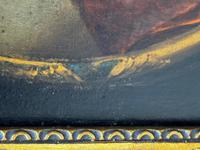
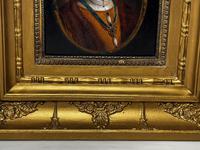
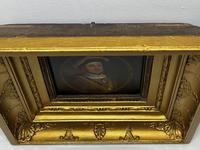
Presented in its original 18th-century carved wooden gilt frame, contemporary with the panel.
The frame retains its original carved structure and has been later overpainted in gilt. Visible wear includes losses, cracking, small chips and historic repairs, all consistent with an authentic period frame.
A compact cabinet-scale painting with strong visual presence within its substantial period frame.
Provenance:
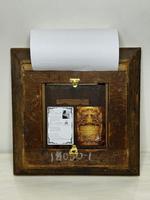
Private German Collection (early descriptive label verso)
Gorringes Auctioneers, Sussex – Fine Art & Interiors Sale
Curated by Cheshire Antiques Consultant LTD
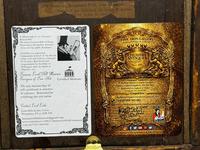
Exhibited: The Antiquarian King: Henry VIII and the Georgian Revival of Tudor Portraiture, Famous Lord Hill Museum
The German label and exhibition history contribute to the work’s documentary depth and collector appeal.
This example offers several desirable attributes:
* Direct connection to the Holbein Whitehall tradition
* Mid 18th Century execution
* Oak panel support
* Original period frame
* Documented provenance history
* Professional conservation
Such cabinet-scale portraits appeal to collectors of Tudor history, British portraiture, and early English interiors.
measurements
Framed: 35cm x 35cm x 7cm depth
Panel: 15cm x 15cm
declaration
Cheshire Antiques Consultant LTD has clarified that the Portrait of King Henry VIII (1491–1547) After Hans Holbein the Younger English School c.1750 (LA566299) is genuinely of the period declared with the date/period of manufacture being c.1750
condition
Condition
Professional Conservation
The painting was professionally conserved in January 2026 by a fine art conservator based at the Williamson Art Gallery.
Treatment included:
Surface cleaning using tri-ammonium citrate
Reduction and removal of aged varnish
Removal of historic overpaint
Filling of paint losses
Retouching using conservation-grade materials
Application of stable varnish layers
The conservation has restored tonal clarity and chromatic balance while preserving the painting’s historic integrity. Full photographic documentation is available.
Panel Condition
Structurally stable oak panel
Age-appropriate craquelure
Historic losses professionally filled and retouched
No active flaking or movement
Frame Condition
Original 18th-century carved frame
Structurally sound
Age-related wear including gilt losses, cracking and historic repairs
Later gilt overpaint with original carving intact
Overall, a well-preserved and professionally conserved example retaining its original frame.
A full digital conservation report is available upon request.
additional info
Period:
Category:
Material:
Origin:
Date of Manufacture:
c.1750
location
This Portrait of King Henry VIII (1491–1547) After Hans Holbein the Younger English School c.1750 is located in Greater London, United Kingdom
Share:
Ask a question
Please note,
This dealer does not accept instant online payment for this item.
To buy this item please email the dealer using the enquiry form below.
A selection of items from Cheshire Antiques Consultant LTD
Cheshire Antiques Consultant LTD has 341 items available.18th Century Portrait of Sir Walter Raleigh After the Historic Lennard Tradition
£ 12,000
€13,989$16,036
Cheshire Antiques Consultant LTD
Oil Royal Portrait Lost Heir Henry Frederick, Prince of Wales in Armour with the Order of the Garter
£ 9,500
€11,075$12,695
Cheshire Antiques Consultant LTD
English School, 19th Century In the Manner of Richard Ansdell At Bay: A Bear and Hounds in Mortal Combat
£ 4,950
€5,771$6,615
Cheshire Antiques Consultant LTD
Victorian Oil Painting of Persimmon Racehorse with Jockey Jack Watts – Royal Thoroughbred Owned by King Edward VII – In the Manner of John Frederick Herring Sr. – Newmarket c.1898
£ 8,500
€9,909$11,359
Cheshire Antiques Consultant LTD