
Specialists in antique and decorative furniture, based in Sussex.
White’s Antiques
'%3e%3cpath fill='%23012169' d='M0 0v30h60V0z'/%3e%3cpath stroke='%23fff' stroke-width='6' d='m0 0 60 30m0-30L0 30'/%3e%3cpath stroke='%23C8102E' stroke-width='4' d='m0 0 60 30m0-30L0 30' clip-path='url(%23b)'/%3e%3cpath stroke='%23fff' stroke-width='10' d='M30 0v30M0 15h60'/%3e%3cpath stroke='%23C8102E' stroke-width='6' d='M30 0v30M0 15h60'/%3e%3c/g%3e%3c/svg%3e) UK
UK
Address
Unit 10 The Vinery, Arundel Road
Poling, West Sussex
United Kingdom
BN18 9PY
Opening times
Monday-Friday 10-4 Saturday by appointment
Mobile
+447717 321455
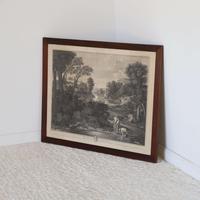
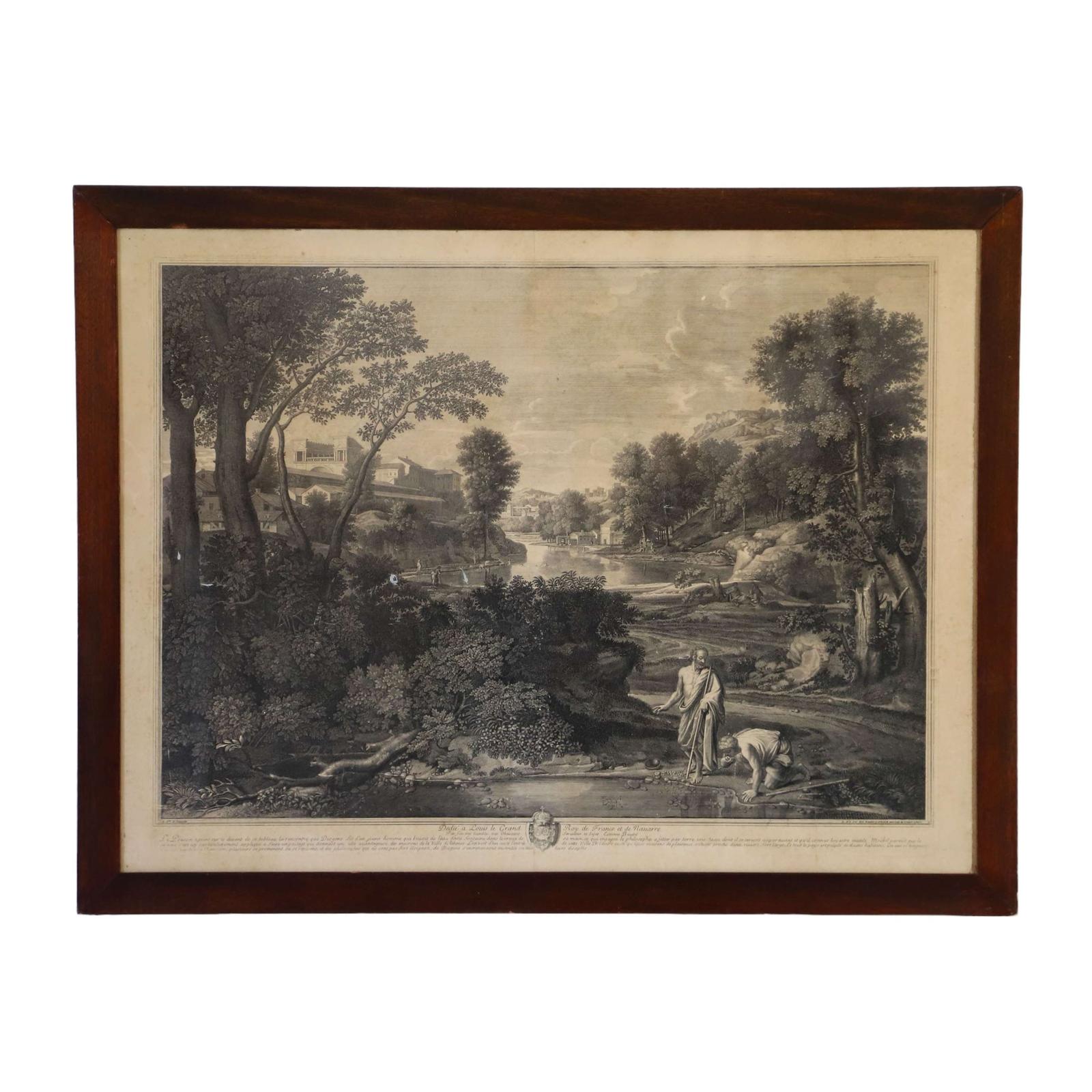
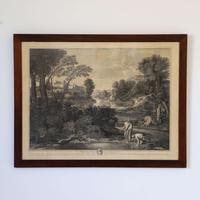
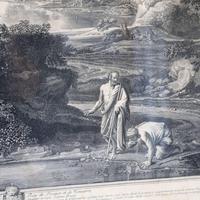
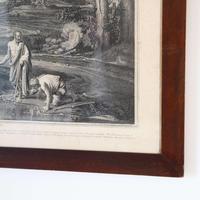
18th Century French Engraving 'Landscape with Diogenes' by Étienne Baudet - original frame
REF: WA130 / LA544093
£375
€436
$498
Secure Payments By
LoveAntiques Dealersince Feb 2021984 sales by dealerAvailable for local pick-up
LoveAntiques Dealersince Feb 2021984 sales by dealerAvailable for local pick-up
Description
18th Century French Engraving Landscape with Diogenes by Étienne Baudet in original frame
Origin & Era: 18th Century French engraving; inspired by Nicolas Poussin’s celebrated painting, Landscape with Diogenes which is in Le Musée du Louvre, Paris
Art Movement: Baroque/Classical, steeped in royal patronage
Concept: Masterful reinterpretation of Nicolas Poussin’s original vision depicting a classic landscape scene with figures in natural surroundings;
Provenance/Authenticity: Exquisitely detailed hand-engraving by renowned master Étienne Baudet with precise line work, bold textures, and delicate tonal variations that captures the emotive power of Poussin’s art
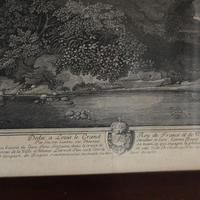
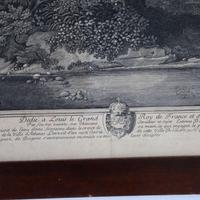
Dedication: Dedié à Louis le Grand Roy de France et de Navarre
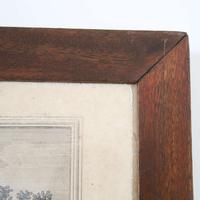
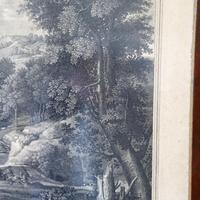
Materials: Print of engraving on aged, high-quality paper, preserved behind original protective glass and housed within its authentic carved wooden frame
Dimensions: Height: 70 cm (27.6") | Width: 90 cm (35.4")
Why Choose Antiques?
Stylish & Sustainable: Elevate your interior with history-enriched décor that extends the life of cherished objects
Craftsmanship Preservation: By choosing this piece, you support traditional artisans and restoration experts, sustaining age‑old craft techniques
Eco-Friendly Impact: Reduce your carbon footprint, minimise waste, while discouraging deforestation and the mass production of synthetic materials through the acquisition of timeless antiques.
This captivating engraving, with its intricate detailing and profound historical significance, is a true testament to the legacy of French art. It stands ready to grace your collection with the rich narrative of Poussin’s inspiration, Baudet’s masterful execution, and the historic dedication to Louis le Grand - a timeless masterpiece for the discerning connoisseur
Cultural and Artistic Legacy: A Testament to French Heritage & Royal Patronage
Step back to an era untouched by modern innovations - a time when art was commissioned by monarchs and revered as a mark of both duty and refined aesthetics. In that period, art was the primary medium for conveying history, philosophy, and power, shaping cultural identity through visual storytelling.
This exquisite French 18th‑century engraving exemplifies royal patronage, sublime craftsmanship, and sustainable elegance by preserving art history for future generations. Whether displayed in a contemporary setting or a classic interior, it brings historical gravitas and a dynamic narrative to any collection. Explore its full narrative through our interactive gallery, where every high-resolution close-up invites you to appreciate the intricate details, authentic wear, and timeless beauty of this masterpiece.
Transforming a Vision into Mastery: Transforming Nicolas Poussin’s visionary painting, Landscape with Diogenes, into Étienne Baudet’s meticulous engraving demanded a delicate balance - a dialogue of artistic finesse and cultural exchange. Baudet’s work distils the majestic aura of a 17th‑century canvas into an intimate, accessible form. In the process, he preserved the emotive essence and classical allusions of Poussin’s original while enhancing it with fine ornamentation and carefully rendered text. This synthesis renders the engraving an invaluable artefact of art history and a conversation piece that bridges art, literature, and royal legacy.
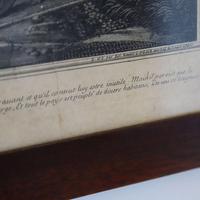
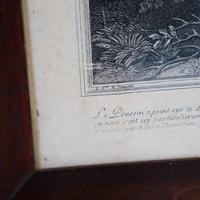
The Royal Dedication: Dedicated to Louis le Grand, King of France and Navarre, this distinguished 18th Century engraving is firmly anchored in its historical context. Its inscription provides a rich, multi-layered dedication:
French: "Dedié a Louis le Grand Roy de France et de Navarre, Par son très humble, très obéissant, très fidèle sujet et serviteur, Nicolas Poussin, A Paris chez Pierre Mariette rue St Jacques a l'Esperance avec privilège du Roy"
English: "Dedicated to Louis the Great, King of France and of Navarre, by his most humble, most obedient, most faithful subject and servant, Nicolas Poussin; in Paris, at Pierre Mariette, Rue Saint Jacques at l'Esperance, with the King's privilege."
This elaborate dedication is both a testament to the artwork’s exceptional quality and an affirmation of French monarchical grandeur. By linking the piece to such an illustrious royal figure, the inscription reassured patrons and collectors of its official status and firmly anchored it within the cultural and political narratives of its time. It pays tribute to a monarch whose reign was synonymous with elegance, robust artistic patronage, and political might - an era when art and authority intertwined to foster masterpieces like this engraving.
A Timeless Conversation Piece for the Discerning
Overview & Historical Significance: This rare engraving is far more than an historical artefact; it is a captivating conversation piece. It resonates with discerning buyers, antique collectors, interior designers, architects, and dealers alike. Rooted in a time when masterpieces were commissioned by royalty representing and cultural identity was defined by national pride and intellectual spirit, the engraving communicates history, philosophy, and power through every finely rendered detail.
Narrative Depth & Cultural Resonance: Layered with classical allusions and enriched by its royal dedication and master engraver’s signature, the engraving weaves a narrative that goes well beyond aesthetics. Every detail - from the elegant cursive script to the intricate floral borders - bears witness to the extraordinary skill and painstaking attention invested by its creators. These elements not only capture the sublime integration of antiquity and French classicism, but also invite viewers to engage with the enduring dialogue between art and cultural identity.
Exquisite Craftsmanship & Authentic Detail
Baudet’s technical brilliance shines through in every facet of the engraving:
Direct Authorship: The inscription “Premier a signé Étienne Baudet” attests to his hands-on artistry and affirms the work’s provenance.
Masterful Technique: Delicate cross-hatching, subtle shading, and refined line work capture both the grandeur and intimate subtleties of Poussin’s original vision. Dual-language inscriptions (in French and Latin) and classical nuances further reinforce the work’s rich cultural context.
Marks of Time: The genuine aging of the paper - evident in subtle foxing and a gentle patina - celebrates the engraving’s long journey, serving as a tangible record of its enduring quality and historical integrity.
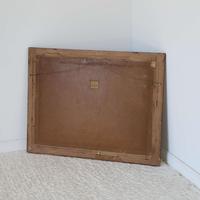
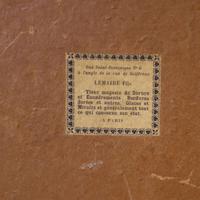
Framing, Label, and Provenance: Showcased in its original carved wooden frame - a true example of 18th‑century French craftsmanship - every element of the presentation contributes to its historical narrative. The frame’s meticulously mitred joinery and ornate decorative details enhance its character and provenance. A key aspect is the verso label, inscribed by Lemaire Fils at Rue Saint-Dominique (corner of Rue Solférino) in Paris, which:
Authenticates the work by documenting the specialised trades of gilding and framing.
Offers a glimpse into the decorative arts of the period, noting expertise in gilt borders, mirrors, and elaborate finishing touches.
Reinforces the chain of custody, an essential factor for collectors and historians.
Inscription from the label reads:
French: Rue Saint-Dominique No 6 à l’angle de la rue Solférino LEMAIRE Fils. Tient magasin de Dorure et Encadrements. Bordures dorées et autres. Glaces et Miroirs et généralement tout ce qui concern son état. A PARIS
English: Rue Saint-Dominique No. 6, at the corner of Rue Solférino LEMAIRE Fils Operates a shop of gilding and framing - gilt borders and other items; glass and mirrors, and generally everything pertaining to its condition.
This not only validates the piece’s provenance but also offers fascinating insight into the meticulous craftsmanship behind its presentation.
A Legacy Bridging Eras: Collectively, this background situates the engraving within its rich historical framework while celebrating the enduring artistry of its creator and the inspiration of its muse. Discerning collectors and connoisseurs appreciate not only Baudet’s disciplined lines and striking contrasts but also the captivating narrative - a tale where art bridges the philosophical introspection of antiquity with the luminous era of French classicism. In essence, this engraving is more than an historical artefact; it is a timeless conversation piece that continues to inspire, captivate, and resonate with those who value art that speaks to both past and present.
Étienne Baudet: Master Engraver Extraordinaire
This timeless engraving is a masterful interpretation executed by Étienne Baudet, one of the most distinguished figures in 18th‑century French engraving. Renowned for his meticulous technique and refined attention to detail, Baudet transforms the complex textures and nuances of Nicolas Poussin’s original work into a standalone masterpiece. His skillful handling of delicate gradations of light and shade is a testament to his technical brilliance and artistic sensitivity.
Étienne Baudet (circa 1638-1711) emerged as one of France’s eminent engravers, he honed his skills under the guidance of artists such as Sébastien Bourdon and Cornelis Bloemaert. His extensive training included an influential sojourn in Rome, where he absorbed the grandeur of Italian art - a formative experience that later enriched his signature style. Upon returning to Paris, Baudet crafted a distinctive style marked by impeccable line work, early bold clarity, and later an evolution into subtle tonalities and textures that elevated his prints to new heights.
His landscapes, particularly those adapted from Nicolas Poussin’s works, are celebrated for echoing the ambiance and intellectual depth of their inspirational source. Baudet’s dedication and technical mastery eventually earned him the prestigious title of Engraver to the King in 1693 - a recognition not only of his exceptional craftsmanship but also of the significant role his work played in the thriving artistic culture of France.
Nicolas Poussin’s Original Masterpiece
Landscape with Diogenes
At the heart of this engraving lies the enduring influence of Nicolas Poussin (1594-1665), a pivotal figure in 17th‑century European art and widely regarded as the quintessential Classical artist. His masterpiece, Landscape with Diogenes, housed in the Louvre, is celebrated for its balanced, harmonious composition, intellectual depth, and powerful use of colour. Admired for its meditative quality, the painting reflects Poussin’s visionary interpretation of nature and human introspection, establishing a legacy of order, balance, and poetic resonance that continues to inspire.
Drawing on Greco‑Roman history and the insights of Plutarch’s Parallel Lives, Poussin ventured beyond familiar myths to present “new and rare” subject matter. In Landscape with Diogenes, he transforms a simple landscape into an evocative stage that interweaves the presence of the ancient Greek philosopher Diogenes of Sinope with the esteemed Athenian statesmen Cimon and Pericles. These classical figures and themes from Ancient Athens are carefully interlaced - not only within the visual narrative but also through the engraving’s symbolic imagery and inscriptions - to convey profound moral and philosophical ideals.
The painting presents an idealized ancient landscape where architectural elements and narrative details subtly evoke Athens’s Golden Age under Pericles and the civic virtues exemplified by Cimon. In the foreground, the Cynic philosopher Diogenes enacts his famed gesture of renunciation, depicted as he discards his drinking bowl after observing a youth drink water directly with cupped hands. The discarded cup lies at his feet, now rendered superfluous in this context, while in the distance, a tranquil lake and grand classical buildings set the stage for a dialogue between human modesty and the grandeur of urban civilization.
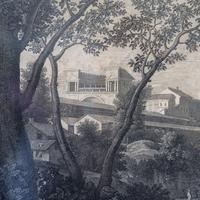
The composition is rich with classical cues. Temples, porticoes, and a citadel-like structure immediately call to mind the splendour of an ancient city - Athens, the “political and cultural focus of Greece” under Pericles. This deliberate contrast between the serene philosopher and the luminous cityscape is underscored by J.M.W. Turner’s observation in 1802, when he noted that Poussin’s work was arranged in “three broad strata”: a vast sky, the light, distant city buildings, and the dark, earthy foreground where Diogenes and the natural spring reside. Turner observed that this striking contrast ‘amplifies the central theme of rejecting worldly goods in favour of a return to nature’.
The engraving’s Latin and French inscriptions further clarify the scene’s action and moral intent. By integrating the towering edifices of a great city with the humble act of a solitary philosopher, the work creates a dynamic interplay between ideals of civic leadership, public virtue, and philosophical asceticism. Each figure - Diogenes, Cimon, and Pericles - contributes a unique strand to this intricate tapestry: leadership, humility, and renunciation.
Baudet’s rendition of the engraving faithfully channels the spirit, complexity, and poetic nuances of Poussin’s original canvas. Far from being a mere reproduction, the engraving becomes an interpretive work that speaks to the enduring allure of classical ideals, inviting viewers to experience the sublime interplay between nature, philosophy, and art.
Diogenes (4th century BCE) was a Greek Cynic philosopher renowned - and sometimes scorned - for his extreme rejection of material comforts and social pretensions. A resident of Athens (and later Corinth), he embodied the Socratic idea of virtue through simplicity, living in austere conditions (traditionally said to dwell in a large jar or barrel) and embracing the Cynic creed to live “in accordance with nature.” “Owning nothing” beyond the clothes on his back and a few rudimentary items, Diogenes prided himself on self-sufficiency, unflinching honesty, and defiance of convention - famously roaming Athens in broad daylight with a lantern in search of an honest man.
measurements
Height:
70 cm
Width:
90 cm
declaration
White’s Antiques has clarified that the 18th Century French Engraving 'Landscape with Diogenes' by Étienne Baudet - original frame (LA544093) is genuinely of the period declared with the date/period of manufacture being 18th Century
additional info
Period:
Category:
Material:
-
Origin:
-
Date of Manufacture:
18th Century
location
This 18th Century French Engraving 'Landscape with Diogenes' by Étienne Baudet - original frame is located in United Kingdom
Share:
Ask a question
Please note,
This dealer does not accept instant online payment for this item.
To buy this item please email the dealer using the enquiry form below.
A selection of items from White’s Antiques
White’s Antiques has 333 items available.17th Century / 18th Century British Oak Salt Box with Original Iron Hardware & Red Paint Traces
£ 625
€727$830
White’s Antiques
Small French Rustic Milking Stool with Original Paint - Late 19th Century / Early 20th Century
£ 185
€215$246
White’s Antiques