


About Cheshire Antiques Consultant LTD®
Cheshire Antiques Consultant LTD® is an international fine art dealer and online gallery specialising in British and European paintings, sculpture and decorative arts.
Established in 2005 and led by directors Michael and Victoria, the firm brings over two decades of experience in sourcing, evaluating and placing historically significant works with private collectors, galleries, interior designers and institutions worldwide.
As elected members of the Fine Art Trade Guild, our work is grounded in connoisseurship, academic research and rigorous standards of authenticity. Every work we present is subject to careful vetting and offered with full transparency regarding condition and provenance.
Private Online Gallery
Virtual Viewings by Appointment
We operate exclusively online, offering private one-to-one virtual viewings to discuss condition, scale and provenance in detail. High-resolution images and comprehensive condition reports are available upon request, ensuring complete confidence prior to acquisition.
Areas of Specialisation
Fine Art & Works of Art (17th–21st Century)
British and European oil paintings, watercolours and mixed media
Portraiture, marine and nautical subjects
Animal, hunting and sporting scenes
Landscapes, cityscapes and genre compositions
Sculpture and three-dimensional works
Decorative Arts
Period furniture and interior pieces
Bronzes, carvings and objets d’art
Hallmarked silver, ceramics and glassware
Collectible works spanning the 18th–20th centuries
Each piece is selected with careful attention to historical context, condition and aesthetic quality, curated for both established collectors and emerging buyers.
Sustainability & Enduring Craftsmanship
We recognise the inherent sustainability of historic works of art and decorative arts. These pieces require no new materials while preserving craftsmanship, cultural heritage and artistic legacy. They integrate seamlessly into both traditional and contemporary interiors, offering individuality and permanence.
Payments & Shipping
Payments
Card payments accepted online up to £5,000
Amounts exceeding £5,000 payable by bank transfer
Proforma invoices available upon request
Shipping
UK and worldwide shipping available (quotation on request)
All items professionally packed, fully insured and shipped with tracked delivery
Customs & International Orders
All international shipments are handled on a Delivery Duty Unpaid (DDU) basis. Import duties, VAT and customs clearance are the responsibility of the buyer.
Clients within the European Union and United States are advised to consult local customs authorities regarding applicable import procedures. If a shipment is refused and returned, return shipping costs will be deducted from any refund.
Company Information
Cheshire Antiques Consultant LTD®
71–75 Shelton Street
Covent Garden
London WC2H 9JQ
United Kingdom
Registered in England & Wales
Company No. 15666518
GB VAT No. 466128775
Cheshire Antiques Consultant LTD® is a registered United Kingdom trade mark (UK00004303420).


Cheshire Antiques Consultant LTD
ID verified dealer
'%3e%3cpath fill='%23012169' d='M0 0v30h60V0z'/%3e%3cpath stroke='%23fff' stroke-width='6' d='m0 0 60 30m0-30L0 30'/%3e%3cpath stroke='%23C8102E' stroke-width='4' d='m0 0 60 30m0-30L0 30' clip-path='url(%23b)'/%3e%3cpath stroke='%23fff' stroke-width='10' d='M30 0v30M0 15h60'/%3e%3cpath stroke='%23C8102E' stroke-width='6' d='M30 0v30M0 15h60'/%3e%3c/g%3e%3c/svg%3e) Greater London, UK
Greater London, UK
Address
71-75 Shelton Street
London
Greater London
United Kingdom
WC2H 9JQ
Opening times
By appointment only
Mobile
+447494 763382
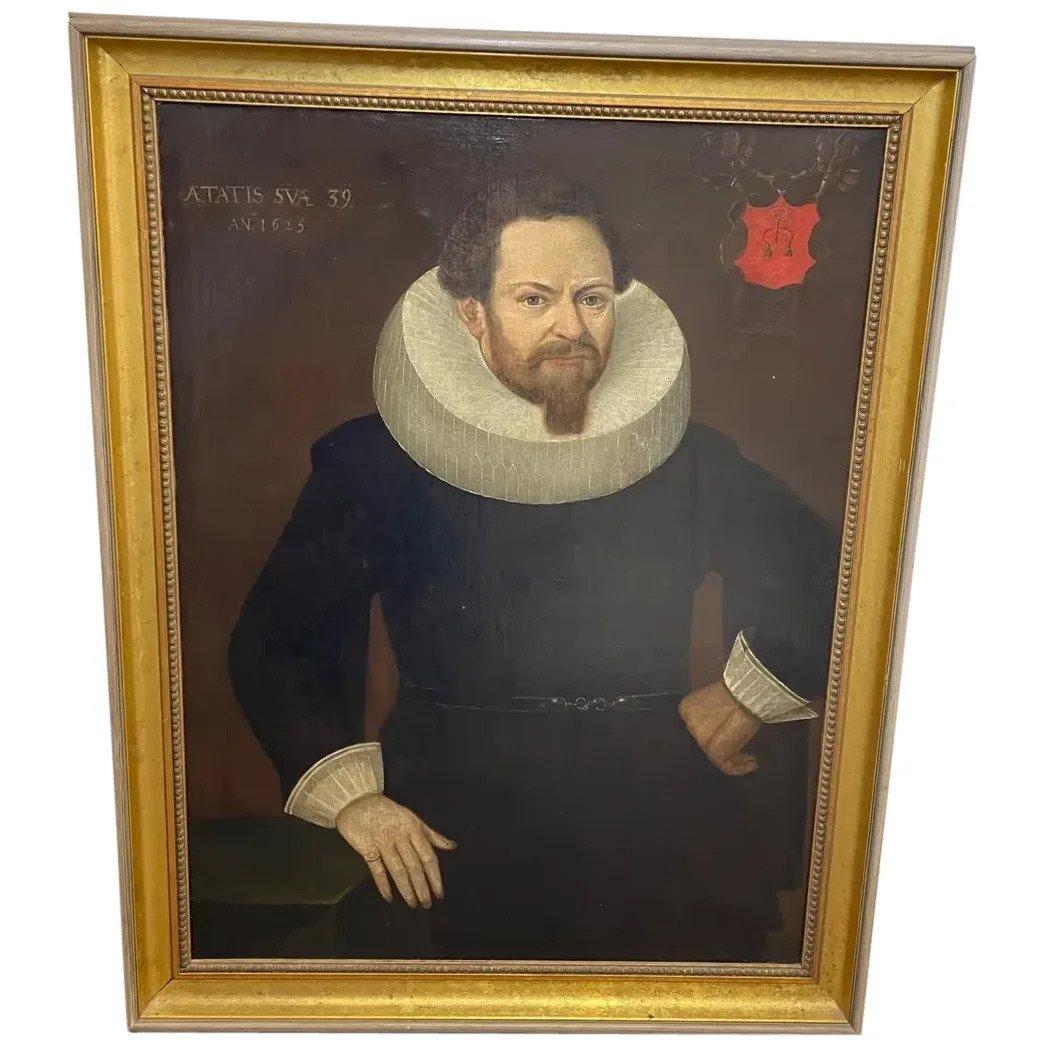
Early 17th Century Oil Painting Portrait Dutch Golden Age Merchant
REF: LA430072
£8,000
€9,308
$10,621
LoveAntiques Dealersince Mar 2017Approved item553 sales by dealerFree DeliveryAvailable for local pick-up
LoveAntiques Dealersince Mar 2017Approved item553 sales by dealerFree DeliveryAvailable for local pick-up
Description
Fine large early 17th Century antique oil painting on canvas portrait of Important Dutch Golden Age Merchant Gentleman - Three quarter length front profile view portrait of a wealthy bearded Dutch Merchant Gentleman. He is wearing an elaborate wide white ruff lace collar cuffs and having a sumptuous black costume which is the highest fashion for the period and indicated the sitter is of significant importance and wealth in Dutch society. He has such a powerful pose by his standing posture with 1 arm leaning over a table and his other hand placed on his hip, he is looking directly at the viewer. He has a well groomed brown beard & hair. You can see he is wearing a gold ring on his little finger and is wearing a chained loop belt. Furthermore to the top right section of the painting is a fabulous cartouche containing winged cherubs on either side with a pictorial of a key, which is so unusual & intriguing.
Hanging wire thread on the back ready for immediate home wall display. Latin inscription Atatis Suae 39, Ani 1625`.
Unsigned by A Dutch School artist. Circa 17th century dated 1625, the sitters age is also stated as being 39 in his prime when he was painted.
Provenance formally from a large mansion home in Cheshre and purchased from a fine art auction label verso. A great conversation & statement work of art.
In just over one hundred years, the provinces of the Northern Netherlands went from relative obscurity as the poor cousins of the industrious and heavily urbanized Southern Netherlands provinces of Flanders and Brabant to the pinnacle of European commercial success. Taking advantage of a favorable agricultural base, the Dutch achieved success in the fishing industry and the Baltic and North Sea carrying trade during the fifteenth and sixteenth centuries before establishing a far-flung maritime empire in the 17th Century.
In many respects the 17th Century Dutch Republic inherited the economic successes of the Burgundian and Habsburg Netherlands. For centuries, Flanders and to a lesser extent Brabant had been at the forefront of the medieval European economy. An indigenous cloth industry was present throughout all areas of Europe in the early medieval period, but Flanders was the first to develop the industry with great intensity. A tradition of cloth manufacture in the Low Countries existed from antiquity when the Celts and then the Franks continued an active textile industry learned from the Romans.
Industries also developed as a result of overseas colonial trade, in particular Amsterdam’s sugar refining industry. During the sixteenth century, Antwerp had been Europe’s most important sugar refining city, a title it inherited from Venice once the Atlantic sugar islands began to surpass Mediterranean sugar production. Once Antwerp fell to Spanish troops during the Revolt, however, Amsterdam replaced it as Europe’s dominant sugar refiner. The number of sugar refineries in Amsterdam increased from about 3 around 1605 to about 50 by 1662, thanks in no small part to Portuguese investment.
Dutch merchants purchased huge amounts of sugar from both the French and the English islands in the West Indies, along with a great deal of tobacco. Tobacco processing became an important Amsterdam industry in the seventeenth century employing large numbers of workers and leading to attempts to develop domestic tobacco cultivation.
Building on the early successes of their Baltic trade, Dutch shippers expanded their sphere of influence east into Russia and south into the Mediterranean and the Levantine markets. By the turn of the seventeenth century, Dutch merchants had their eyes on the American and Asian markets that were dominated by Iberian merchants. The ability of Dutch shippers to effectively compete with entrenched merchants, like the Hanseatic League in the Baltic, or the Portuguese in Asia stemmed from their cost cutting strategies (what de Vries and van der Woude call “cost advantages and institutional efficiencies,”
Dutch Finance
The last sector that we need to highlight is finance, perhaps the most important sector for the development of the early modern Dutch economy. The most visible manifestation of Dutch capitalism was the exchange bank founded in Amsterdam in 1609; only two years after the city council approved the construction of a bourse (additional exchange banks were founded in other Dutch commercial cities). The activities of the bank were limited to exchange and deposit banking. A lending bank, founded in Amsterdam in 1614, rounded out the financial services in the commercial capital of the Netherlands.
The ability to manage the wealth generated by trade and industry (accumulated capital) in new ways was one of the hallmarks of the economy during the Golden Age.The Dutch Golden Age lasted from roughly 1580, when the Dutch proved themselves successful in their fight with the Spanish, to about 1670 - Ref source Donald J. Harreld, Brigham Young University.
We select & sell our paintings based solely upon subject, quality & significance. We offer our clients exceptional professional customer service. Viewings are welcome by appointment only for customer support please send a message thank you. Browse our other exciting collections available in our shop gallery, happy shopping.
measurements
Height:
113.5 cm
Width:
88.5 cm
Depth:
5 cm
declaration
Cheshire Antiques Consultant LTD has clarified that the Early 17th Century Oil Painting Portrait Dutch Golden Age Merchant (LA430072) is genuinely of the period declared with the date/period of manufacture being 1625
condition
Offered in fine used condition. The painting surface has various craquelure, repairs to the upper right side and some paint re-touching to the collar area, also some paint loss. Set in magnificent later gilt frame which was made in Sweden shown verso, having some general wear minor chips in places commensurate with usage & age.
additional info
Period:
Category:
Material:
Date of Manufacture:
1625
location
This Early 17th Century Oil Painting Portrait Dutch Golden Age Merchant is located in Greater London, United Kingdom
Share:
Ask a question
Please note,
This dealer does not accept instant online payment for this item.
To buy this item please email the dealer using the enquiry form below.
A selection of items from Cheshire Antiques Consultant LTD
Cheshire Antiques Consultant LTD has 341 items available.Oil Painting Portrait British Infantry Officer Second Lieutenant Killed Aged 19
£ 2,650
€3,083$3,518
Cheshire Antiques Consultant LTD
Scottish Oil Painting Portrait of Iron & Steel Merchant William Muirhead by John McGhie
£ 18,000
€20,942$23,897
Cheshire Antiques Consultant LTD
17th Century Oval Portrait Oil Painting Boy with Dog Circle Mary Beale
£ 14,000
€16,289$18,587
Cheshire Antiques Consultant LTD