No: 11184
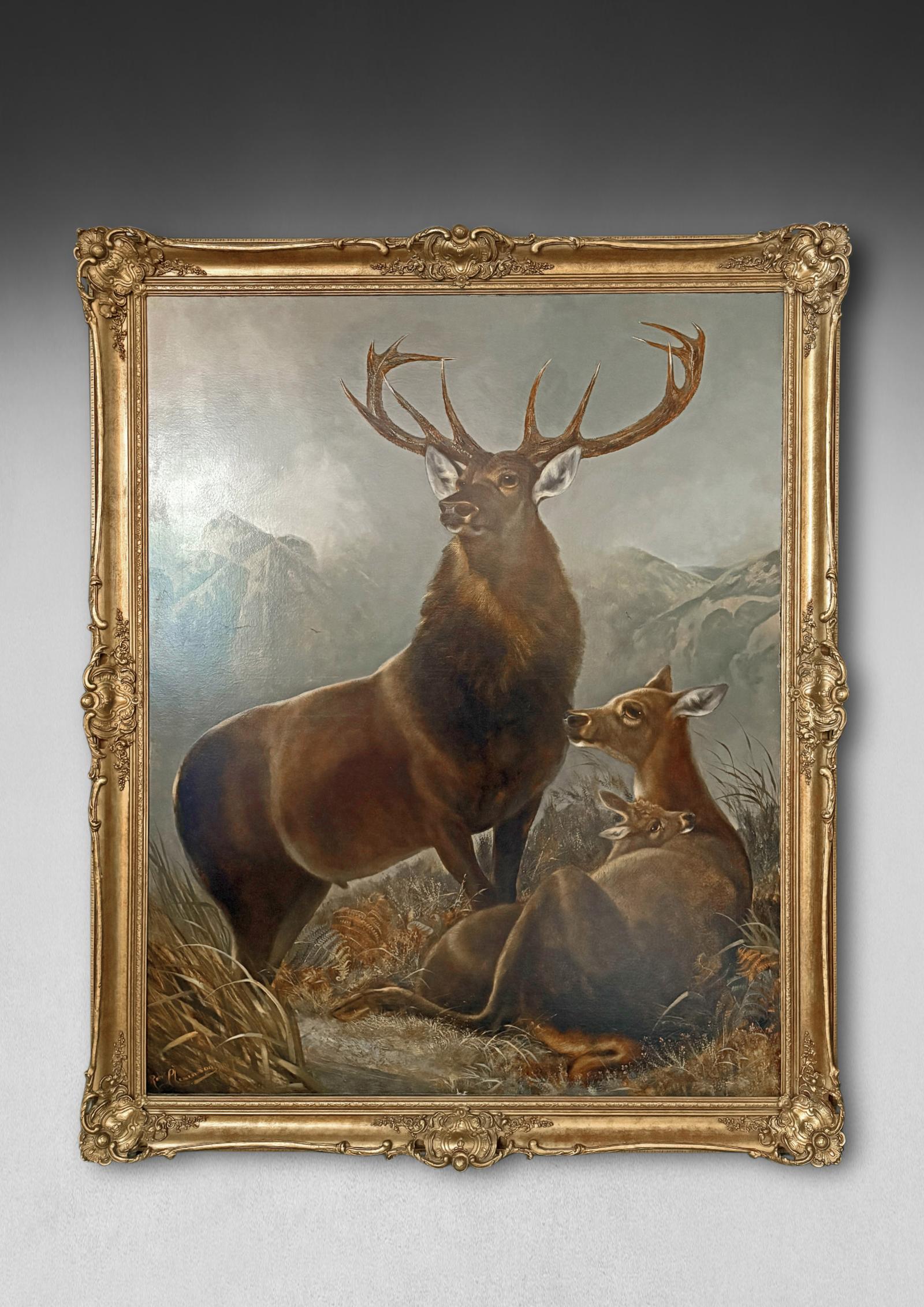
Royal Stag, Hind and Fawn in a Highland landscape
A stunning original oil on canvas painting signed by Robert Cleminson, in its original carved, gilt frame. Robert Cleminson was a painter in oils of landscapes, Highland game and sporting dog pictures and it his animal and dog paintings for which he is best known. He was a follower of Sir Edwin Landseer (1802-1873) and this painting of a Royal stag, hind and fawn is derivative of Landseer’s original Monarch of the Glen oil painting. Landseer was Queen Victoria’s most admired artist.
Cleminson was such a good artist that one can almost feel the heat emanating from the Stag’s nostrils. His attention to detail is superb and if one looks carefully he has included details such as the birds on the wing and the snow caps on the mountains. His treatment of both the grass and heather to give the picture that slightly purple Highland feel is apparent.
Dated 1871 and signed lower left corner
Price :£ 5,000
Inc Frame: Height: 56 ¼”, (143cm), Width: 46 ½”, (118 cm), Depth: 2 ¾”, (7cm).
Note: Taken from the National Gallery write up on Landseer’s Monarch of the Glen:
“Landseer’s greatest enjoyment was to wander in the lonely glens, or climb to the steep mountain-top, in search of that nature, animate or inanimate, with which his heart was in accord and there it was that he derived the inspiration which prompted the greater part of his noblest production.” (Obituary from The Report of the Council of the Royal Scottish Academy of Painting, Sculpture and Architecture, 1873)
No British painting of the 19th century is as immediately recognisable as ‘The Monarch of the Glen’. It has so often been reproduced that it is part of our shared visual memory; however, this means that it can be hard to look at it with fresh eyes. Today Landseer is not a household name; however, he was one of Victorian Britain’s most renowned artists. He was Queen Victoria’s favourite artist (she bought dozens of paintings from him) and prints of his works could be found on walls of homes across the globe. During the 20th century, when some aspects of Victorian culture were dismissed as old-fashioned,’ The Monarch of the Glen’ intriguingly survived this shift in taste, assuming a new purpose as an extremely popular marketing image. Today, the story of how it was originally created is long forgotten.
It was the great fire of 1834 that destroyed the Palace of Westminster which resulted in Landseer receiving the commission for his most famous painting. Plans to rebuild included the establishment of a ‘Fine Arts Commission’ – which included Sir Charles Eastlake, who would go on to become the National Gallery’s first Director in 1843 – to commission works of art to decorate the new building. One of these was ‘The Monarch of the Glen’. The painting of a life-size stag was first exhibited at the Royal Academy in 1851, which was then housed in the National Gallery building.
Christopher Baker, Director of European and Scottish Art and Portraiture at National Galleries of Scotland, says in his book , “Landseer’s life and career encompassed soaring talent, public adulation, and private tragedy. The drama, sentimentality, and often sophisticated exploration of the complex interaction between people and animals found in his works struck a chord with millions. What distinguishes The Monarch of the Glen from other works by the artist is its euphoric, triumphal quality; it shows an animal in command of its environment, not – as yet – at the mercy of pursuers.”
Landseer’s connection to the tradition of Old Master painting, demonstrates his strong interest in another great animal painter’s study of anatomy – George Stubbs, Landseer owned Stubbs’s collection of anatomical drawings of the horse and imitated his study of animal anatomy.
Landseer’s The Monarch of the Glen also highlights the artist’s close relationship with Queen Victoria and Prince Albert, whom he tutored in etching and visited in the Scottish Highlands – included in the show is a work by her own hand, ‘A pencil drawing of a stag after Landseer’s mural on the Dining Room wall at Ardverikie Shooting-lodge’ (5 Sept 1847, The Royal Collection). Christopher Baker comments in his book “The Queen knighted Landseer in 1850 and she recalled in the 1870’s how ‘He kindly had shown me how to draw stags’ heads…’, but he memorably described her in a private letter as ‘a very inconvenient little treasure.”
Robert Cleminson 1844-1903
Cleminson was a painter in oils of landscapes, Highland game and sporting dog paintings and it his animal and dog paintings for which he is best known. He no doubt found a ready market for his paintings which are as popular today as they were during his lifetime. He flourished from about 1864 until his death and exhibited 10 works at the British Institution which was established as a rival to the Royal Academy, at Boydell”s Shakespeare Gallery in Pall Mall, London. He exhibited further works at the Society of British Artists, Suffolk Street, London. He is renowned for his excellent brush work and exceptional gift for capturing the moment in his paintings.
Royal Stag: Stags with an even 12-point head are called Royals. To secure this status, they should have three points present on the beams, plus three crown tines on each side.
measurements
Height:
143 cm
Width:
118 cm
Depth:
7 cm
measurements
declaration
WR Harvey & Co (Antiques) Ltd has clarified that the Oil on Canvas Painting by Robert Cleminson (LA546934) is genuinely of the period declared with the date/period of manufacture being 1820