
Wick Antiques was established by Charles Wallrock in the early 1980s. Having grown up in the Antiques world Charles developed an extensive wealth of knowledge. Starting out as a ‘man with a van’ he quickly gained a good reputation and embarked on a longstanding relationship with Harrods. He was later joined by his wife, Caroline Wallrock. Caroline having completed a Persian degree, went on to study at Christie’s fine art and then joined Sotheby’s specializing in Islamic and Japanese works of art, as well as taking the occasional auction. Together they make a formidable team with extensive knowledge and buy and sell some of the best items on the market.


Wick Antiques Ltd
'%3e%3cpath fill='%23012169' d='M0 0v30h60V0z'/%3e%3cpath stroke='%23fff' stroke-width='6' d='m0 0 60 30m0-30L0 30'/%3e%3cpath stroke='%23C8102E' stroke-width='4' d='m0 0 60 30m0-30L0 30' clip-path='url(%23b)'/%3e%3cpath stroke='%23fff' stroke-width='10' d='M30 0v30M0 15h60'/%3e%3cpath stroke='%23C8102E' stroke-width='6' d='M30 0v30M0 15h60'/%3e%3c/g%3e%3c/svg%3e) Hampshire, UK
Hampshire, UK
Address
Unit 2 Riverside Business Park
Lymington
Hampshire
United Kingdom
SO41 9BB
Opening times
By Appointment Only
Mobile
+447768 877069
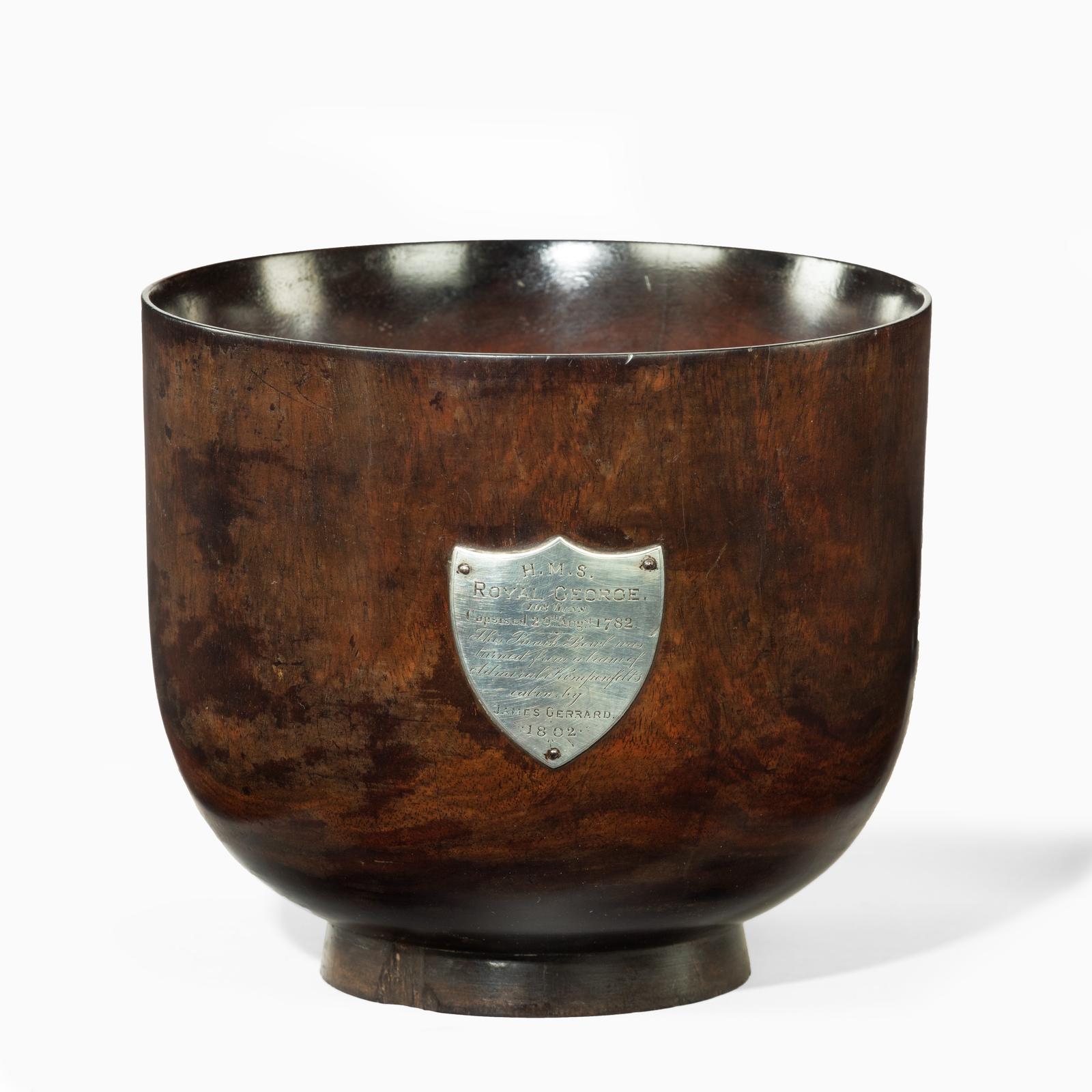
George III Punch Bowl Made of Oak from H.M.S. Royal George 1802
REF: LA479259
£5,300
€6,166
$7,036
LoveAntiques Dealersince Jan 2019Approved item572 sales by dealer
LoveAntiques Dealersince Jan 2019Approved item572 sales by dealer
Description
This turned commemorative oak bowl is of deep cylindrical form applied with a silver shield-shaped plaque inscribed ‘H.M.S. Royal George. (108 Guns) Capsised 29th Augst. 1782. This Punch Bowl was turned from a beam of Admiral Kempenfelts cabin, by James Gerrard. 1802.’
The Royal George was commissioned at the start of the Seven Years War (1756-1763). After serving with distinction, Rear Admiral Richard Kempenfelt was due to relieve Admiral Howe in Gibraltar, 1782. The 100-gun, first-rate ship of the line anchored at Spithead to carry out essential work on the cistern pipe. Once heeled onto one side, the vessel took on water through the gun ports, capsized and quickly sank in the Solent. This naval disaster holds significant importance in British naval history. Having been denied shore leave, several of the crew's visiting families and dignitaries were among the casualties, which exceeded 900 in total. A controversial court martial acquitted the crew and officers of any wrongdoing and tainted the reputation of the Navy Board. The masts of the wreck remained visible from the shoreline as late as 1794, serving as a macabre reminder of the tragedy. Prompted by local sailors, a series of pioneering dives by Charles and John Deane recovered much of the Royal George's timber and cannons, including a bronze cannon which later formed part of Nelson's column. The masts and beams were reimagined into household items and souvenirs. The wreckage was destroyed in 1840 by the Royal Engineers in a controlled explosion.
This turned commemorative oak bowl is of deep cylindrical form applied with a silver shield-shaped plaque inscribed ‘H.M.S. Royal George. (108 Guns) Capsised 29th Augst. 1782. This Punch Bowl was turned from a beam of Admiral Kempenfelts cabin, by James Gerrard. 1802.’
The Royal George was commissioned at the start of the Seven Years War (1756-1763). After serving with distinction, Rear Admiral Richard Kempenfelt was due to relieve Admiral Howe in Gibraltar, 1782. The 100-gun, first-rate ship of the line anchored at Spithead to carry out essential work on the cistern pipe. Once heeled onto one side, the vessel took on water through the gun ports, capsized and quickly sank in the Solent. This naval disaster holds significant importance in British naval history. Having been denied shore leave, several of the crew’s visiting families and dignitaries were among the casualties, which exceeded 900 in total. A controversial court martial acquitted the crew and officers of any wrongdoing and tainted the reputation of the Navy Board. The masts of the wreck remained visible from the shoreline as late as 1794, serving as a macabre reminder of the tragedy. Prompted by local sailors, a series of pioneering dives by Charles and John Deane recovered much of the Royal George’s timber and cannons, including a bronze cannon which later formed part of Nelson’s column. The masts and beams were reimagined into household items and souvenirs. The wreckage was destroyed in 1840 by the Royal Engineers in a controlled explosion.
James Gerrard of Lymington (fl.1800-1830)
It is possible that we have discovered a little more about James Gerrard, the maker of the bowl according to the attached plaque. There was a James Gerrard, chairmaker and turner, operating in our local town of Lymington in Hampshire around the turn of the 19th century. The BIFMO entry for Gerrard, taken from the Dictionary of English Furniture Makers 1660-1840, describes him as flourishing around 1830. However there are documents surviving in Dorset Record Office that add significantly to this picture. In 1800 and 1801 Gerrard signed apprenticeship agreements, taking two young men from the workhouse (namely George Pond and George Green respectively) under his tutelage. Given that our bowl was made in 1802, this is very significant. Even more interesting perhaps is another document in the record office's collection and dating from 1803. This is a
'Printed Order of the Lords of the Admiralty to James Gerrard, Constable of Lymington, empowering him to impress seamen for service in the navy'.
If, as seems likely, this is the same James Gerrard then he obviously had links to the navy as well which could explain his acquisition of naval timbers used to make the present punch bowl.
measurements
Height:
6.25 in
Width:
7 in
Depth:
7 in
Diameter:
7 in
declaration
Wick Antiques Ltd has clarified that the George III Punch Bowl Made of Oak from H.M.S. Royal George 1802 (LA479259) is genuinely of the period declared with the date/period of manufacture being 1802
additional info
Category:
Material:
Date of Manufacture:
1802
location
This George III Punch Bowl Made of Oak from H.M.S. Royal George 1802 is located in Hampshire, United Kingdom
Share:
Ask a question
Please note,
This dealer does not accept instant online payment for this item.
To buy this item please email the dealer using the enquiry form below.
A selection of items from Wick Antiques Ltd
Wick Antiques Ltd has 751 items available.Model of a Cannon Made from Bronze Recovered from the the Former Flagship of the Royal Navy’s Western Squadron, HMS Royal George
£ 1,250
€1,454$1,660
Wick Antiques Ltd